Hot Tub Chemicals: The No-Nonsense Beginner’s Playbook
Everything you need to balance your water, choose the right sanitizer, and keep your spa crystal-clear — without the guesswork.
Water Chemistry Is the Difference Between a Spa and a Health Hazard
Every first-time hot tub owner faces the same wall: you open the box, you inflate the tub (or roll back the cover), fill it with your garden hose — and then stare at a bag of chemicals wondering where to begin. The labels use terms like “total alkalinity,” “free chlorine,” “combined chloramines,” and “saturation index” without ever explaining what they mean in plain English. Meanwhile, you’re just trying to enjoy a relaxing soak.
This guide cuts through all of that. If you’ve just bought your first hot tub — whether it’s a plug-and-play inflatable like the ones covered in our best inflatable hot tubs guide, or a permanent hard-shell installation — you will walk away from this article knowing exactly what chemicals you need, why you need them, and how to add them correctly without overdosing or wasting money.
Hot tub water isn’t like pool water. The volume is dramatically smaller — often under 400 gallons for inflatables versus 20,000+ gallons for a backyard pool — which means every ounce of chemical has far greater impact. The water is also hotter, which accelerates chemical reactions, degrades sanitizers faster, and creates ideal conditions for bacterial growth if you’re not on top of your maintenance. Understanding this context is what separates a confident spa owner from someone who’s constantly fighting green water or skin rashes.
The hot tub’s water chemistry safety requirements exist because warm, agitated water is uniquely hospitable to organisms like Pseudomonas aeruginosa (which causes folliculitis, often called “hot tub rash”) and Legionella (the bacteria behind Legionnaires’ disease). These are real, documented health risks that proper chemical maintenance completely neutralizes. This isn’t scaremongering — it’s the reason that knowing hot tub water chemistry isn’t optional knowledge. It’s essential.
There’s also the matter of protecting your equipment. Imbalanced water either corrodes metal components, erodes pump seals, and pits acrylic surfaces — or causes scale buildup that clogs jets, chokes heater elements, and shortens the life of everything. A few dollars of properly dosed chemicals every week will save you hundreds in avoidable repair bills.
Check out our full breakdown of inflatable hot tub maintenance and water care for a companion guide covering filter cleaning and long-term upkeep alongside chemistry.
The 5 Core Water Parameters Every Beginner Must Know
Before you open a single bottle or sachet, you need to understand what you’re measuring and why. There are five numbers that govern everything in a hot tub. Think of them as five dials — turn them all to the right range and your water works; leave one out of range and the whole system starts breaking down.
pH: The Master Parameter
pH measures how acidic or alkaline your water is on a scale of 0–14, where 7.0 is perfectly neutral. Hot tub water needs to stay between 7.4 and 7.6 — slightly alkaline, which mimics the natural pH of human skin and tears. This isn’t a coincidence: water at this range is comfortable to soak in, compatible with your sanitizer’s active chemistry, and gentle on equipment.
When pH drops below 7.2, the water becomes corrosive. Bathers experience stinging eyes and irritated skin. Metal fittings corrode. Pump impellers pit. Heater elements and sensors get attacked. When pH rises above 7.8, sanitizers lose effectiveness rapidly — chlorine at pH 8.0 is up to 80% less effective than the same concentration at pH 7.4. Scale deposits form on surfaces and plumbing. The jets produce an unpleasant, slimy feel. Both extremes are problems, but high pH is the one most beginners underestimate because the water looks fine even as sanitization quietly fails.
Total Alkalinity: The pH Stabilizer
Total alkalinity (TA) measures the concentration of alkaline substances in the water — primarily bicarbonates, carbonates, and hydroxides. Its job is to act as a buffer that prevents wild pH swings. Think of it as a shock absorber for your pH reading. Without sufficient alkalinity, pH bounces around unpredictably every time you add a dose of sanitizer or step into the tub. The ideal range is 80–120 ppm for most hot tubs.
When TA falls below 60 ppm, you’ll see “pH bounce” — the reading climbs and drops erratically, making it nearly impossible to hold a stable pH. When TA exceeds 150 ppm, pH becomes stubborn and locks at the high end, causing scale. The critical rule for beginners: always adjust total alkalinity before adjusting pH. Getting alkalinity right first makes the pH correction easier and more stable.
Calcium Hardness
Calcium hardness measures the concentration of dissolved calcium in the water. This parameter matters mostly because of its relationship to surface protection. Water that’s too soft (below 100 ppm) is “hungry” — it will leach calcium from surfaces like acrylic shells, fiberglass, plaster, and even the PVC of inflatable tubs, creating etching and pitting over time. Water that’s too hard (above 400 ppm) precipitates calcium scale on every surface, heater element, and jet nozzle it touches.
For inflatable and vinyl hot tubs specifically, manufacturers generally recommend keeping calcium hardness on the lower end, around 100–150 ppm, because the softer surfaces are less prone to the mineral damage that affects acrylic shells. Hard-shell acrylic and fiberglass spas benefit from 150–250 ppm.
Free Sanitizer Level
This is the concentration of active sanitizer — either free chlorine or free bromine — that’s available to kill bacteria, viruses, and algae right now. “Free” means unattached and reactive. “Combined” chlorine (chloramines) or “combined” bromine (bromamines) refers to sanitizer that has already bonded to contaminants and is no longer doing its protective job — in fact, combined chlorine is what causes that sharp chemical smell and eye irritation people often blame on “too much chlorine.” The target for free chlorine is 3–5 ppm. For bromine, the same range applies, though many spa care guides suggest 3–5 ppm is appropriate for bromine too.
Total Dissolved Solids (TDS)
TDS measures every dissolved substance in the water: minerals, chemicals, body oils, cosmetics, skin cells, and all of the chemical compounds you’ve added over time. It’s measured in parts per million, and your fill water already has a baseline TDS that varies by region. As you use the tub and add chemicals, TDS climbs. Once it passes roughly 1,500 ppm above your original fill-water baseline, chemicals stop working efficiently because the water is effectively “full.” The remedy is a complete drain and refill, not more chemicals. Most hot tubs need this every 3–4 months under normal use. For high-use inflatable tubs, as little as 8–10 weeks is normal.
You can read more about why hot tub water gets cloudy — high TDS is one of the most underdiagnosed causes of persistent cloudiness that doesn’t respond to shocking.

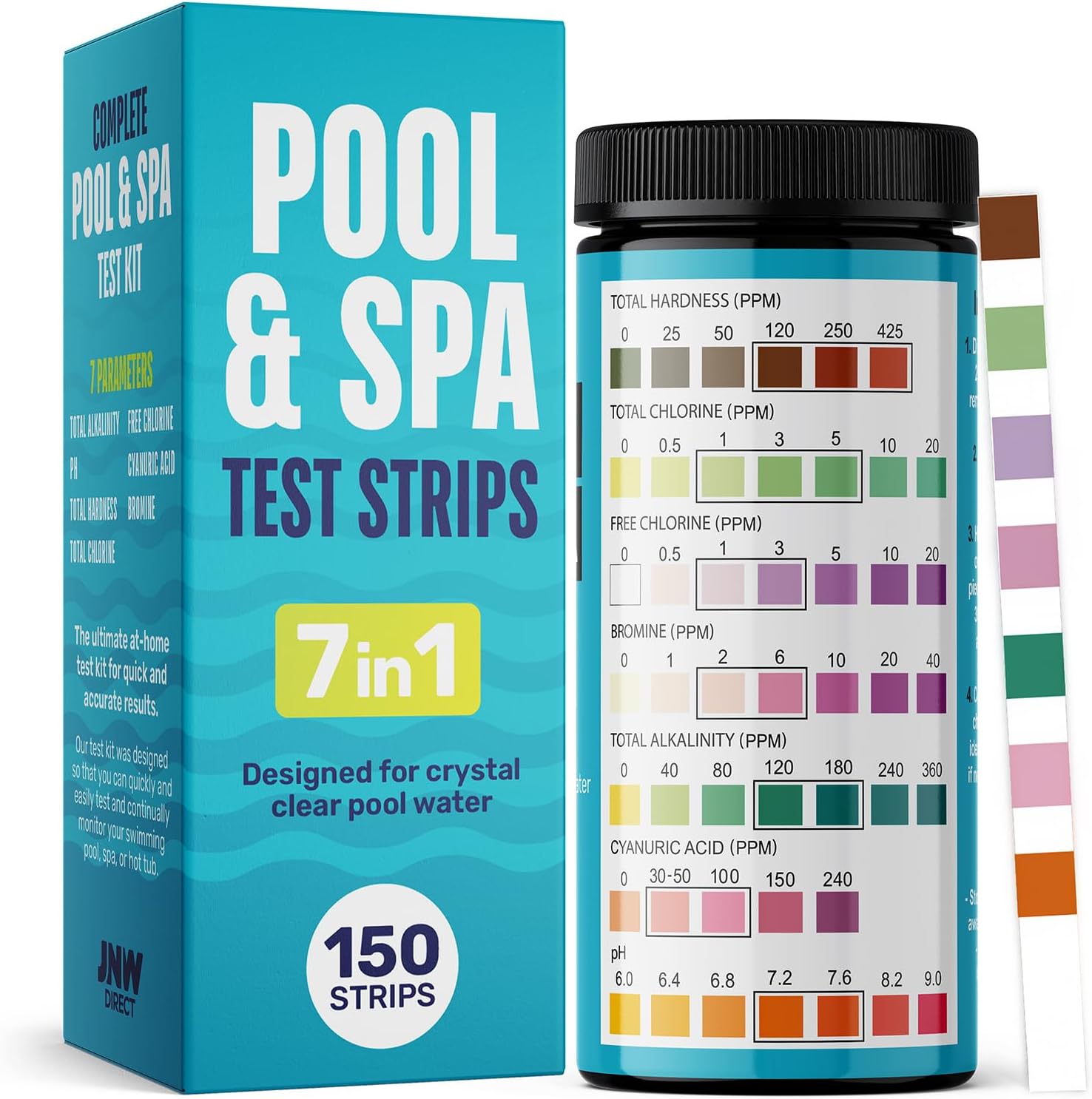
AquaChek 7-in-1 Hot Tub Test Strips
Measures Free Chlorine, Bromine, pH, Alkalinity, Hardness, Cyanuric Acid & Total Chlorine in seconds.
Check Price on Amazon →How to Pick and Add Hot Tub Chemicals: The 6-Step Beginner Process
The single biggest mistake beginners make is adding chemicals in the wrong order — or dumping everything in at once. Hot tub chemistry follows a strict sequence. Each parameter you adjust affects the others. Get the order right and you’ll spend less time and money on corrections. Here’s the exact process, every time you start a fresh fill or reset your chemistry.
Test Your Current Water First
Before you add a single chemical, you need to know where your water stands. Skipping this step is like dosing medication without knowing the diagnosis. You can test using test strips (quick and beginner-friendly) or a liquid drop test kit (more accurate, better for troubleshooting).
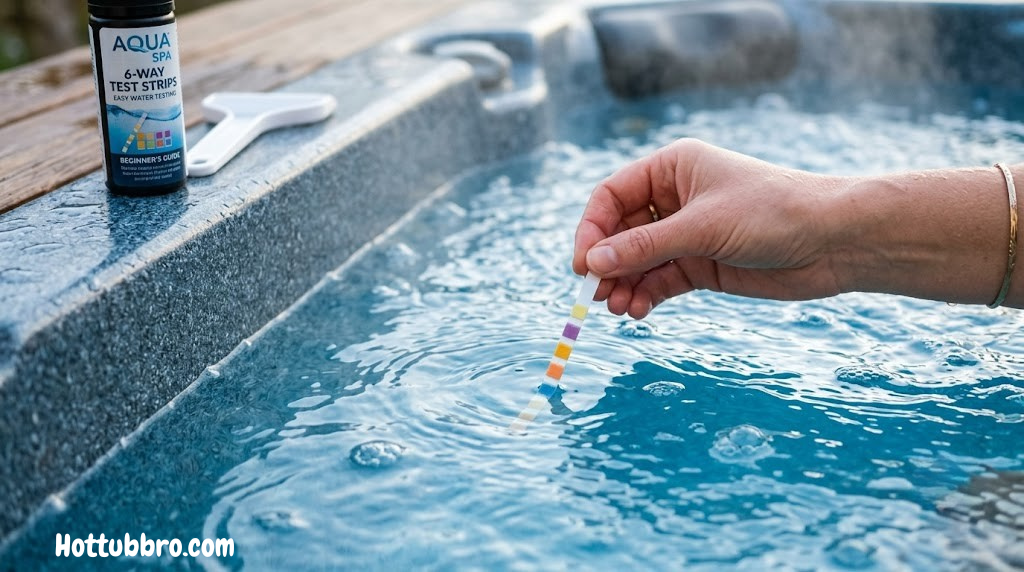
Dip a test strip into the water for about 2 seconds, remove it without shaking, and wait the prescribed time (usually 15–30 seconds) before comparing colors to the chart. A good strip will give you readings for: Free Chlorine/Bromine, pH, Total Alkalinity, and Calcium Hardness. Record every number. This is your baseline for this session.
For more precise testing options, check out our best hot tub water testers guide — it covers everything from budget dip strips to professional-grade digital meters with automatic temperature compensation.
Step 1 — Dip your test strip, wait the required time, then compare color pads against the reference chart and record every reading.
Always take a water sample from elbow depth (away from jets and jets return outlets) in a clean cup, then test that — don’t dip the strip at the surface. Surface readings can be 15–20% off due to aeration and evaporation effects near jets. Also, store test strips in a cool, dry place — humidity ruins them quickly.
Balance Total Alkalinity First
This is the most critical sequence rule in hot tub chemistry: always adjust alkalinity before pH. Because alkalinity buffers pH, adjusting alkalinity will often move your pH partway toward target on its own. If you adjust pH first and then change alkalinity, your pH reading will shift again and you’ll be chasing your tail.
If your alkalinity reads below 80 ppm, add Alkalinity Increaser (sodium bicarbonate). As a general guide, add roughly 1.4 oz per 100 gallons to raise alkalinity by about 10 ppm. Dissolve the chemical in a bucket of warm spa water first, then pour it slowly near an active jet with the pump running. Wait 20 minutes, retest, and repeat if needed — always in small increments, never all at once.
If your alkalinity reads above 120 ppm, use pH Decreaser (sodium bisulfate or muriatic acid — always use the sodium bisulfate granular version for spa use, not liquid muriatic acid which is far harder to control in small volumes). Add in small doses near a jet, circulate for 30 minutes, and retest.
Need a detailed walkthrough? See our guide on how to raise hot tub alkalinity with baking soda and our guide on lowering alkalinity for the other direction.
Step 2 — Low alkalinity causes erratic pH swings. Adding sodium bicarbonate (baking soda) raises it to the 80–120 ppm target, which stabilizes pH before you even touch it.
Adjust pH to 7.4–7.6
Once alkalinity is in range, check your pH. After the alkalinity adjustment settles for 20–30 minutes with the jets running, it often moves pH closer to target automatically. Retest before adding anything else.
If pH is below 7.2, add pH Increaser (sodium carbonate, also called soda ash). Add small doses — typically ½ oz per 250 gallons to raise pH by about 0.2 points — dissolve in a bucket first, pour near a running jet, circulate 20 minutes, and retest.
If pH is above 7.8, add pH Decreaser (sodium bisulfate granules). Apply the same method: small dose, dissolve, circulate, retest. Never pour dry granular chemicals directly onto the tub surface — always pre-dissolve in a bucket of spa water.
Mixing pH Up, pH Down, or shock in the same bucket can trigger violent reactions. Always use a clean bucket, add one chemical at a time, and let it fully dissolve. This isn’t theoretical caution — chemical burns and fire hazards from pool/spa chemical mixing are documented incidents.
Step 3 — The pH sweet spot is 7.4–7.6. Below 7.2, water corrodes equipment and irritates bathers. Above 7.8, sanitizers fail and scale forms.
Set Calcium Hardness
With pH and alkalinity balanced, address calcium hardness if it’s outside the 150–250 ppm range (100–150 ppm for inflatable vinyl spas). This parameter moves slowly and usually only needs adjustment at the start of a fresh fill or once a season for established spas.
To raise hardness, use Calcium Chloride (often sold as Calcium Hardness Increaser). Add it pre-dissolved in water near a running jet, in doses that raise calcium by no more than 50 ppm per addition. Wait an hour before rechecking. To lower hardness, partial draining and dilution with fresh water is the only practical option — there is no effective chemical that removes calcium from spa water without also affecting other parameters significantly.
For most owners using municipal tap water, hardness comes in at 100–200 ppm naturally and rarely needs adjustment at startup. Well water users often face the opposite problem — hardness can come in at 300–500 ppm, requiring a pre-filter or dilution before filling. A good inline hose pre-filter is worth every penny if your source water is very hard.
Step 4 — Calcium hardness protects surfaces. Soft water leaches minerals from the shell; hard water deposits scale on jets and heaters. Inflatable spas need the lower range.
Add Your Sanitizer
With pH, alkalinity, and hardness in range, your water is now ready to receive sanitizer effectively. This is the chemical that actually kills bacteria, viruses, and other pathogens. You have several options, each with distinct characteristics (covered in detail in the next section). For a fresh fill, you’ll add an initial “startup” dose, then maintain ongoing levels every 2–3 days.
Chlorine (dichlor granules): For a fresh fill, dose to reach 3–5 ppm free chlorine. Dissolve granules in a bucket of spa water, never apply directly to the surface or near plastic/vinyl fittings. Run the jets for at least 30 minutes after adding. For ongoing maintenance, a dose of ½–1 tsp per 200 gallons raises chlorine by about 1–2 ppm.
Bromine (sodium bromide + MPS activator, or bromine tablets): For a fresh fill, add a “bromide bank” by dosing sodium bromide according to package instructions, then activate with a small dose of non-chlorine shock. Maintain by adding bromine granules or using a floating tablet dispenser set to deliver 3–5 ppm.
For a deeper dive on this choice, see our bromine vs. chlorine for hot tubs comparison, as well as our breakdown of chlorine granules vs. tablets if you’re sticking with chlorine.
Step 5 — Always pre-dissolve sanitizer granules in spa water first. Pour near a running jet and circulate for 30 minutes, then retest before anyone gets in.
Shock the Water to Oxidize Contaminants
Shocking is the process of adding a high dose of oxidizer to the water to destroy combined chlorine (chloramines), combined bromine (bromamines), organic waste, body oils, and other contaminants that regular sanitizer can’t break down efficiently on its own. Think of it as a deep reset for the water.
For a fresh fill: add a startup shock dose after completing steps 1–5. For ongoing maintenance: shock weekly, or after any heavy use session, strong chemical smell, cloudy water episode, or after the tub sits unused for more than a week. If you’re wondering how often to shock a hot tub, the short answer is: when in doubt, shock it.
Non-chlorine shock (MPS — monopersulfate): The most popular choice for regular use. Oxidizes contaminants without adding chlorine. Compatible with both chlorine and bromine systems. You can re-enter the water 15–20 minutes after dosing. Ideal for weekly maintenance shocking.
Chlorine shock (dichlor or granular chlorine): Provides both oxidation AND sanitization simultaneously. Use for problem water, heavy contamination, or when starting a fresh fill and wanting to simultaneously raise chlorine. Wait until free chlorine drops below 5 ppm before entering (typically 2–4 hours depending on dose and sunlight).
Keep the cover off and jets running for at least 20 minutes after adding shock — this helps the oxidizer work and dissipate any gas produced in the process.
Step 6 — Non-chlorine shock (MPS) allows re-entry in 20 minutes; chlorine-based shock requires waiting for free chlorine to drop below 5 ppm — typically 2–4 hours. Always test before entering.
Shock produces gas as it oxidizes contaminants. Running with the cover closed traps these gases, creates pressure buildup, and can bleach or damage the underside of your cover — or cause it to billow up unexpectedly. Run with cover off and jets on for at least 20 minutes after adding any shock product.

Leisure Time Renew Non-Chlorine Shock
Fast-dissolving MPS oxidizer compatible with chlorine and bromine systems. Re-enter in 15 minutes.
Check Price on Amazon →Chlorine vs. Bromine vs. Mineral & Saltwater Systems
Choosing your primary sanitizer is the most consequential decision in a beginner’s hot tub chemical kit. Each system has fundamentally different chemistry, maintenance demands, and suitability depending on your tub type, skin sensitivity, and lifestyle. Here’s the full breakdown.
Dichlor Chlorine Granules
Dichloroisocyanuric acid (dichlor) is the standard spa chlorine. Stabilized by cyanuric acid, it dissolves quickly and raises both free chlorine and CYA levels simultaneously. Easy to use, widely available, and affordable.
Bromine Granules / Tablets
Bromine is often preferred for hot tubs because it remains effective at higher temperatures and in a wider pH range (6.8–8.2 vs. chlorine’s narrower window). It also produces less odor and is gentler on sensitive skin for many users.
Saltwater System
A salt chlorine generator converts dissolved salt into chlorine via electrolysis, producing a steady low-level chlorine supply automatically. Water feels silky, odor is minimal, and hands-on dosing is greatly reduced. Needs pH/alk management and periodic shocking.
Our dedicated article on saltwater vs. chlorine hot tubs goes deep on the cost comparison and long-term experience of each system. For those interested in alternative sanitizing technology, we’ve also compared UV vs. ozone hot tub sanitizers — both can dramatically reduce the amount of chemical sanitizer you need, though neither replaces it entirely. And if you’ve seen the FROG Ease cartridge system marketed for plug-and-play spas, our FROG Ease vs. chlorine comparison is worth reading before you decide.
Chlorine vs. Bromine — Head-to-Head
| Factor | Chlorine (Dichlor) | Bromine | Winner |
|---|---|---|---|
| Effectiveness at 104°F | Moderate — degrades faster | Excellent — stable at heat | Bromine |
| Effective pH range | 7.2–7.6 (narrow) | 6.8–8.2 (wider) | Bromine |
| Odor at normal levels | Noticeable if combined Cl high | Low / gentle | Bromine |
| Cost | Lower cost per treatment | Slightly higher | Chlorine |
| Availability | Everywhere | Spa supply stores / online | Chlorine |
| Reactivatable after shock | No — must re-dose | Yes — bromine bank reactivates | Bromine |
| Sensitive skin | Some users report irritation | Generally gentler | Bromine |
| Outdoor UV stability | Degrades in direct sunlight | Breaks down even faster in UV | Chlorine |
- Lower cost and widely available
- Faster-acting kill time
- Works well outdoors (with CYA stabilizer)
- Compatible with most pool-grade equipment
- More testing strips available
- Degrades rapidly in hot water
- Narrower effective pH window
- Strong odor when combined chlorine forms
- Eye and skin irritation more common
- Can bleach swimwear over time
For a complete guide on converting your inflatable to a saltwater system, see our step-by-step saltwater conversion guide.

SpaGuard Enhanced Brominating Tablets
Long-lasting bromine tablets designed for hot tubs. Slow-dissolving, stable at high temps, and easy to dose via a floating dispenser.
Check Price on Amazon →Hot Tub Shock: A Deeper Look at What It Does and When to Use It
No chemical in a beginner’s kit is more misunderstood than shock. Many first-time owners think “shocking” means dumping in extra chlorine whenever the water smells bad. The reality is more nuanced — and understanding it saves you money, protects your equipment, and keeps bathers safer.
What Shock Actually Fixes
When bathers enter the tub, they introduce nitrogen compounds via sweat, urine, saliva, sunscreen, cosmetics, and body oils. Sanitizer reacts with these compounds and gets “used up” — the resulting combined chlorine (chloramines) or combined bromine (bromamines) are the main culprits behind:
- That sharp “chemical” smell that most people wrongly blame on “too much chlorine”
- Red, stinging eyes during and after soaking
- Skin irritation and hot tub rash (folliculitis if Pseudomonas is present)
- Hazy or milky water that doesn’t clear with regular sanitizer
- Inefficient sanitization where bacteria can multiply despite “good” total chlorine readings
Shocking oxidizes (breaks apart) these combined compounds, liberating the sanitizer’s ingredients and clearing the contaminants. After shocking, the water smells better, runs clearer, and sanitizes more efficiently. The issue of hot tub biofilm is separate but related — biofilm colonies inside your plumbing can harbor bacteria even with good surface chemistry, which is why periodic deep-cleaning with biofilm-targeting products is also part of thorough water care.
Non-Chlorine Shock vs. Chlorine Shock — Choosing Correctly
| Feature | Non-Chlorine Shock (MPS) | Chlorine Shock |
|---|---|---|
| Active ingredient | Potassium monopersulfate (MPS) | Dichlor or calcium hypochlorite |
| Re-entry time | 15–20 minutes | 2–4 hours (until Cl <5 ppm) |
| Adds chlorine? | No | Yes |
| Compatible with bromine? | ✓ Yes — activates bromide bank | ⚠ Use carefully with bromine |
| Best use case | Weekly routine maintenance | Problem water, startup fills, heavy contamination |
| Cover off required? | Yes (20 min) | Yes (20+ min) |
| Effect on pH | Slightly lowers | Variable |
Use non-chlorine MPS shock for weekly routine maintenance (it lets you get in the tub the same evening). Use chlorine shock for quarterly restarts, after heavy party use, after adding new bathers, or when water is visibly cloudy or strongly smelling despite normal sanitizer levels.
The Beginner’s Weekly Hot Tub Chemical Maintenance Routine
Consistency beats intensity. Spending 5–10 minutes on a predictable schedule is dramatically more effective — and cheaper — than sporadic “damage control” sessions when the water has already gone wrong. Here’s a realistic weekly routine for a household that uses the tub 3–5 times per week.
| Frequency | Task | Notes |
|---|---|---|
| Every 2–3 days | Test water with strips | Record pH, alkalinity, sanitizer. More often after heavy use. |
| Every 2–3 days | Top up sanitizer if below 3 ppm | Small dose, pre-dissolved, near jet. Never overdose. |
| Weekly | Shock treatment | MPS for routine; chlorine shock for problem water. Cover off, jets on, 20 min. |
| Weekly | Rinse filter cartridge | Remove, rinse with a hose (not a pressure washer). Soak monthly in filter cleaner. |
| Weekly | Check pH and alkalinity | Adjust alkalinity first if needed, then pH. Small doses only. |
| Monthly | Deep-clean filter | Chemical soak in diluted filter cleaner overnight. Rotate with a spare if possible. |
| Every 3–4 months | Full drain, clean, and refill | Flush lines with pipe purge cleaner before draining. Wipe shell with spa surface cleaner. |
| Each refill | Check calcium hardness and TDS | These change primarily with refills, not ongoing use. |
For a deeper look at the filter side of maintenance, our guides on how often to replace hot tub filters and how hot tub filters work are useful companions. Filters do half the water-clarity work and are chronically under-maintained by beginners. An overloaded filter is one of the top causes of persistent cloudy water even when chemistry is otherwise perfect.
Before your quarterly drain, add a pipe-purge product and run the jets for 15 minutes, then drain. This flushes biofilm colonies from the internal plumbing — a step that’s invisible but critical. Neglecting it means refilling with water that quickly re-contaminates from the plumbing walls. See our guide on how to clean an inflatable hot tub for the full drain-and-refill protocol.

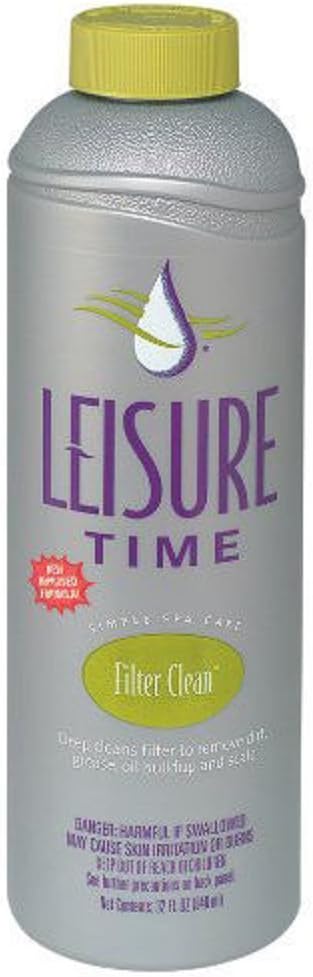
Leisure Time Spa Filter Clean (Concentrated)
Deep-cleaning soak that removes oils, minerals, and embedded debris from cartridge filters. Dramatically extends filter life.
Check Price on Amazon →Troubleshooting Cloudy, Green, or Foamy Hot Tub Water
Even with a solid routine, things go wrong — especially when you’re still learning. Here’s a diagnostic framework for the most common water problems beginners encounter.
Cloudy or Milky Water
Cloudy water is the most common complaint. Causes of cloudy hot tub water include low sanitizer, high pH (scale particles in suspension), a dirty or overloaded filter, high total dissolved solids (TDS), or too many body oils and bather load. Diagnosis approach:
- Test all five parameters. Note which is out of range.
- Rinse the filter first regardless — this is the most common fix.
- If sanitizer is low, add a dose and shock with MPS.
- If pH is high, bring it down to 7.4–7.6.
- If everything tests fine but water is still hazy, TDS is likely the culprit — drain and refill.
Foamy Water
Foam is almost always caused by surfactants — soaps, detergents, body lotion, shampoo residue, deodorant, or laundry detergent from swimwear. Showering before entering the tub eliminates most foam issues. If foam persists, a bottle of spa defoamer provides instant cosmetic relief, but the underlying cause needs addressing. Our hot tub foam guide covers every cause and fix in detail.
Green or Brown Discoloration
Green water in a hot tub usually indicates algae growth — a sign that sanitizer has been absent for an extended period. Shock aggressively with chlorine (super-chlorinate to 10–15 ppm), brush all surfaces, clean the filter, and maintain elevated sanitizer levels for 48 hours while running the jets frequently. If the green persists, you likely have a filter and plumbing issue alongside the chemistry problem.
Slippery Surfaces and Hot Tub Slime
A slippery or slimy feeling on the tub walls is a classic sign of hot tub biofilm. This is a colony of bacteria protected by a polysaccharide matrix — ordinary sanitizer levels don’t fully penetrate it. The fix requires a dedicated biofilm-removal purge product added before the next drain cycle, followed by a thorough scrub of all surfaces, a full drain, and a fresh start with properly balanced water.
Persistent Chemical Odor
Counterintuitively, a strong chemical/chlorine smell usually means you need more sanitizer — specifically, you need to shock. The odor comes from combined chlorine (chloramines), not free chlorine. Free chlorine is essentially odorless. Shock the water with MPS or a chlorine shock dose, run jets for 30 minutes with cover off, and the smell should resolve within a couple of hours.
Consider investing in a digital water tester for more accurate readings than test strips. Our comparison of digital water tester sensors and calibration options covers the top products available. For persistent pH drift, our guide on Intex PureSpa troubleshooting covers chemistry alongside heating issues for that popular platform.
The Complete Beginner’s Hot Tub Chemical Starter Kit
Here’s exactly what a new hot tub owner should have on hand before their first fill. Everything below is essential — these are not optional extras. Organized by category, with the logic behind each item explained so you know what you’re buying and why.
-
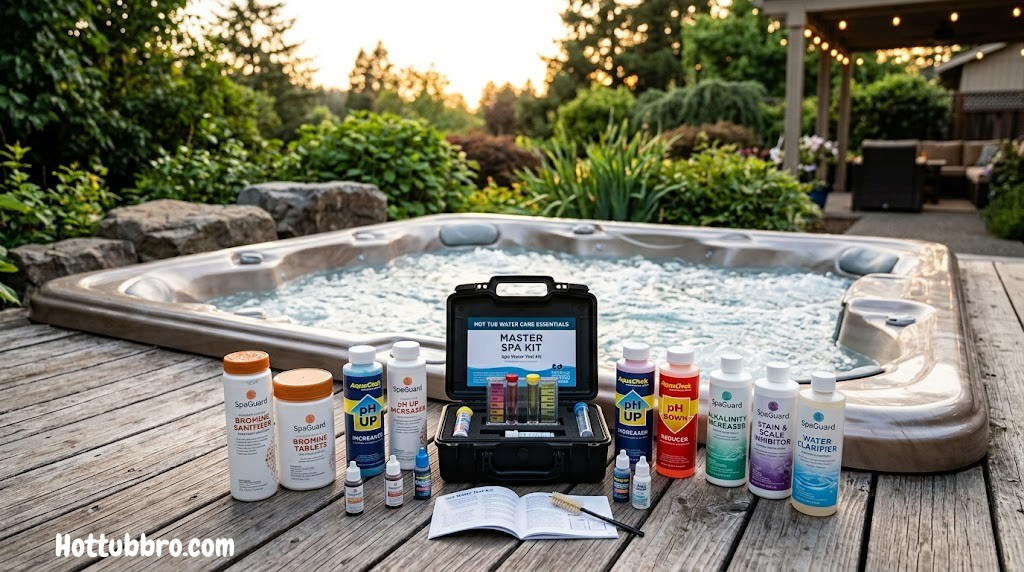
Test Strips or Drop Test Kit The foundation of every maintenance session. Without accurate testing, every chemical decision is guesswork. Get 7-in-1 strips at minimum. A liquid drop kit is more accurate for pH and alkalinity.
-
Sanitizer (Dichlor Granules or Bromine System) Choose one and commit to it. Mixing chlorine and bromine systems causes issues. Granules for both are available at pool/spa supply stores and on Amazon.
-
Non-Chlorine Shock (MPS) For weekly maintenance shocking. Fast, gentle, allows quick re-entry. Complement with chlorine shock for deep-clean situations.
-
pH Increaser (Sodium Carbonate / Soda Ash) pH will drop over time as sanitizers consume alkalinity. You’ll use this more often than pH Down for most fills.
-
pH Decreaser (Sodium Bisulfate Granules) For high pH. Buy granular, not liquid. Easier and safer to handle in spa-sized doses.
-
Alkalinity Increaser (Sodium Bicarbonate) The first parameter to adjust on any fresh fill. Baking soda works but food-grade baking soda is a less concentrated form — use spa-grade for accurate dosing.
-
Calcium Hardness Increaser (Calcium Chloride) Only needed if your source water tests below 100 ppm hardness. Most tap water owners won’t need this at startup — but it’s worth having on hand.
-
Filter Cleaner (Spray + Soak Products) A spray rinse aid for weekly filter rinses and a concentrated soak product for monthly deep cleaning. These significantly extend filter life.
-
Pipe/Line Purge (Biofilm Flush) Use before every drain-and-refill cycle. Flushes biofilm from internal plumbing — invisible but essential for genuinely clean water after refills.
-
Spa Clarifier (Optional but Helpful) A polymer-based water clarifier coagulates fine particles the filter can’t catch on its own, clearing mildly hazy water. Not a substitute for fixing chemistry but a useful tool.

Leisure Time Spa Care Starter Kit
Includes pH Up, pH Down, Alkalinity Increaser, Chlorine granules, and Spa Shock. Everything to start your first fill correctly.
Check Price on Amazon →Additional Resources to Build Your Knowledge
As you get comfortable with the basics, these companion guides will help you go deeper on specific aspects of ownership:
- Inflatable hot tub setup — step-by-step installation guide for getting the tub ready before your first fill
- Inflatable hot tub maintenance and water care for a broader maintenance overview
- Best hot tub covers — a quality cover does as much for chemistry as the chemicals themselves by reducing contamination and evaporation
- Best hot tub scum absorbers — these floating foam discs adsorb body oils before they become chloramine precursors
- Inflatable hot tubs for winter use — cold weather accelerates water turnover and increases chemical demand
Chemical Safety, Health Considerations, and Who Should Take Extra Care
Hot tub chemicals are safe when used correctly — but they are industrial-grade oxidizing agents, and careless handling causes burns, respiratory irritation, and in rare cases, dangerous reactions. Here are the non-negotiable safety rules every owner needs to follow.
Handling and Storage Rules
- Never mix chemicals dry. Always pre-dissolve each chemical separately in a clean bucket of water. Adding one dry chemical on top of another can cause fires, explosions, or toxic gas release.
- Store chemicals in a cool, dry place away from direct sunlight, moisture, and heat sources. Keep lids tight. Heat and humidity degrade most spa chemicals rapidly.
- Keep chemicals out of children’s reach. Even “gentle” spa products are dangerous if ingested or if they contact eyes directly.
- Wear gloves when handling pH decreaser and shock products — these are oxidizers and acids that can cause chemical burns on skin and eyes.
- Never return unused chemicals to their original container. Contamination from small amounts of water or other chemicals can trigger dangerous reactions in the stored supply.
Who Should Exercise Extra Caution
Certain individuals need to consider hot tub chemistry alongside their own health status. Our guide on who shouldn’t use a hot tub covers this in detail, but key groups include:
- Pregnant women — see our pregnancy and hot tub safety guide
- People with compromised immune systems
- Those with cardiovascular conditions — see negative effects of hot tubs on blood pressure
- Children under 12 (both because of heat sensitivity and because chlorine irritation affects smaller bodies more)
Conversely, there’s genuine evidence supporting hot tub use for arthritis pain relief, post-workout muscle recovery, and improving sleep quality. Properly balanced water — not over-chemicalized, not under-sanitized — is safe for regular use and genuinely beneficial for many people.
Hot Tub Chemicals for Beginners — FAQs
For a first fill you need: a sanitizer (chlorine granules or bromine), pH increaser and decreaser, total alkalinity increaser (sodium bicarbonate), and a non-chlorine or dichlor shock. A test kit or test strips are also essential so you can verify every reading before you get in. Optionally, a calcium hardness increaser and a spa clarifier round out a comprehensive starter kit.
Sanitizer levels should be checked and topped up every 2–3 days, or after every heavy-use session. pH and alkalinity should be tested at least twice per week. A full shock treatment is recommended weekly or after any unusual odor or cloudy water event. Filter rinsing is weekly; deep filter cleaning is monthly; full drain and refill is every 3–4 months.
Both work well, but bromine is generally preferred for hot tubs because it remains stable at higher water temperatures and stays active even in a slightly higher pH range. Chlorine dissipates faster in hot water. Sensitive skin? Bromine is typically gentler, though some people find it equally irritating. Cost-wise, chlorine is cheaper and more available. For outdoor tubs, chlorine holds up better under UV; for indoor spas, bromine wins on almost every metric.
The ideal pH range for a hot tub is 7.4–7.6. A range of 7.2–7.8 is acceptable but not optimal. Below 7.2 the water becomes corrosive and irritates skin and eyes. Above 7.8, sanitizer efficiency drops sharply — chlorine at pH 8.0 can be up to 80% less effective — and scale deposits form on heater elements and jets.
Some products overlap — pH Up, pH Down, and sodium bicarbonate for alkalinity are usable in both. However, pool chlorine tablets (trichlor) should never be used in hot tubs because they are far too acidic for the smaller water volume and will rapidly corrode equipment. Always use spa-grade dichlor granules. Cal-hypo (calcium hypochlorite) should also be used with caution in spas as it can cloud water if calcium hardness is already high.
Cloudy water after adding chemicals usually means the chemicals didn’t fully dissolve before going in — always pre-dissolve in a bucket first. It can also mean pH or calcium hardness is now out of range, causing micro-precipitation of dissolved minerals. Let the jets run for 30 minutes, retest, and correct the parameter that’s out of range. If cloudiness persists, rinse your filter — it may be overloaded and unable to clear the fine particles the chemistry adjustment stirred up.
Add sodium bicarbonate (baking soda or a branded Total Alkalinity Increaser) in 1–2 oz increments per 250 gallons, pre-dissolved in warm spa water, near a running jet. Each dose raises alkalinity by roughly 10–15 ppm. Wait 20 minutes with jets running before retesting. Always adjust alkalinity before pH — it acts as the buffer that stabilizes pH. See our step-by-step guide on raising hot tub alkalinity for exact dosing charts.
Yes, shocking is non-negotiable. Shock oxidizes combined chlorine (chloramines) or combined bromine (bromamines) that cause odors, irritation, and hazy water. Regular sanitizer doses don’t break these down efficiently — only the high oxidizing power of a shock dose does. Non-chlorine shock (MPS) is popular for regular use because you can re-enter the water within 15–20 minutes. Chlorine-based shock provides deeper sanitization and is better for problem water. Shock weekly at minimum.
For pH or alkalinity adjustments: wait 20–30 minutes with jets running, then retest before entering. For non-chlorine shock (MPS): 15–20 minutes with jets on and cover off. For chlorine shock or dichlor sanitizer doses above 3 ppm: wait until free chlorine reads below 5 ppm on your test strip (typically 2–4 hours depending on dose and water temperature). Always test to confirm, rather than timing alone.
Yes, the chemistry is identical. The main difference is the smaller water volume — most inflatables hold 180–320 gallons vs. 400–500+ gallons for hard shells — so doses are proportionally smaller and errors have a bigger percentage impact. A digital or liquid-drop test kit is especially useful because minor dosing errors in a small volume cause larger parameter swings than in a larger tub.
Yes, but use only spa-formulated aromatherapy products — never essential oils or bath bombs designed for domestic bathtubs. Regular bath products are loaded with surfactants that create foam and leave residues that consume sanitizer rapidly. Spa-specific aromatherapy products are low-foaming and safe for the water chemistry and equipment. See our aromatherapy for hot tubs guide for recommended products.
TDS measures every dissolved substance in the water — minerals, chemicals, body oils, and all compounds accumulated over time. As TDS climbs above 1,500 ppm above your original fill-water baseline, chemicals stop working efficiently because the water is essentially saturated. The only solution is a complete drain and refill. Most hot tubs benefit from this every 3–4 months under normal household use. High-use inflatables may need it every 8–10 weeks.
You Now Have Everything You Need to Get Your Water Right
Hot tub chemistry sounds intimidating when you’re staring at a shelf of unlabeled bottles. But the underlying logic is simple: keep five numbers in range, follow a predictable routine, and add chemicals in the correct order. That’s it. Master those principles and you’ll spend more time enjoying your spa and far less time troubleshooting murky water or chasing erratic pH.
Start with a test before every session. Balance alkalinity first, then pH. Sanitize after balancing. Shock weekly. Clean your filter. Drain every quarter. Those six habits alone will give you consistently clear, safe, comfortable water — the kind of water that makes you actually want to use the tub you invested in.
Read the Full Hot Tub Chemicals Guide → Complete Maintenance Guide →
Taylor K-2006 Complete Water Testing Kit
The gold-standard liquid drop test kit used by professional spa technicians. Accurate readings for chlorine, bromine, pH, alkalinity, hardness, and CYA.
Check Price on Amazon →