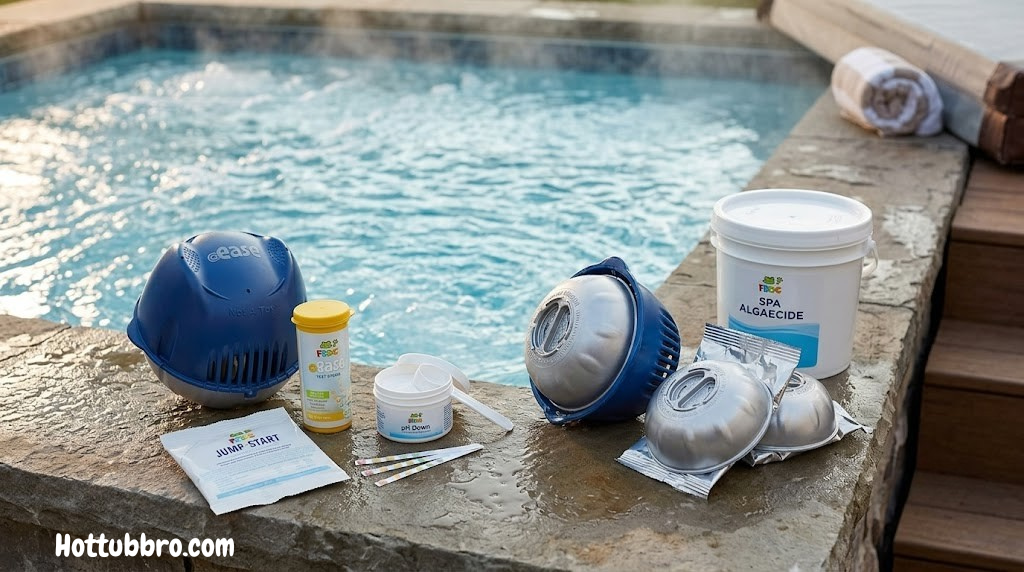
Frog @ease vs Traditional Chlorine: Which System Actually Makes Hot Tub Ownership Easier?
A no-nonsense, owner-focused breakdown of two very different approaches to hot tub sanitation — covering real cost, real effort, and real water quality over time.
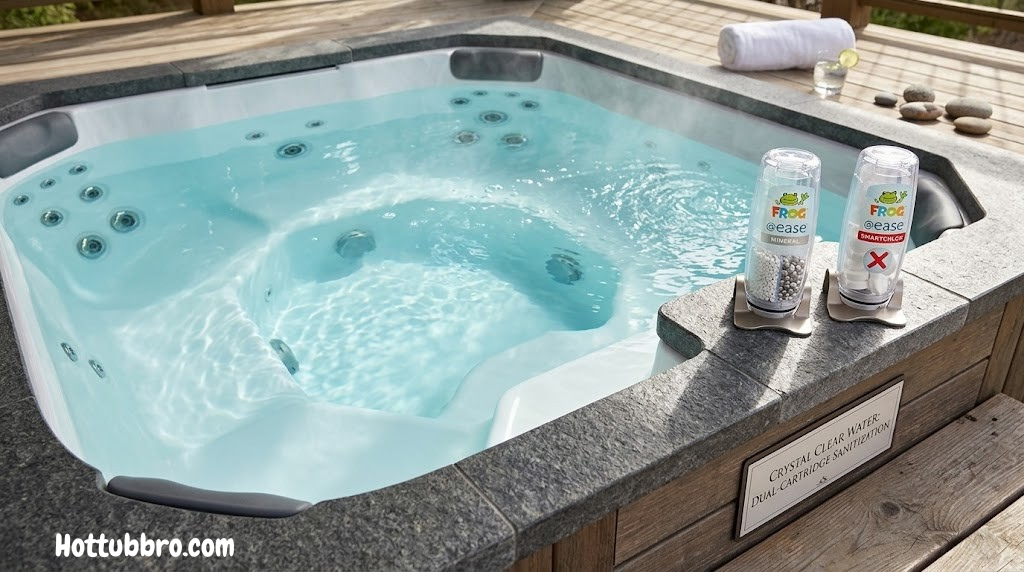
The Sanitization Decision That Defines Your Whole Hot Tub Experience
Bottom line up front: Frog @ease wins on convenience and skin comfort; traditional chlorine wins on cost flexibility and universal compatibility. Your right answer depends on how much you value simplicity versus savings.
Here is the scenario most hot tub owners eventually face: you have been wrestling with pH adjustments, weekly shocks, inconsistent chlorine levels, and water that sometimes smells like a public pool — and someone at the pool store hands you a Frog @ease cartridge and says, “This will change your life.” Is that claim anywhere close to accurate, or is it marketing-speak dressed up in a green plastic shell?
The Frog @ease Floating System uses a patented combination of mineral cartridges and a chlorine delivery mechanism that aims to reduce the amount of active chlorine your spa water needs. Traditional chlorine sanitization — whether you use granular dichlor, trichlor tablets, or liquid chlorine — relies entirely on maintaining a consistent free chlorine residual, which demands more hands-on intervention. These are genuinely two different philosophies about hot tub water care, and choosing between them has cascading effects on your weekly routine, your annual spend, and how your skin feels after a soak.
This guide covers every angle: the actual chemistry, the true cost over time, the real-world maintenance burden, water quality differences, and the honest scenarios where each approach makes the most sense. Before deciding, it also helps to understand the full landscape of hot tub chemicals so you know what role sanitation plays in the larger picture of water balance.
🐸 Frog @ease
- Floats in the tub, works automatically
- Combines minerals + low-dose chlorine
- Designed for less-frequent dosing
- Proprietary cartridge-based system
- Gentler on skin in most reports
💧 Traditional Chlorine
- Manual dosing on a regular schedule
- Full chlorine residual maintained
- Universal, works in any tub
- Chemicals sourced from many vendors
- Complete user control over levels
If you have ever wondered why your hot tub water gets cloudy despite adding chemicals correctly, the root issue often traces back to sanitation system mismatches — a problem this comparison addresses head-on. See our full breakdown of why hot tub water gets cloudy for additional context.
What Is the Frog @ease System and How Did It Come to Be?
The Frog @ease Floating System is a proprietary hot tub water care product developed by King Technology, a Minnesota-based company that has been engineering mineral sanitation systems since the early 1990s. The @ease concept specifically targets hot tub and spa owners who want a simpler, more automated approach to water chemistry management.
The system consists of a floating housing — a distinctive bright-yellow buoy — that sits directly in your hot tub water. Inside that housing are two separate cartridge types working in tandem: a mineral cartridge containing SmartChlor technology (a stabilized chlorine compound), and a FROG mineral cartridge that releases silver and copper-based minerals continuously into the water. This dual-action approach is the core of what makes @ease function differently from simply dumping chlorine granules into your spa.
The SmartChlor Technology Angle
The SmartChlor component is worth understanding in detail because it shapes everything about how the system behaves. Unlike standard chlorine, which dissipates rapidly in warm water and needs constant replenishment, SmartChlor is a stabilized form that is described by the manufacturer as self-regulating. The idea is that SmartChlor maintains a lower but consistent free chlorine residual — typically around 0.5 to 1.0 parts per million — rather than the 3 to 5 ppm range that conventional chlorine programs target.
This lower residual is made possible by the mineral cartridge working alongside it. Silver ions are well-documented bactericides; copper ions act against algae and certain pathogens. When minerals are doing some of the antimicrobial heavy lifting, the chlorine demand is reduced, meaning you need far less active chlorine to achieve equivalent sanitation outcomes. That is the theoretical basis, at least — and in practice, most users report that the chemistry does hold up in regular residential spa use.
Note: The Frog @ease is specifically designed for spas and hot tubs, not swimming pools. Pool versions of the Frog system exist but use completely different chemistry. Using the wrong product is one of the most common mistakes new users make.
Cartridge Replacement Schedule
Each SmartChlor cartridge is rated for approximately 3 to 4 weeks of use depending on bather load, water temperature, and sunlight exposure. The mineral cartridge lasts significantly longer — typically through 4 months or an entire water cycle before needing replacement. This staggered replacement timeline is part of what makes the system feel low-maintenance; you are not changing everything at once.
The floating housing itself includes a small dial that you rotate to control the chlorine output rate, giving you some ability to increase dosing during periods of heavy use. This is an important feature that distinguishes @ease from fully passive systems.
If you are already using an inflatable or portable spa, note that not every product is compatible with the @ease cartridge housing. Check your tub’s specifications, and see our guide to inflatable hot tub maintenance and water care for guidance on which products work best in non-rigid spas.
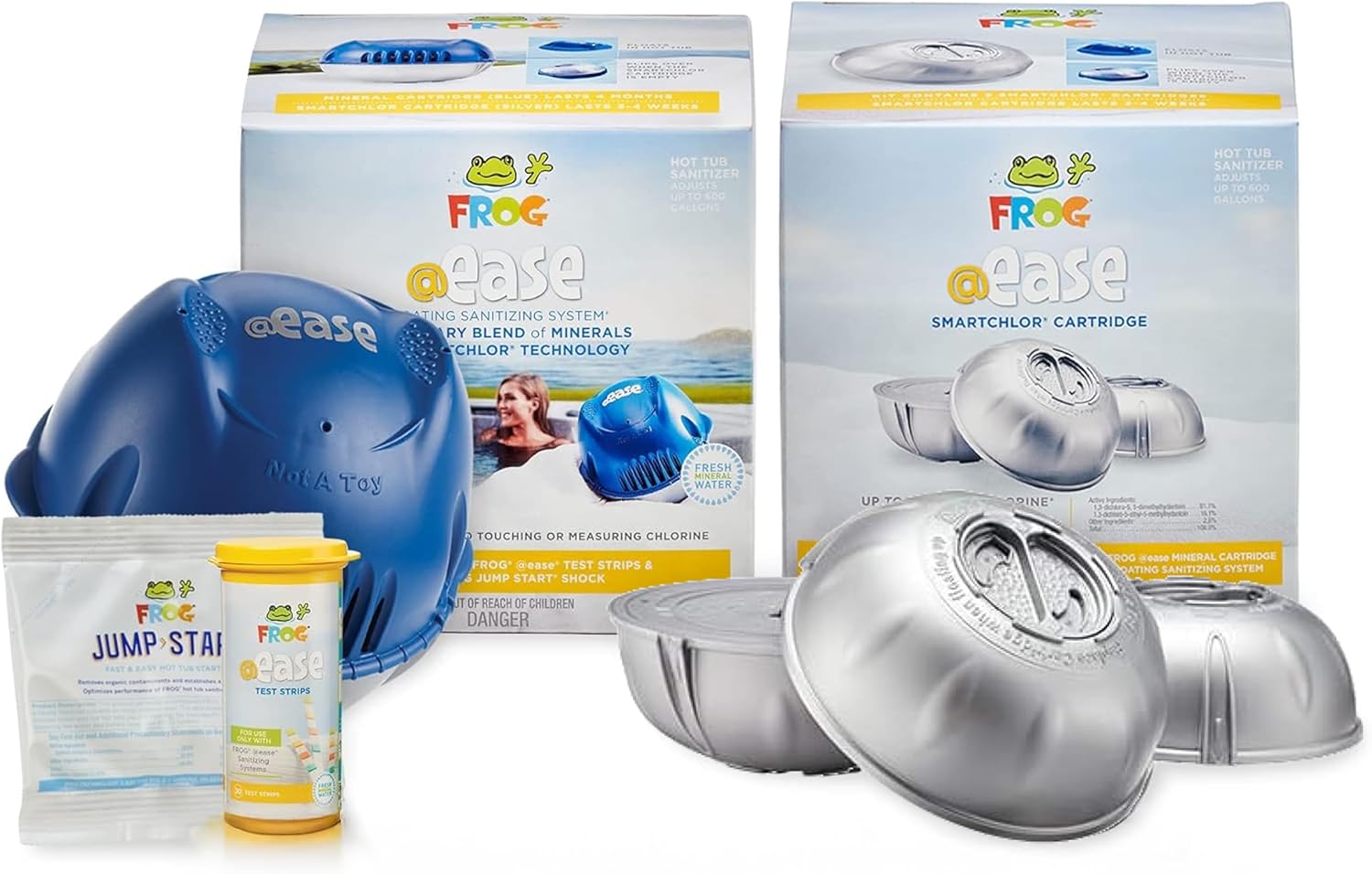
Frog @ease Floating System for Hot Tubs
The complete starter kit with SmartChlor cartridge and mineral cartridge. Works automatically in your spa — no daily measuring required.
View on Amazon →Traditional Chlorine Sanitation: The Standard That Every Hot Tub Owner Learns First
When someone says “traditional chlorine” for a hot tub, they are usually referring to one of three compound types: sodium dichloro-s-triazinetrione (dichlor), trichloroisocyanuric acid (trichlor), or occasionally sodium hypochlorite (liquid chlorine). Each delivers free chlorine to your water, but they differ in pH behavior, cyanuric acid content, and application method.
Dichlor: The Hot Tub Default
Dichlor granules are by far the most commonly used chlorine form for residential spas. They dissolve rapidly, are easy to measure, have a near-neutral pH impact (around 6.5 to 6.8), and contain built-in cyanuric acid stabilizer to slow chlorine loss. Most hot tub starter kits include dichlor, and it is the product your tub manufacturer likely references in the owner’s manual when they say “add chlorine.”
The standard program with dichlor involves: testing water two to three times per week, adding chlorine granules to bring free chlorine into the 3–5 ppm target range, shocking the water weekly or after heavy use, and adjusting pH, alkalinity, and calcium hardness as needed to keep everything balanced. It is not complicated, but it is genuinely hands-on.
Trichlor: Slower Release, But Acidic
Trichlor tablets offer a slower, more sustained chlorine release compared to dichlor granules. However, trichlor is significantly more acidic than dichlor (pH around 2.8), which means consistent use will drive your spa water’s pH down and require constant alkalinity and pH correction. For this reason, trichlor is far less popular in spas than in pools, where the larger water volume buffers the acid load more effectively.
Liquid Chlorine: Fast-Acting, No Stabilizer
Sodium hypochlorite — standard liquid bleach at spa-grade concentration — adds free chlorine without adding cyanuric acid, making it useful for shocking or for spas where cyanuric acid levels have built up too high. It is highly alkaline (pH around 11–13), so it raises pH on each application. Most residential spa owners avoid it as a primary sanitizer and use it only for oxidizing shocks.
Cyanuric Acid Buildup: One of the least-discussed problems with long-term dichlor use in spas is cyanuric acid accumulation. Because dichlor contains built-in stabilizer, cyanuric acid levels rise with each addition. At levels above 80–100 ppm, the stabilizer actually reduces chlorine effectiveness significantly — meaning you need more chlorine to achieve the same sanitation effect. The only fix is a partial drain and refill. This is sometimes called “chlorine lock.”
Understanding the difference between granules and tablets matters more than most new owners realize. Our comparison of chlorine granules vs tablets breaks down the trade-offs in detail. For a broader perspective on how chlorine stacks up against its alternatives, see our comparison of bromine vs chlorine for hot tubs.
The flexibility of traditional chlorine is its biggest strength. You can source it from pool supply stores, big-box retailers, and online vendors at competitive prices. You have full control over every aspect of the chemistry. And because it works in every spa — regardless of brand, size, or material — there are no compatibility concerns.
How Each System Actually Works in Your Spa Water
To make an informed choice, it helps to visualize what is happening chemically in your hot tub water under each system. The processes are genuinely different, and those differences explain why owners report such different maintenance experiences.
The Frog @ease Process Flow
The floater circulates through your water with every pump cycle. As water passes through the cartridge housing, minerals leach out continuously and the SmartChlor compound releases a metered amount of stabilized chlorine. The beauty of the system — and its limitation — is that you are largely hands-off between cartridge changes. The system does not respond dynamically to bather load spikes, which means heavy use periods may temporarily push the water out of optimal range.
The Traditional Chlorine Dose Cycle
Traditional chlorine requires active cycle management. Water is tested, a calculated dose of granules is added, you wait for the chemicals to distribute, then you re-test to confirm the levels. This cycle repeats multiple times per week. Additionally, a weekly shock — either with non-chlorine oxidizer or a high-dose chlorine shock — is essential to destroy chloramines, which are the combined chlorine compounds responsible for that classic “pool smell” and skin irritation.
The chlorine residual under traditional programs naturally fluctuates between doses. Right after dosing, you might have 4–5 ppm. Twelve hours later, hot water and agitation may have dropped that to 1–2 ppm. This fluctuation is normal and manageable, but it means your tub is not operating at optimal sanitation 100% of the time unless you test and dose with near-perfect regularity.
For a complete overview of how to handle all the chemistry involved, our hot tub water chemistry guide walks through every parameter you need to track.
Chemistry Comparison: What Is Actually Happening in the Water
Water chemistry is where the real differences between these two systems become concrete. The numbers below are not abstract — they determine how safe your water is, how comfortable it feels, and how much corrective work you need to do on a weekly basis.
Free Chlorine Target Ranges
| Parameter | Frog @ease Target | Traditional Chlorine Target | Impact of Deviation |
|---|---|---|---|
| Free Chlorine (ppm) | 0.5 – 1.0 | 3.0 – 5.0 | Below minimum: contamination risk. Above maximum: irritation. |
| pH | 7.2 – 7.8 | 7.2 – 7.8 | Low pH: corrosion and eye irritation. High pH: cloudy water, scale. |
| Total Alkalinity (ppm) | 80 – 120 | 80 – 120 | Low TA: pH instability. High TA: scale, cloudiness. |
| Calcium Hardness (ppm) | 150 – 250 | 150 – 250 | Low: foamy/aggressive water. High: scaling on surfaces and jets. |
| Cyanuric Acid (ppm) | 30 – 50 (built-in) | 30 – 50 (accumulates over time) | Over 80 ppm: chlorine lock / reduced effectiveness. |
| Combined Chlorine (ppm) | < 0.5 | < 0.5 | Above 0.5: odor, irritation, need to shock. |
Why Frog @ease Can Operate at Lower Chlorine Levels
This is the chemistry question that skeptics ask most often: if the EPA-established minimum free chlorine for spa water is around 2–4 ppm in most sanitation guidelines, how does Frog @ease claim to work effectively at 0.5–1.0 ppm? The answer lies in the mineral component.
Silver ions (Ag⁺) are potent biocides that disrupt bacterial cell membranes and interfere with enzyme function. Copper ions (Cu²⁺) are algaecidal and also have some bactericidal properties at very low concentrations. When these minerals are present continuously in the water, they reduce the total pathogen load that chlorine needs to address. The chlorine, then, is not doing all the antimicrobial work — it is working synergistically with the minerals, which is why a lower concentration can achieve acceptable sanitation.
There is important nuance here, though. Independent water chemistry researchers have noted that the 0.5–1.0 ppm chlorine level is adequate under normal residential conditions — a couple using the tub a few times per week with routine showering beforehand. Under higher-load scenarios (parties, frequent use, users not showering first), the combination may struggle to keep up, and the manufacturer does recommend increasing the output dial setting and possibly supplementing with a shock treatment under those conditions.
Shocking Still Required: One of the most persistent misconceptions about Frog @ease is that you never need to shock. The manufacturer explicitly states that shocking your spa is still necessary — typically once a week or after heavy use. You can use either a non-chlorine oxidizer (MPS) or a chlorine shock. This requirement is identical to traditional chlorine programs.
Chloramine Formation and the Smell Factor
The characteristic “pool smell” is not from chlorine itself — it is from chloramines, which form when free chlorine reacts with nitrogen-containing compounds from bathers (sweat, body oils, urine, cosmetics). Traditional chlorine programs at 3–5 ppm have more free chlorine available, but they also produce more chloramines if not managed with regular shocking. Because Frog @ease operates at a lower chlorine level, some users report reduced odor — but this is partly because there is simply less chlorine available to form chloramines in the first place, not necessarily because the system prevents chloramine formation entirely. For those bothered by chlorine smell, the comparison between saltwater and chlorine systems offers another alternative worth exploring.

SpaGuard Enhanced Spa Shock & Dichlor Granules
The workhorse of traditional spa sanitation. Fast-dissolving dichlor granules for precise free chlorine control in any spa.
View on Amazon →Maintenance Effort Compared: A Realistic Weekly Time Assessment
This is the section most owners actually care about. How many minutes per week does each system genuinely require? The honest answer involves separating “what the marketing says” from “what real-world owners report.”
Frog @ease Weekly Maintenance Reality
Test Water Twice Weekly (5–8 minutes)
Even with @ease, you still need to test water 2 times per week — the system does not eliminate chemistry management, it reduces it. You are testing pH, alkalinity, and free chlorine. Using a good digital tester speeds this up considerably. See our comparison of best hot tub water testers for recommendations.
Adjust pH and Alkalinity as Needed (3–10 minutes)
The @ease system does not manage pH or alkalinity — those still drift based on water source, bather load, and CO₂ loss from agitation. You will still add pH Up or pH Down regularly, just as you would with a traditional program. This is frequently where @ease users discover the system does not simplify things as dramatically as expected.
Weekly Shock Treatment (5–7 minutes)
Shocking is required once per week or after heavy bather loads. You add non-chlorine oxidizer (MPS) or a chlorine shock, run the pump for 15–20 minutes with the cover off, then allow the tub to off-gas. This step is identical under both systems.
Check Cartridge Level (1–2 minutes)
The @ease floater has an indicator window showing when the SmartChlor cartridge is depleted. Checking this takes seconds. When depleted (roughly every 3–4 weeks), you replace the cartridge — a 2-minute process. The mineral cartridge is checked less frequently.
Traditional Chlorine Weekly Maintenance Reality
With a traditional chlorine program, plan for testing at minimum three times per week — ideally before each use. Each test requires adding chemicals (chlorine, pH adjuster, possibly alkalinity increaser), waiting for distribution, and sometimes re-testing. The total active time per week is roughly 30–40 minutes for a typical residential spa, which is nearly double the Frog @ease experience.
The frequency of intervention is the key difference. With @ease, you are checking and adjusting every few days. With traditional chlorine, you are on a daily-or-every-other-day rhythm. For owners with busy schedules or those who travel frequently, this difference is meaningful. Our comprehensive guide to inflatable hot tub maintenance outlines how these routines adapt for portable spas.
The Real Annual Cost: Frog @ease vs Traditional Chlorine
Cost is where traditional chlorine programs reassert themselves strongly. The Frog @ease system is convenient, but convenience carries a price premium. Let’s break down what you actually spend over the course of a full year of regular hot tub use.
Frog @ease Annual Cost Breakdown
| Item | Frequency | Unit Cost (Approx.) | Annual Cost (Approx.) |
|---|---|---|---|
| SmartChlor Cartridge | Every 3–4 weeks (13x/yr) | $12–$16 | $156–$208 |
| Mineral Cartridge | Every 4 months (3x/yr) | $10–$14 | $30–$42 |
| Non-Chlorine Shock (MPS) | Weekly (52x/yr, 1 tbsp each) | $15 per 2lb tub (12 uses/tub) | $65–$80 |
| pH Up / pH Down | As needed (~monthly purchase) | $8–$12/bottle | $40–$60 |
| Test Strips / Reagents | Ongoing | $15–$25/pack (100 strips) | $30–$50 |
| Total @ease Annual Cost | $321–$440 |
Traditional Chlorine Annual Cost Breakdown
| Item | Frequency | Unit Cost (Approx.) | Annual Cost (Approx.) |
|---|---|---|---|
| Dichlor Granules (2 lb tub) | ~1 tub per 2 months (6x/yr) | $14–$20 | $84–$120 |
| Chlorine Shock | Weekly or bi-weekly | $12–$18 per 2 lb tub | $50–$75 |
| pH Up / pH Down | As needed | $8–$12/bottle | $40–$60 |
| Alkalinity Increaser | Monthly or as needed | $10–$16/tub | $30–$50 |
| Test Strips / Reagents | Ongoing (test 3x/week) | $20–$30/pack | $40–$60 |
| Total Traditional Annual Cost | $244–$365 |
Cost Verdict: Traditional chlorine programs cost roughly $80–$100 less per year on average. Over five years, that difference accumulates to $400–$500 — meaningful, but not shocking. Whether the time savings of @ease justifies that premium depends entirely on how you value your time. For owners who track maintenance costs closely, see how different hot tub running costs compare with our piece on do inflatable hot tubs use a lot of electricity.
Hidden Costs: What the Price Tags Do Not Show
The cost comparison above does not capture several real-world financial considerations. First, Frog @ease cartridges are proprietary — you cannot substitute third-party products without voiding the system’s design intent. Traditional chlorine chemicals, by contrast, are universally sourced and frequently discounted by pool retailers and warehouse stores. Bulk buying can drive the traditional chlorine cost down significantly.
Second, the cost of water changes matters. Both systems eventually require a complete drain-and-refill, but @ease users who do not test for mineral buildup (silver and copper accumulate in the water over time) may need to change water more frequently than they expected. Quarterly water changes — the standard recommendation for most residential spas — cost roughly $20–$40 in water, plus spa flush and filter cleaning. Our guide on how to clean an inflatable hot tub covers the full process.

Frog @ease Mineral + SmartChlor Cartridge Bundle
Replacement cartridge packs for Frog @ease users. Stock up to reduce per-cartridge cost and ensure consistent water care.
View on Amazon →Water Quality and Skin Feel: The Soaking Experience Comparison
Chemistry numbers on paper mean little if the actual bathing experience does not reflect them. This section synthesizes owner reports, dermatologist considerations, and the practical reality of how each system affects what you feel when you step into your hot tub.
The Skin and Eye Comfort Factor
The most consistently reported advantage of Frog @ease among actual users is reduced skin and eye irritation. This claim has a credible chemical basis. Traditional chlorine at 3–5 ppm is noticeably more harsh on mucous membranes and skin than the 0.5–1.0 ppm level maintained by @ease. For users who are particularly sensitive to chlorine — those with dry skin, eczema, or certain respiratory sensitivities — the lower chlorine exposure of @ease can be a genuine quality-of-life improvement.
However, it is worth noting that properly balanced traditional chlorine at 3 ppm with well-managed combined chlorine levels is not as irritating as many people assume. The “harsh chlorine” experience is often attributable to poorly managed chemistry rather than the chlorine level itself. Chloramines — the combined chlorine compounds formed by improper shocking — cause most of the eye redness and skin dryness that hot tub users complain about. A traditional program maintained with discipline and regular shocking can achieve comfort levels comparable to @ease.
That said, @ease still wins this category for the average owner who is not going to be disciplined about shocking exactly on schedule. The system’s lower baseline chlorine simply provides a more forgiving experience for casual users. If you are concerned about what is in your hot tub water from a health perspective, our overview of inflatable hot tub safety and water chemistry risks provides important context.
Water Clarity
Both systems can produce crystal-clear water when properly managed. Neither has an inherent advantage in this category. Cloudy water under either system is almost always a chemistry problem — typically alkalinity out of range, calcium hardness too high, or combined chlorine buildup — rather than a problem specific to the sanitization method. For context on how to diagnose and fix clarity issues, our breakdown of why hot tub water gets cloudy is essential reading.
Odor
Users who switch from traditional chlorine to @ease frequently report reduced odor. This is consistent and expected given the lower chlorine level. However, the metallic note from mineral release (silver and copper) is occasionally detectable by sensitive users, particularly if the copper level builds up over time. Testing for copper periodically — a step many @ease guides omit — is advisable if you notice any unusual water character.
Hot Tub Surface and Material Compatibility
Long-term, both systems are generally safe for acrylic and vinyl spa shells when operated within their intended parameters. Traditional chlorine at persistently high levels (above 5 ppm) can accelerate fading and surface degradation over years. @ease’s lower chlorine level is actually slightly more material-friendly in this respect, though the difference in a properly managed traditional program is minimal.
What Owners Actually Report After Switching
Based on aggregated owner feedback, the most common experience pattern after switching from traditional chlorine to Frog @ease is:
- Noticeable reduction in post-soak skin tightness and dryness
- Less time spent measuring and adding chemicals
- Initial frustration with the cartridge cost and sourcing
- Surprise that pH still needs regular adjustment
- Overall positive assessment, with most users continuing with @ease
Setup Process and Learning Curve for Each System
How hard is it to start with each approach, and how steep is the learning curve? These are important practical questions for new hot tub owners choosing a sanitation system from day one, as well as established owners considering a switch.
Starting with Frog @ease from a Fresh Fill
The @ease setup is genuinely straightforward for a new tub owner. The process involves filling the tub, balancing the water parameters (pH, total alkalinity, and calcium hardness must all be in range before adding the cartridges — this is a hard requirement that the manufacturer stresses), adding an initial shock to oxidize any contaminants from the new water, then inserting both cartridges into the floater housing and placing it in the water.
The initial balance step trips up more new @ease users than any other part of the process. The @ease system does not work correctly in water that is out of balance — particularly if pH is above 7.8, which makes the SmartChlor less effective. Getting the baseline balance right before loading the cartridges is non-optional. Our step-by-step guide to inflatable hot tub setup and installation covers this initial balance process in the broader context of getting a new spa ready.
Starting with Traditional Chlorine
Traditional chlorine setup takes somewhat longer initially because you are establishing a full chemistry baseline from scratch — balancing alkalinity first, then pH, then calcium hardness, then shocking the fresh water, and finally confirming the chlorine residual. The process is methodical and well-documented, but it requires understanding why each step comes in a specific order. For anyone who has ever successfully maintained a swimming pool, the transition to hot tub chlorine management is intuitive. For first-time spa owners with no chemistry background, there is a definite learning curve of a few weeks before the process feels automatic.
Learning Curve Score
Tub Compatibility, Limitations, and Special Considerations
Not every hot tub works equally well with every sanitation system, and this is an important practical consideration before committing to either approach.
Frog @ease Compatibility
The @ease Floating System is designed for use in hot tubs and spas with water volumes between 150 and 600 gallons. For most standard residential hot tubs, this covers the entire range. However, there are some meaningful compatibility concerns:
- Inflatable spas: The @ease floater works in most inflatable hot tubs, but the lower water volume and thinner walls of inflatables mean the system may deplete faster. Always verify your tub’s volume and choose the appropriate cartridge size.
- Ozone and UV systems: Frog @ease is compatible with ozone and UV sanitation aids. In fact, the combination of @ease plus an ozone generator is a popular setup that can reduce total chemical consumption further. Our comparison of UV vs ozone hot tub sanitizers explores this combination.
- Saltwater systems: @ease should not be combined with saltwater chlorination systems — these already generate chlorine, and adding a second chlorine source creates chemistry management complexity. See our guide on converting a hot tub to saltwater if you are considering that route.
- Bromine systems: Never combine @ease SmartChlor with bromine. Mixing chlorine and bromine sanitizers in a spa creates hazardous chemical reactions and will cause immediate water problems. If you want to switch from bromine to @ease, a complete drain, clean, and refill is required before starting.
Traditional Chlorine Compatibility
Traditional chlorine is essentially universal. It works in every hot tub regardless of brand, size, shell material, or age. This flexibility is a genuine advantage that @ease cannot match. Traditional chlorine is also fully compatible with most supplemental sanitation systems, though some caveats exist:
- Saltwater systems use a chlorine generator to convert salt to chlorine — so “traditional chlorine” and saltwater systems are not mutually exclusive, though you typically use one or the other as the primary source.
- UV and ozone systems work well with traditional chlorine, reducing the amount of chlorine needed and improving overall water quality.
- Mineral sanitizers (standalone silver/copper systems) can reduce traditional chlorine demand similarly to @ease minerals, but you are assembling the components separately rather than using an integrated product.
For owners of specific hot tub models, compatibility questions often arise. If you own a Coleman SaluSpa or similar inflatable model, our Coleman SaluSpa review addresses chemical compatibility specifically. Intex PureSpa owners can find relevant maintenance guidance in our Intex PureSpa troubleshooting guide.
Switching Between Systems
If you want to switch from traditional chlorine to Frog @ease (or vice versa), a complete drain, spa flush, and refill is the safest approach. Residual chemical loads from one system can interfere with the other, particularly if cyanuric acid has accumulated. King Technology (the @ease manufacturer) specifically recommends starting fresh. Our spa flush and drain process is covered in the full spa cleaning guide.

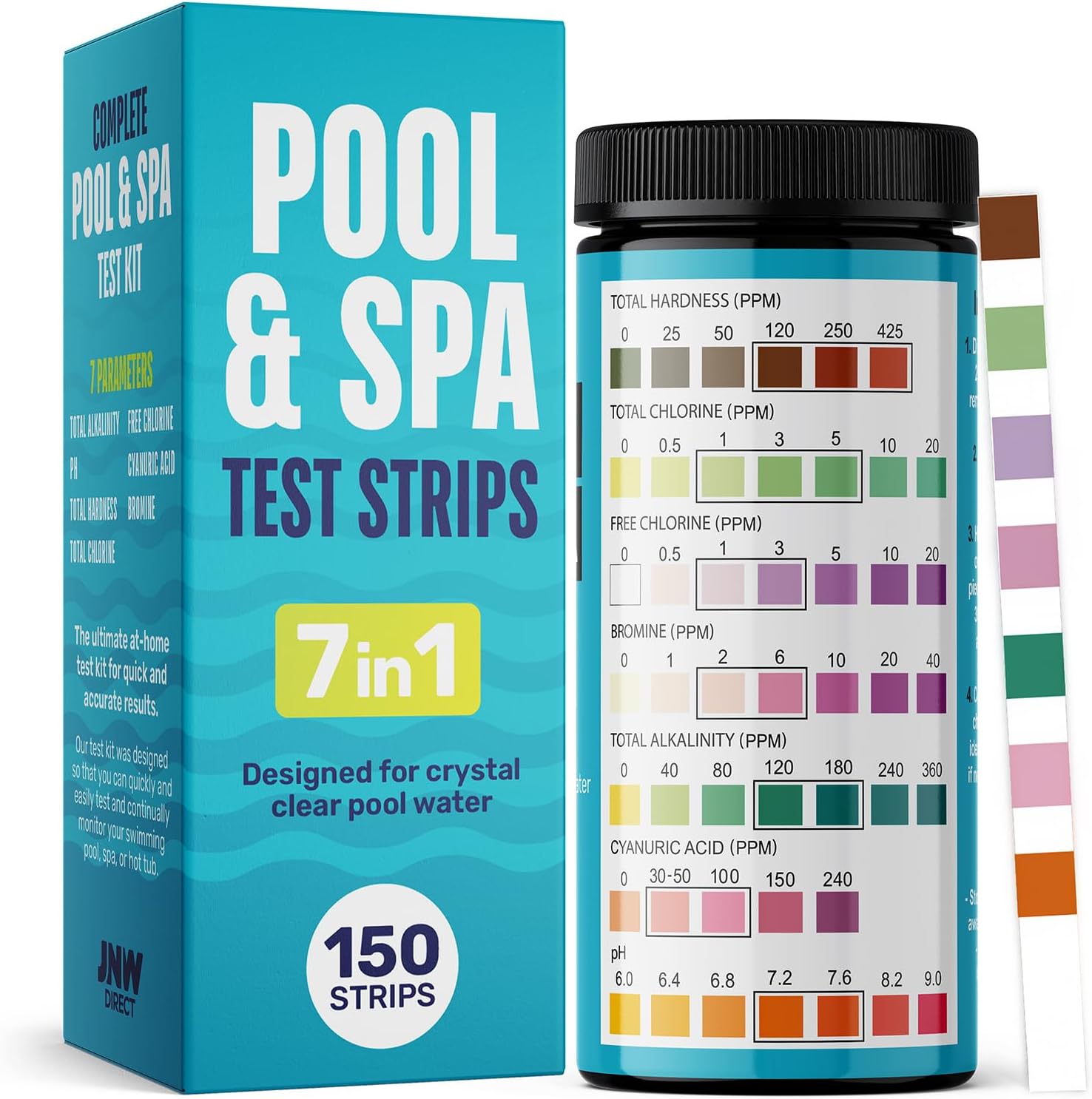
6-Way Hot Tub Test Strips (100 Count)
Essential for both @ease and traditional chlorine users. Measures free chlorine, combined chlorine, pH, alkalinity, and calcium hardness in one dip.
View on Amazon →Pros and Cons: Complete Side-by-Side Assessment
Frog @ease Pros and Cons
✅ Pros
- Dramatically simpler weekly routine
- Lower chlorine level means gentler on skin and eyes
- SmartChlor is self-regulating — reduces overdosing risk
- Mineral component provides continuous passive sanitation
- Good visual indicator of cartridge depletion
- Compatible with ozone and UV systems
- Beginner-friendly with predictable cartridge replacement schedule
- Reduced odor in most user reports
❌ Cons
- Significantly higher annual cost than traditional chlorine
- Proprietary cartridges — availability depends on vendor
- Still requires shocking and pH/alkalinity management
- May underperform in high-bather-load scenarios
- Not suitable for use with bromine or saltwater systems
- Copper mineral buildup requires periodic water testing
- Does not eliminate the need for chemistry knowledge
- Floater takes up space in smaller inflatable tubs
Traditional Chlorine Pros and Cons
✅ Pros
- Lower annual cost — significant multi-year savings
- Available everywhere — no proprietary lock-in
- Works in any hot tub regardless of brand or type
- Complete user control over all chemistry parameters
- Responds dynamically to bather load increases
- Compatible with all supplemental systems
- Easy to over-dose to handle unusual contamination events
- Extensively documented — massive community knowledge base
❌ Cons
- More time-intensive weekly maintenance routine
- Higher chlorine levels can irritate sensitive skin and eyes
- Chloramine buildup causes odor if not shocked regularly
- Cyanuric acid accumulates with dichlor — needs monitoring
- More variables to track and adjust
- Chlorine levels fluctuate between dosing sessions
- Requires accurate measuring to avoid over/under dosing
- Less forgiving if testing is skipped for a week
Quick Decision Matrix
| Category | Frog @ease | Traditional Chlorine | Winner |
|---|---|---|---|
| Annual Cost | $321–$440 | $244–$365 | Chlorine |
| Weekly Time | ~20 minutes | ~32 minutes | @ease |
| Skin & Eye Comfort | High | Medium (if managed well) | @ease |
| Learning Curve | Gentle | Moderate | @ease |
| Water Quality | Excellent (when balanced) | Excellent (when managed) | Tie |
| Tub Compatibility | Most hot tubs | All hot tubs | Chlorine |
| Product Availability | Specialty/online | Universal | Chlorine |
| Odor Reduction | Noticeably better | Dependent on shocking | @ease |
| Heavy Use Performance | May need dial increase | Simply add more chlorine | Chlorine |
| Beginners | Recommended | Requires learning | @ease |
Who Should Choose Frog @ease — and Who Should Stick with Traditional Chlorine
Generic recommendations miss the point. The right answer depends entirely on your specific situation — your bather load, budget constraints, tolerance for chemistry learning, and how your skin reacts to chlorine.
Choose Frog @ease If…
- You are new to hot tub ownership and want the least stressful entry point into water chemistry
- Your skin or eyes are sensitive to high chlorine levels and you have noticed irritation with traditional programs
- You travel frequently or have an unpredictable schedule that makes daily or every-other-day testing unrealistic
- You primarily use the tub for personal relaxation — 2–4 people maximum, 3–5 times per week
- You have a household budget that can absorb $60–$100 of additional annual chemical cost in exchange for time and simplicity
- You are considering pairing a sanitation system with an ozone generator for maximum water quality with minimum chemicals
- You already own a compatible floater housing and find the cartridge replacement routine manageable
Choose Traditional Chlorine If…
- You already understand hot tub or pool chemistry and are comfortable with manual testing and dosing
- You have a larger family or frequently entertain — high bather loads demand the flexibility to quickly increase chlorine levels that traditional programs provide
- Annual chemical cost is a meaningful consideration for your budget
- You own multiple types of spas or frequently buy from different vendors and want chemical universality
- You use your tub seasonally or want to be able to source chemicals wherever you happen to be
- You prefer having complete, granular control over every aspect of your water chemistry
- You are already using bromine or are considering a saltwater conversion
Consider a Hybrid Approach
A middle path that experienced hot tub owners sometimes choose is running @ease as the primary system but keeping a supply of traditional dichlor granules on hand for shock dosing and for heavy-use periods. This approach gives you the convenience baseline of @ease with the flexibility fallback of manual chlorine addition when circumstances demand it. It does require understanding how the two interact (SmartChlor is chlorine-based, so adding traditional dichlor is chemistry-compatible, unlike adding bromine), but for confident users it can deliver the best of both approaches.
🏆 Overall Recommendation
For the majority of residential hot tub owners — people who bought a spa to relax, not to manage chemistry — Frog @ease is the better daily experience. The cost premium is real but reasonable. The time savings and skin comfort improvement are consistent across user reports.
For cost-conscious owners, chemistry enthusiasts, or anyone running a high-use tub, traditional chlorine offers unbeatable flexibility and savings. Its higher weekly time investment pays dividends in full system control.
Either system, when properly managed, produces safe, clean, enjoyable spa water. The choice is about lifestyle fit, not about one system being fundamentally safer than the other.
If you are still evaluating inflatable spa options in addition to sanitation systems, our guide to the best inflatable hot tubs by jet power, size, and build quality can help you choose a tub that pairs well with your preferred maintenance approach. For those specifically researching year-round use, our winter hot tub guide covers best inflatable hot tubs for winter insulation and heating power, where sanitation choices can affect how often you need to intervene in cold weather.

Leisure Time Renew Non-Chlorine Shock (MPS)
The preferred weekly shock for Frog @ease users and an excellent supplement to traditional chlorine programs. Destroys chloramines without raising chlorine levels.
View on Amazon →FAQs: Frog @ease vs Traditional Chlorine
Conclusion: Making the Right Call for Your Hot Tub Life
After breaking down the chemistry, the cost, the weekly routine, the water quality, and the user experience across both systems, the conclusion is not a simple “winner takes all” — it is a genuine recognition that these two approaches serve different types of hot tub owners equally well within their respective contexts.
Frog @ease is not magic. It does not eliminate chemistry. It does not mean you never think about your water again. What it genuinely delivers is a simplified weekly routine, a gentler water feel, and an approachable entry point for owners who want the relaxation benefits of a hot tub without becoming amateur chemists. For that audience, the additional $80–$100 per year is a reasonable exchange for the reduced mental overhead.
Traditional chlorine is not difficult once you learn it. The weekly routine becomes second nature for most owners within a month, and the comprehensive control it gives you over every aspect of your water chemistry is genuinely valuable when something goes wrong. The cost savings compound meaningfully over years of ownership, and the complete lack of proprietary lock-in is an underrated advantage for long-term owners.
Both approaches are safe when properly managed. Both require attention to pH, alkalinity, and calcium hardness. Both require shocking. The choice between them is ultimately a lifestyle decision, not a safety decision — which is the right framing for any water care comparison.
For further reading on related topics that will inform your overall hot tub water care strategy, consider our guides on how often to shock a hot tub, the complete overview of hot tub water chemistry, and if you are weighing broader system alternatives, the comparison of saltwater vs chlorine systems. Each of those resources connects to the same fundamental goal: water you can trust every time you step in.
Ready to Simplify Your Hot Tub Routine?
Whether you go with Frog @ease or stick with traditional chlorine, the right tools and knowledge make all the difference. Explore our complete collection of hot tub maintenance guides, water care resources, and product reviews.
Browse the Full Hot Tub Chemicals Guide →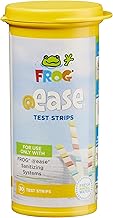
Frog @ease Complete Spa Care Bundle
Everything you need to start an @ease program: floater, SmartChlor cartridge, mineral cartridge, and MPS shock. One purchase, full system setup.
View on Amazon →