THE 5 BEST HOT TUB WATER TESTERS OF: A GUIDE TO CRYSTAL CLEAR WATER
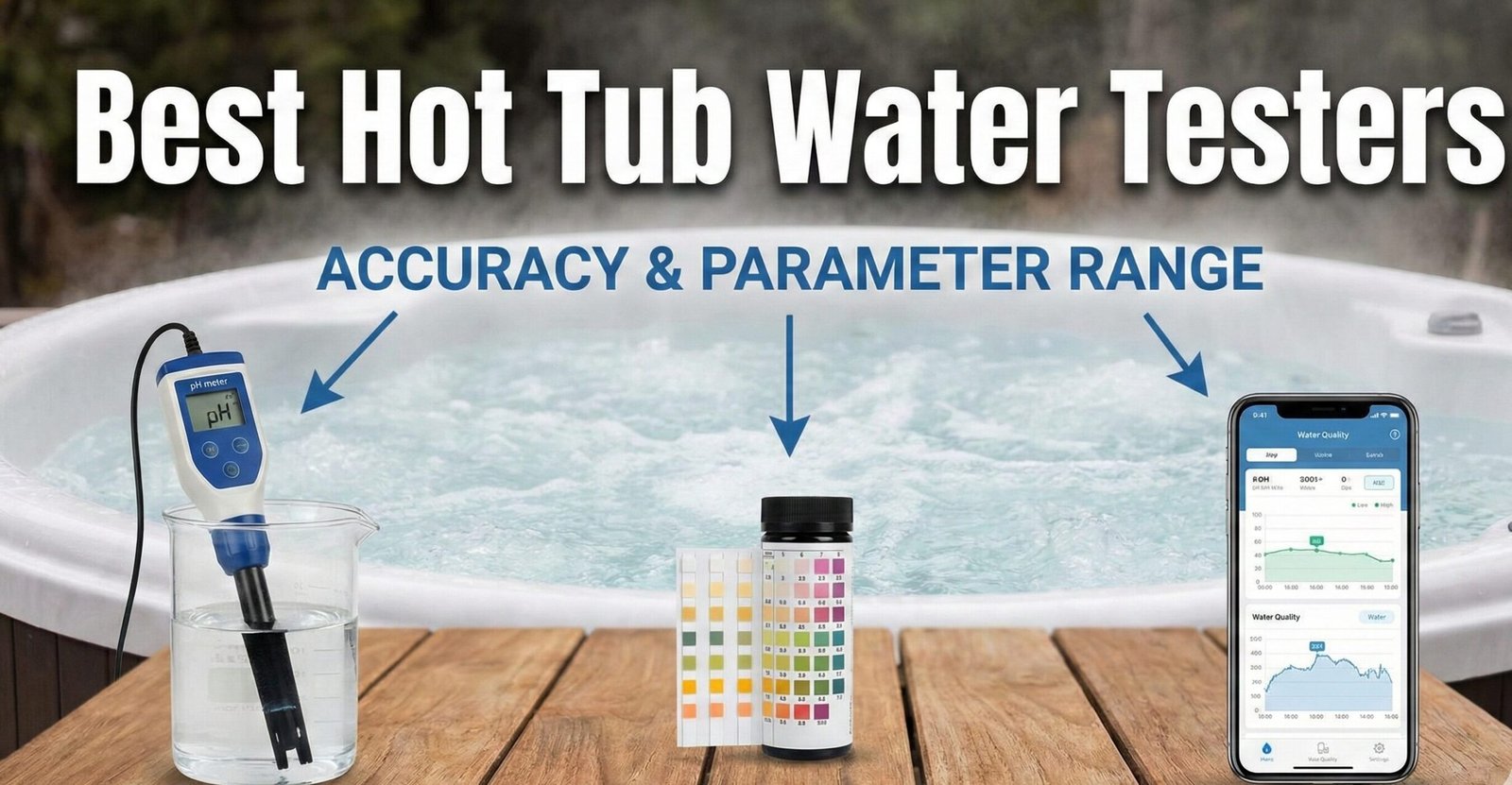
Accurate water testing is the most important part of a safe and enjoyable spa experience.
The perfect hot tub experience is a sensory delight: the warmth of the water, the soothing massage of the jets, the calming ambiance of your backyard. But the invisible foundation of that entire experience is your water chemistry. Clean, safe, and balanced water is non-negotiable. Get it right, and your spa is a haven of relaxation. Get it wrong, and you can face a host of frustrating problems: cloudy water, skin irritation, foul odors, and even damage to your hot tub’s components.
So, how do you ensure your water is perfect? You test it. A reliable hot tub water tester is the most critical tool in your maintenance toolkit—more important than vacuums, skimmers, or any other accessory. It’s your diagnostic dashboard, telling you exactly what your water needs to stay pristine. But the market can be confusing. Should you use simple test strips, a more complex liquid reagent kit, or a high-tech digital reader? Which one is the most accurate? Which is the easiest to use?
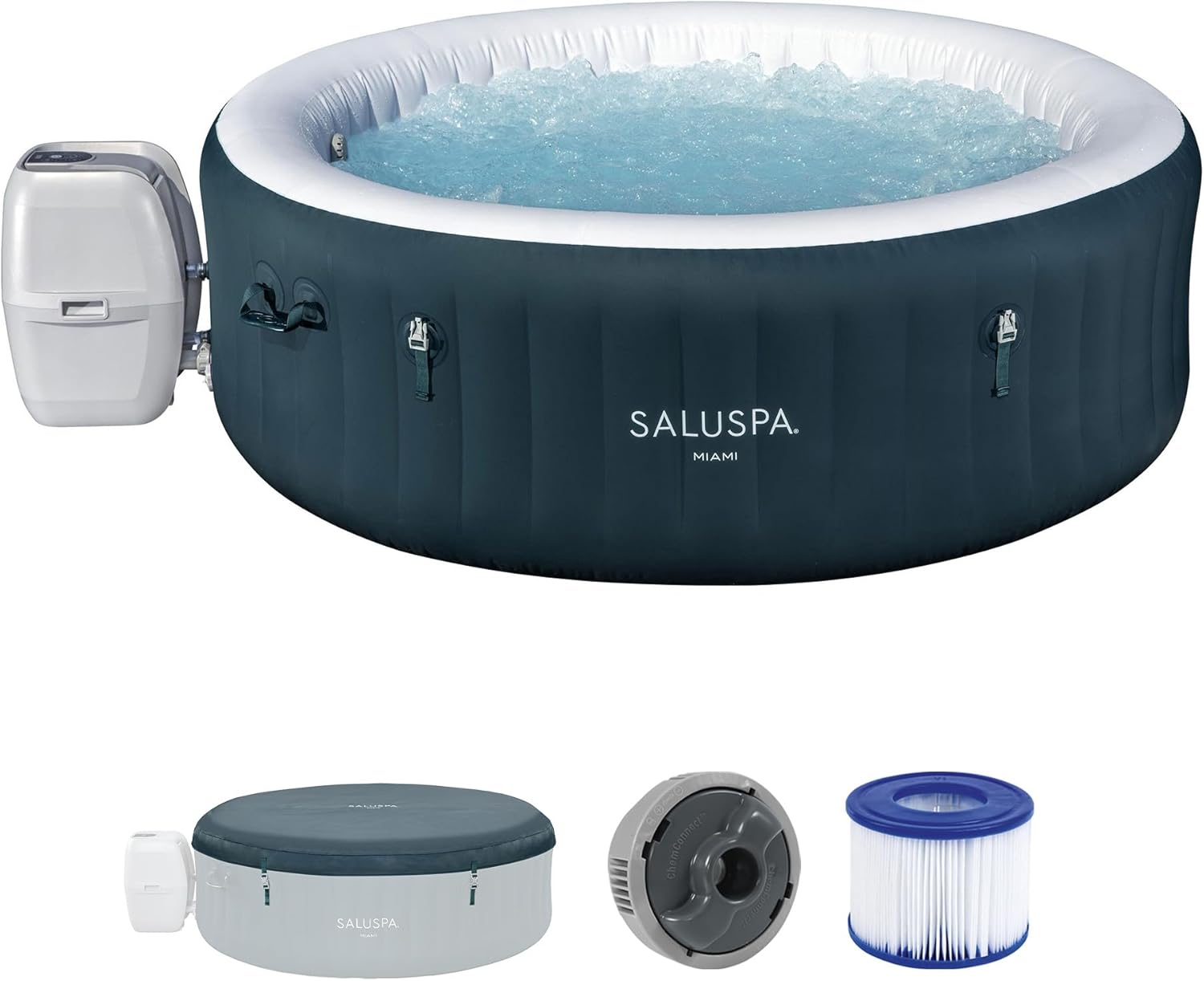
This is your definitive guide to mastering hot tub water chemistry. We will demystify the key parameters you need to measure, explore the pros and cons of each type of tester, and provide in-depth reviews of the 5 best and most reliable water testers available today. Beyond the core basics, we’ll also dig into advanced topics that most guides skip entirely: how testing changes for saltwater systems, why Total Dissolved Solids quietly determines when it’s time to drain your spa, how to interpret an ORP reading, and how to diagnose common symptoms like cloudy or foamy water using nothing but your test results. This knowledge is the bedrock of any solid inflatable hot tub maintenance program and is essential for owners of any spa, from a simple Bestway SaluSpa Miami to a high-end acrylic model.
WATER CHEMISTRY 101: WHAT ARE YOU ACTUALLY TESTING?
Before you choose a tester, you need to understand the vital signs of your spa’s water. A good test kit will measure these four critical parameters:
- Sanitizer (Chlorine or Bromine): This is the disinfectant that kills bacteria and viruses. You need to measure “Free Chlorine/Bromine,” which is the amount available to actively sanitize the water. The ideal range is typically 3-5 ppm (parts per million).
- pH: This measures how acidic or basic your water is on a scale of 0-14. The ideal range for a hot tub is 7.4 to 7.6. If the pH is too low (acidic), it can cause skin irritation and corrode your equipment. If it’s too high (basic), it can cause cloudy water and reduce the effectiveness of your sanitizer.
- Total Alkalinity (TA): This is a measure of your water’s ability to resist changes in pH. Think of it as a “buffer” for your pH. If your alkalinity is in the correct range (80-120 ppm), your pH will be stable and easy to control. If it’s too low, your pH will swing wildly.
- Calcium Hardness (CH): This measures the amount of dissolved calcium in your water. If the water is too “soft” (low calcium, typically below 150 ppm), it can become corrosive and damage surfaces and equipment. If it’s too “hard” (high calcium, above 250 ppm), it can lead to cloudy water and scale buildup on your heater and jets.
WHY BALANCED WATER MATTERS MORE FOR INFLATABLE AND PORTABLE SPAS
If you own an inflatable model like a Bestway SaluSpa or an Intex PureSpa, water testing isn’t just about comfort, it’s about protecting the equipment itself. Unlike a hard-shell acrylic spa, inflatable and portable spas rely on vinyl or PVC-based liners, seams, and integrated pumps that are considerably more sensitive to imbalanced water than a traditional plaster or acrylic surface. Low pH can accelerate degradation of vinyl seams over time, while consistently high calcium hardness can leave scale deposits inside the narrower internal plumbing and heating elements that inflatable models use, potentially restricting flow or reducing heating efficiency. Because these systems are also generally lower-volume than a built-in spa, chemical swings tend to happen faster and more dramatically, which makes frequent testing even more important rather than less.
Portable and inflatable spa owners should also pay particularly close attention to Total Dissolved Solids, since these smaller water volumes concentrate contaminants more quickly than a larger built-in unit. A full drain and refill, which is relatively painless with most inflatable models given their smaller total water capacity, is often the simplest and most cost-effective way to reset water quality before it becomes a bigger problem.
TYPES OF WATER TESTERS: STRIPS VS. LIQUID KITS VS. DIGITAL
There are three main technologies for testing your water, each with clear pros and cons.
- Test Strips: These are the most common, convenient, and affordable option. You dip a strip in the water, and colored pads react to the chemicals, which you then compare to a chart on the bottle. They are great for quick, daily checks.
- Liquid Reagent Kits (Titration Kits): These are the gold standard for accuracy. You take a water sample and add specific chemical drops (reagents) one at a time until the water changes color. The number of drops used tells you the precise chemical level. They are more complex and time-consuming but provide much more accurate readings than strips.
- Digital Testers: These electronic devices offer the best of both worlds: the accuracy of a liquid kit with the speed and ease of a test strip. You dip the sensor in the water, and it gives you a precise digital reading on an LCD screen. They are the most expensive option but are becoming increasingly popular for their accuracy and convenience.
STRIPS VS. LIQUID VS. DIGITAL: A SIDE-BY-SIDE COMPARISON
Reading the pros and cons in a list is helpful, but sometimes it’s easier to see the differences laid out side by side. The table below breaks down how each testing method stacks up across the factors that matter most to a hot tub owner: cost, speed, accuracy, and day-to-day convenience.
- Test Strips: Cost per test is roughly 20-40 cents. Result time is about 15 seconds. Accuracy is “range” based rather than exact. Best suited for a quick, daily glance at your water.
- Liquid Titration Kits: Cost per test is roughly 30-60 cents depending on reagent prices. Result time is 3-5 minutes per parameter. Accuracy is precise, down to a single ppm or less. Best suited for a weekly deep-dive and for troubleshooting stubborn problems.
- Digital Strip Readers: Cost per test is roughly 40-70 cents, factoring in proprietary strips. Result time is under a minute. Accuracy is consistent and removes color-matching bias. Best suited for owners who want objective numbers without learning titration.
- Digital Photometers: Cost per test is roughly 50-90 cents in reagents. Result time is 2-4 minutes. Accuracy rivals a professional laboratory. Best suited for owners who want laboratory-grade confidence at home.
Notice that none of these methods is objectively “best” for every situation. Many experienced owners actually own two testers: an inexpensive test strip for the 30-second pre-soak check, and a more precise liquid or digital tool for a deeper weekly review. This hybrid approach saves money on reagents while still catching subtle imbalances that strips alone might miss.
HOW TO GET AN ACCURATE READING FROM TEST STRIPS EVERY TIME
Test strips are simple, but a surprising number of owners get inaccurate results because of small technique errors. Follow these steps to make sure your strip readings are as reliable as possible.
- Sample from mid-depth, away from jets and returns. Testing water right next to a jet or a chemical dispenser gives you a reading of concentrated chemical, not your actual overall water balance. Dip the strip about elbow-deep, away from any equipment.
- Hold the strip, don’t stir it. Dip the strip in the water for exactly one second, moving it gently, then remove it. Swishing it around vigorously can wash the reagent pads before they’ve had a chance to react properly.
- Hold it flat and let gravity work. Immediately after removing the strip, hold it horizontally, pad-side up, for the time specified on the bottle. Holding it vertically lets colors run between pads, which can bleed one reading into another and skew adjacent results.
- Read it in natural light. Artificial lighting, especially warm-toned bulbs, can shift how colors appear. Read your strip in daylight or under a neutral white light for the truest color match.
- Compare immediately. Most pads continue to react and shift color after the recommended wait time. A reading taken 60 seconds late can look completely different from one taken at the correct interval. Time it with a phone timer if you tend to get distracted.
HOW TO GET AN ACCURATE READING FROM A LIQUID TITRATION KIT
Liquid kits reward careful technique with genuinely lab-grade precision, but sloppy habits can introduce just as much error as a cheap test strip. Keep these best practices in mind.
- Rinse the vial between every single test. Reagent residue left in the sample vial from a previous test can contaminate your next reading. Rinse thoroughly with tap water, and ideally with a small amount of the sample water itself, before filling it.
- Fill to the exact line. Titration math depends on a precise water volume. Even a few milliliters of variance can throw off your final ppm calculation, especially for tests that count drops.
- Hold the reagent bottle vertically and drop straight down. Tilting the bottle can change the drop size, which changes how many “drops” correspond to a given ppm level in the kit’s conversion chart.
- Swirl gently between drops, don’t shake. Vigorous shaking can introduce air bubbles that make the color change harder to see and can also cause reagent to splash out of the vial.
- Watch for the true endpoint color, not the first hint of it. Many titration tests ask you to count drops until the sample “just turns” a specific color and holds it for 30 seconds. Stopping the moment you see the faintest tint often undercounts your reading.
- Replace reagents annually. Liquid reagents, especially chlorine-based ones like DPD and FAS, degrade with heat, light, and age. Expired reagents are one of the most common reasons a liquid kit suddenly seems “less accurate” than it used to be.
TAYLOR K-2006 TEST KIT
The Gold Standard for Accuracy
WHY IT’S #1
If you ask any pool or spa professional what they use, the answer is almost always a Taylor kit. The K-2006 is the undisputed champion of residential water testing, offering professional-grade accuracy that test strips simply cannot match. It’s a liquid reagent kit that allows you to perform highly precise titration tests for Free and Total Chlorine (allowing you to calculate Combined Chlorine), pH (with an acid/base demand test), Total Alkalinity, and Calcium Hardness. The FAS-DPD test for chlorine is far more accurate than color-matching. While it has a learning curve, mastering this kit will turn you into a true water chemistry expert and give you the confidence that your water is perfectly balanced, not just “in the ballpark.”
- Type: Liquid Reagent Titration Kit
- Tests For: Free Chlorine, Total Chlorine, pH, Alkalinity, Calcium Hardness, Stabilizer
- Method: Titration (drop counting) & Color Matching
PROS
- Professional-grade accuracy
- Allows for precise chemical dosing
- Tests for a wide range of parameters
- Considered the industry benchmark
CONS
- Steeper learning curve than test strips
- Takes more time to perform tests
Testing Tip: The FAS-DPD titration in this kit uses two separate reagents to isolate Free Chlorine from Total Chlorine, which lets you calculate Combined Chlorine by subtraction. If you’re new to titration, practice on a sample you already know the approximate level of, like fresh tap water, before relying on it to make dosing decisions for your actual hot tub. Rinse the titration vial with a small splash of the sample water itself before filling it for the real test, since a plain tap-water rinse can leave trace chlorine behind that skews your very first reading of the day.
AQUACHEK 7-WAY TEST STRIPS
Best for Quick & Convenient Daily Checks
WHY IT’S A TOP PICK
For fast, easy, and frequent testing, nothing beats a quality test strip. AquaChek is one of the most trusted brands in the industry, and their 7-Way strips provide a comprehensive snapshot of your water’s health in about 15 seconds. You simply dip the strip, wait a moment, and compare the colored pads to the clear, easy-to-read chart on the bottle. They test for all the key parameters, including Total Hardness, Total Chlorine, Free Chlorine, pH, Total Alkalinity, and Stabilizer. While not as precise as a liquid kit, they are more than accurate enough for the routine checks needed to keep your water in its ideal ranges. They are an essential tool for any hot tub owner. For owners of popular models like the Coleman SaluSpa, these strips are the perfect daily driver.
- Type: Test Strips
- Tests For: Total Hardness, Total Chlorine, Free Chlorine, pH, Alkalinity, Stabilizer
- Method: Color Matching
PROS
- Extremely fast and easy to use
- Affordable and convenient
- Tests for a wide range of parameters
- Easy-to-read color chart
CONS
- Less accurate than liquid or digital kits
- Color interpretation can be subjective
Testing Tip: Because this strip includes a combined Free Chlorine/Bromine pad, it works whether you sanitize with chlorine or bromine, but remember that the ideal target ppm differs between the two sanitizers. Check the specific chlorine and bromine ranges printed on the bottle rather than assuming one number applies to both. Also keep the bottle away from the humid air directly above the water; a shelf inside a cabinet a few feet from the spa will keep the pads reading accurately far longer than storage on the tub’s built-in cup holder or cabinet lid.
AQUACHEK TRUTEST DIGITAL TEST STRIP READER
Eliminating Color-Matching Guesswork
WHY IT’S A TOP PICK
Do you struggle to tell the difference between “peach” and “salmon” on a test strip color chart? The AquaChek TruTest digital reader solves that problem. This clever device combines the convenience of a test strip with the objectivity of a digital reading. You simply dip one of their proprietary test strips, insert it into the reader, and it gives you a numerical readout for Free Chlorine/Bromine, pH, and Total Alkalinity. It eliminates the guesswork and subjective interpretation of color-matching, giving you more confident and consistent results. For anyone who finds traditional test strips frustrating, the TruTest is a game-changing upgrade.
- Type: Digital Test Strip Reader
- Tests For: Free Chlorine/Bromine, pH, Total Alkalinity
- Method: Digital Analysis of Test Strip
PROS
- Eliminates color-matching guesswork
- Provides fast, numerical results
- Easy to use: just dip and insert
- More affordable than full digital testers
CONS
- Requires proprietary AquaChek test strips
- Does not test for Calcium Hardness
Testing Tip: Keep the reader’s optical window clean, since body oils and mineral film from your hands or the strip itself can build up on the sensor and gradually shift readings even when nothing else has changed. A quick wipe with a soft, dry cloth after each use, and an occasional cleaning with isopropyl alcohol, keeps the unit reading as accurately on day 300 as it did on day one. Because this device doesn’t test Calcium Hardness, pair it with a monthly hardness check using a simple test strip or liquid drop test to keep your full water profile covered.
LAMOTTE COLORQ PRO 7 DIGITAL TESTER
Ultimate Digital Accuracy
WHY IT’S A TOP PICK
For the data-driven hot tub owner who wants the best of the best, the LaMotte ColorQ Pro 7 is the answer. This is a photometer-style digital tester that uses liquid reagents but eliminates the need for color-matching by eye. You add reagents to a water sample, which causes a color change, and then insert the vial into the meter. The meter reads the color with a light sensor and provides a precise, numerical result on the digital display. It combines the accuracy of a liquid kit with the definitive results of a digital reader. It tests for Free Chlorine, Total Chlorine, Bromine, pH, Alkalinity, and Calcium Hardness. It’s a significant investment, but for those who demand precision, it’s the ultimate tool.
- Type: Digital Photometer
- Tests For: FC, TC, Bromine, pH, TA, CH
- Method: Liquid Reagents with Digital Reading
PROS
- As accurate as a professional kit
- Clear, unambiguous digital results
- Removes all human error from color matching
- Comes in a rugged, organized case
CONS
- Very high upfront cost
- Still requires handling liquid reagents
Testing Tip: Because this unit reads reacted reagent color through an optical sensor rather than by eye, always wipe the outside of the sample vial with a lint-free cloth before inserting it into the meter. Fingerprints, water droplets, or a stray bubble on the glass can all scatter the light path and produce an inaccurate reading even when your titration or reagent addition was performed perfectly. This is also one of the few consumer-level testers accurate enough to double-check a professional pool store’s water analysis if you ever want a second opinion on a confusing result.
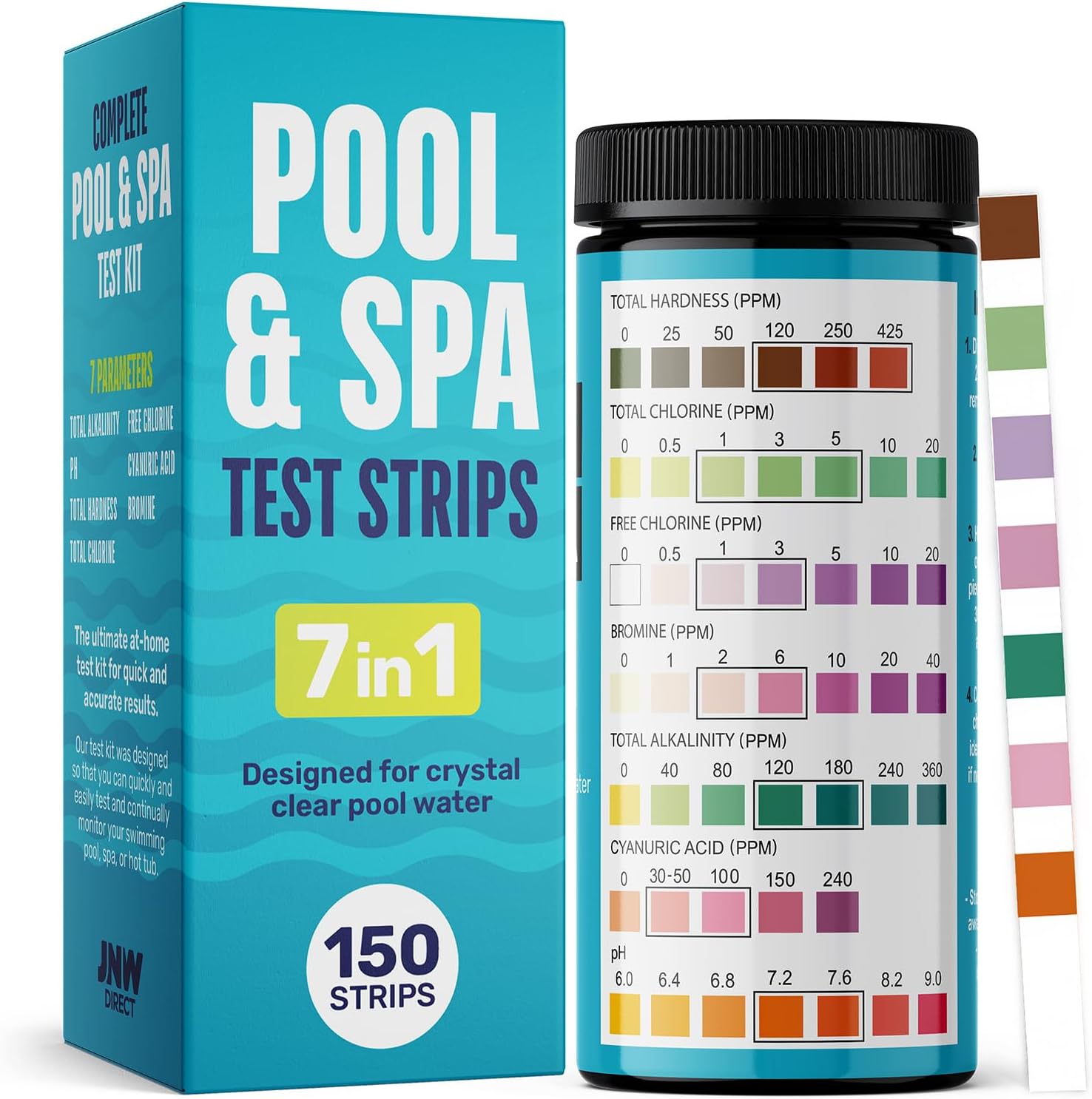
JNW DIRECT 9-IN-1 TEST STRIPS
Most Comprehensive Test Strips
WHY IT’S A TOP PICK
While the AquaChek 7-Way is a fantastic standard, some hot tub owners want even more data. The JNW Direct 9-in-1 strips offer the most comprehensive snapshot available in a single strip. In addition to the standard tests, they also measure for Copper and Iron, which can be useful for diagnosing water source issues or staining problems. The bottle features a durable, water-resistant label with large, clear color blocks, making comparison easier. The company also provides a free mobile app that helps you track your results and offers chemical dosing advice. For the data-hungry owner who loves the convenience of strips, this is an excellent and highly-rated choice.
- Type: Test Strips
- Tests For: Free/Total Chlorine, Bromine, pH, TA, CH, Stabilizer, Copper, Iron
- Method: Color Matching
PROS
- Tests for a very wide range of parameters
- Includes tests for metals like copper and iron
- Comes with a helpful companion app
- Large, clear color chart on the bottle
CONS
- More data can be overwhelming for beginners
- Like all strips, less accurate than liquid kits
Testing Tip: Save the copper and iron pads for troubleshooting rather than routine weekly checks; you don’t need to monitor metals on a regular basis unless you’re on well water or have noticed discoloration. If a metals test does come back positive, resist the urge to shock the water right away, since shocking can sometimes oxidize dissolved metals and cause them to precipitate out as visible staining rather than removing them. Add a sequestering agent first, then retest before deciding on next steps.
TESTING FOR BROMINE VS. CHLORINE: WHAT ACTUALLY CHANGES
Not every hot tub owner sanitizes with chlorine. Bromine is a popular alternative, especially for people with sensitive skin, because it tends to feel gentler and produces less of the sharp, “chemical” odor associated with chlorine. If you use bromine, your testing routine needs a few adjustments.
WHY BROMINE READS DIFFERENTLY THAN CHLORINE
Bromine and chlorine are both halogens and both work as sanitizers, but they behave differently in water. Chlorine forms chloramines when it reacts with contaminants like sweat, oils, and urea; these chloramines are what cause the strong “chlorine smell” and eye irritation, and they have little remaining sanitizing power. Bromine, on the other hand, forms bromamines when it reacts with the same contaminants, and bromamines retain a meaningful amount of their sanitizing ability. This is one reason bromine users don’t need to shock their water as aggressively or as often as chlorine users, and it’s also why a “Total Bromine” reading is generally considered more useful on its own than parsing out combined versus free the way chlorine users must.
Because of this, most test strips and liquid kits designed for dual use will have a single bromine scale that reads higher numbers than the equivalent chlorine scale. A reading of 4-6 ppm for bromine covers roughly the same sanitizing power as 3-5 ppm for chlorine. If you switch sanitizers, don’t assume your old target numbers carry over directly. Check your tester’s packaging, since most kits list separate ideal ranges for chlorine and bromine on the same color chart.
CAN YOU USE A CHLORINE TEST STRIP FOR A BROMINE HOT TUB?
Many test strips, including several of the ones reviewed above, include a combined “Free Chlorine/Bromine” pad specifically so one strip works for either sanitizer. However, dedicated bromine test strips and reagent tests exist too, and they’re worth seeking out if you notice your dual-purpose strip’s bromine readings seem inconsistent. The DPD reagent used in many liquid kits also reacts to both chlorine and bromine, which is why a single FAS-DPD titration test in a kit like the Taylor K-2006 can be used for either sanitizer with the appropriate multiplier applied to the drop count.
SALTWATER HOT TUBS: HOW TESTING IS DIFFERENT
Saltwater systems have grown in popularity because they promise softer water and less handling of harsh chemicals. It’s important to understand, though, that a saltwater hot tub is still a chlorinated hot tub. The salt cell uses electrolysis to convert dissolved salt into chlorine, so you still need to test and maintain a proper sanitizer level, pH, alkalinity, and calcium hardness exactly as you would in a traditionally chlorinated spa.
TESTING SALT LEVELS
The one truly new parameter for saltwater owners is the salt level itself, typically measured in parts per million. Most residential saltwater hot tub systems are designed to run somewhere in the 2,500 to 4,000 ppm range, though you should always confirm the exact target specified by your particular salt cell’s manufacturer, since generators are calibrated to slightly different concentrations. Salt level test strips are widely available and work the same way as any other test strip: dip, wait, and compare to a color chart. Some owners prefer a dedicated digital salt meter, which measures the water’s electrical conductivity and displays a precise ppm reading rather than a color-matched range.
Salt itself does not evaporate the way water does, so levels tend to rise slowly over time through evaporation and concentrate further whenever you add more salt without accounting for what’s already dissolved. Test your salt level monthly, and always test before adding more salt rather than assuming a “top-up” is needed. Overshooting the target range can make the water feel unpleasantly briny and can accelerate wear on the electrolytic cell.
WHY SANITIZER TESTING STILL MATTERS
It’s a common misconception that a salt system eliminates the need to test for chlorine because “the system handles it automatically.” In reality, the salt cell only generates chlorine; it doesn’t guarantee that the amount produced matches your bather load or water temperature on any given day. Warmer water and heavier use both burn through sanitizer faster, and a salt cell running on a fixed timer can fall behind during a busy weekend. Test free chlorine at least as often as you would in a traditional setup, and keep an eye on your cell’s indicator lights, since most units will flag a “low salt” condition before it becomes a sanitizing problem.
ORP: THE ADVANCED METRIC SALTWATER OWNERS SHOULD KNOW
Oxidation-Reduction Potential, or ORP, is a measurement of your water’s actual sanitizing power, expressed in millivolts, rather than a simple ppm count of chlorine or bromine present. Some higher-end saltwater systems and standalone controllers include an ORP sensor because it more directly reflects how effectively the water is killing pathogens, accounting for factors like pH and temperature that a basic ppm reading doesn’t capture. A healthy hot tub typically reads in the 650-750 mV range on an ORP meter. If you own a system with a built-in ORP controller, use it alongside, not instead of, a manual chlorine test strip or liquid test, since ORP probes require periodic calibration and can drift out of accuracy over months of use.
TOTAL DISSOLVED SOLIDS (TDS): THE PARAMETER MOST OWNERS IGNORE
Free chlorine, pH, alkalinity, and calcium hardness get most of the attention in water testing conversations, but there’s a fifth parameter that quietly determines how long your water will stay easy to maintain: Total Dissolved Solids, or TDS. Every time you add a chemical, every time a bather enters the water, and every time water evaporates and concentrates what’s left behind, your TDS level climbs a little higher.
WHAT TDS ACTUALLY MEASURES
TDS is a catch-all measurement of everything dissolved in your water that isn’t water itself: minerals, salts, metals, and organic byproducts from lotions, sweat, and sanitizer reactions. It’s usually measured with a small handheld digital TDS meter that reads the water’s electrical conductivity, since dissolved ions conduct electricity and pure water does not. Unlike pH or alkalinity, there’s no chemical you can add to lower TDS. The only fix is dilution: draining some or all of your water and replacing it with fresh fill water.
WHY A SMALL HOT TUB HITS ITS TDS LIMIT FASTER THAN A POOL
Because a hot tub holds a relatively small volume of water compared to a swimming pool, and because that water is used just as intensively (or more) by the same number of bathers, TDS builds up far more quickly in a spa than it would in a backyard pool. Two people soaking in a 400-gallon hot tub contribute a similar sanitizer demand to roughly two hundred people in a large residential pool. This is one of the key reasons hot tub water needs to be fully drained and refreshed every few months, even when every other chemical parameter tests within range.
WHEN TO TEST AND WHEN TO DRAIN
Test your TDS when you first fill your hot tub with fresh water to establish a baseline reading, since tap water itself already contains some dissolved solids. From that point on, check TDS monthly. As a general guideline, once your TDS reading climbs roughly 1,500 ppm above your baseline fill-water reading, it’s time to drain and refill, regardless of how your other test results look. Persistent cloudiness, a hot tub that seems to “eat” sanitizer faster than it should, or foam that won’t go away even after using a defoamer product are all practical warning signs that your TDS has likely crept too high, even before you check the meter.
METALS, PHOSPHATES, AND STABILIZER: THE ADVANCED PARAMETERS
Once you’ve mastered the core four parameters, a handful of secondary readings can help you diagnose more unusual water problems. These aren’t things you need to test every week, but knowing when and why to check them can save you a lot of frustration.
COPPER AND IRON
Dissolved metals, most commonly copper and iron, typically enter hot tub water through a fill source like well water, through corroding heater elements, or through certain algaecides. Metals are the usual culprit behind water that turns green, brown, or rust-colored even when your sanitizer and pH are both within range. A test strip with a dedicated metals pad, like the JNW Direct 9-in-1 strips reviewed above, can quickly confirm whether metals are the source of a discoloration problem. If metals test positive, a sequestering agent added to the water can bind the metal ions and keep them suspended so they don’t stain surfaces or cloud the water, though the underlying source of the metal contamination should still be identified and addressed.
CYANURIC ACID (STABILIZER)
Cyanuric acid, often just called “stabilizer” or “conditioner,” is a chemical used in some pool products to slow down how quickly UV light breaks down chlorine. It’s extremely useful outdoors in sunlit swimming pools, but it plays a much smaller role for most hot tubs, which are frequently covered and see far less direct sun exposure. The U.S. Centers for Disease Control and Prevention specifically advises against using cyanuric acid or chlorine products that contain it in hot tubs, noting that stabilizer can build up in a small volume of water and suppress chlorine’s ability to kill germs effectively. If your test kit includes a stabilizer pad, use it mainly to confirm that levels haven’t crept up from dichlor or trichlor-based sanitizing tablets, which do contain cyanuric acid, rather than as a routine parameter you’re actively trying to raise.
PHOSPHATES
Phosphates enter hot tub water from sources like fertilizer runoff in fill water, certain cleaning products, and even some bather care products. On their own, phosphates aren’t dangerous, but they act as a food source for algae, and they’ve also been shown to interfere with how efficiently chlorine sanitizes water. A dedicated phosphate test kit, sold separately from most standard chlorine and pH kits, can confirm whether phosphates are contributing to a persistent algae or cloudiness problem that doesn’t respond to shocking. If phosphate levels test high, a phosphate remover product can bring them down without requiring a full drain and refill.
HOW OFTEN TO TEST: A BATHER-LOAD BASED SCHEDULE
“How often should I test?” doesn’t have a single universal answer, because a hot tub used daily by a family of four burns through sanitizer at a dramatically different rate than one used occasionally by a single person. Instead of memorizing a fixed schedule, it helps to think in terms of bather load and adjust accordingly.
- Light use (occasional soaks, 1-2 people, a few times per week): A quick test strip check before each use, plus one more thorough liquid or digital test each week, is generally sufficient.
- Moderate use (daily soaks, 1-2 people): Test with a strip before every soak. Sanitizer can deplete meaningfully overnight even without heavy use, so a same-day check matters more than it might seem.
- Heavy use (multiple people daily, or frequent guests): Test before and after each use. A hot tub with several bathers can see free chlorine drop by more than half in a single 20-minute soak, so a “before” reading tells you if you’re starting in a safe range, and an “after” reading tells you how much your usage pattern actually depletes sanitizer, which helps you fine-tune your dosing.
- After a party or unusually high bather load: Test immediately afterward and again the next morning. Heavy bather loads introduce a spike of organic contaminants that can overwhelm your normal sanitizer routine, and many experienced owners choose to fully drain and refill after a particularly large gathering rather than trying to chemically recover the water.
Regardless of usage level, weekly testing for Total Alkalinity and Calcium Hardness is a reasonable baseline for nearly every owner, since these two parameters shift more slowly than sanitizer and pH.
TESTING AROUND SHOCK TREATMENTS AND AFTER A REFILL
Two specific moments call for testing outside your normal routine: right after shocking your water, and right after a full drain and refill.
AFTER SHOCKING
Shock treatments, whether chlorine-based or a non-chlorine oxidizer, are designed to rapidly raise your sanitizer level to break down chloramines, bromamines, and organic contaminants that have built up in the water. Wait at least 15-20 minutes after adding shock before testing, since the reaction needs time to complete and a test taken immediately can give an artificially high or unstable reading. Chlorine-based shock in particular can temporarily push your reading well above the normal 3-5 ppm target range, which is expected; wait for it to settle back down, generally within a few hours, before allowing bathers back in the water. Always follow your product’s specific label instructions for the recommended wait time before re-entry, since this varies by shock formulation.
AFTER A FRESH FILL
New fill water is rarely perfectly balanced straight out of the tap. Municipal water supplies vary widely in their starting pH, alkalinity, and calcium hardness, and well water in particular can carry elevated metals or hardness levels. Test your water within the first hour of filling, before adding any sanitizer, so you have an accurate baseline to work from. This is also the ideal moment to record your starting TDS reading, which becomes your reference point for deciding when a future drain and refill is due.
TROUBLESHOOTING: WHY YOUR TEST RESULTS DON’T MATCH REALITY
Every hot tub owner eventually runs into a moment where the water looks or smells wrong, but the test results say everything is fine, or vice versa. A few common culprits are almost always to blame.
EXPIRED OR HEAT-DAMAGED REAGENTS
Test strips and liquid reagents are chemically active products with a genuine shelf life, typically one to two years unopened and considerably shorter once the bottle has been opened repeatedly. Heat is the biggest enemy: a bottle of strips or reagents left in a hot garage, a car, or even too close to the hot tub itself can degrade far faster than the printed expiration date would suggest. If your readings suddenly seem inconsistent with the visible condition of your water, expired product is the first thing to rule out.
WATER TEMPERATURE EFFECTS
Hot tub water is, by definition, warmer than a swimming pool, and some reagents react slightly differently at higher temperatures. Most test kit manufacturers calibrate their color charts assuming a sample somewhere close to room temperature. If possible, let a small sample cool for a couple of minutes before testing rather than testing water straight out of a 102°F tub, especially for pH and total alkalinity readings, which can be more temperature-sensitive than a basic chlorine test.
COLOR PERCEPTION AND LIGHTING
A meaningful percentage of the population has some degree of color vision deficiency, which can make comparing subtle shades on a test strip chart genuinely difficult. If you or a family member routinely struggles to distinguish between adjacent colors on a chart, a digital reader like the AquaChek TruTest, which removes color interpretation from the process entirely, is a worthwhile upgrade rather than a luxury.
CLOUDY OR DISCOLORED SAMPLES
Very cloudy water can make it difficult to read a color-matching test accurately, since the cloudiness itself can wash out or muddy the true color of a reacted pad or reagent. If you’re testing cloudy water to diagnose the cause of the cloudiness, be aware that your sanitizer or pH reading may be somewhat less reliable than usual, and consider re-testing once the water has cleared to confirm your results.
DIGITAL SENSOR FOULING
Digital testers and photometers rely on a clean optical path or a clean probe surface to deliver accurate readings. Body oils, lotions, and mineral buildup can coat a sensor over time and throw off results even when the device itself is functioning correctly. Refer to your specific unit’s manual for cleaning instructions, but a gentle rinse with clean water after each use, and an occasional deeper clean with isopropyl alcohol on a soft cloth, will keep most digital sensors reading accurately for years.
CARING FOR YOUR TESTER: STORAGE, SHELF LIFE, AND CALIBRATION
A water tester is only as good as its upkeep. A few simple habits will keep any of the testers reviewed above delivering trustworthy results for as long as possible.
- Keep the cap on tight, always. Test strip bottles are designed to be airtight when sealed. Humidity is the number one enemy of test strips, and even a few seconds with the cap off in a steamy spa area can introduce enough moisture to degrade the pads over weeks of repeated exposure.
- Store in a cool, dry, dark place. A cabinet inside the house, away from the hot tub itself, is almost always a better storage spot than a poolside cabinet or an outdoor storage bin, both of which see far greater temperature and humidity swings.
- Don’t touch the test pads with your fingers. Oils from your skin can contaminate a test strip’s reactive pads before you’ve even dipped it in the water.
- Replace liquid reagents on a schedule, not just when they run low. Because reagents degrade with age regardless of how much remains in the bottle, mark your calendar to replace a liquid kit’s core reagents annually, even if you haven’t used the full bottle.
- Calibrate digital meters per the manufacturer’s schedule. Digital pH meters, ORP probes, and TDS meters generally need periodic calibration against a known reference solution to stay accurate. Check your specific device’s manual, since calibration intervals range from monthly to a few times a year depending on the sensor technology used.
GLOSSARY: KEY WATER CHEMISTRY TERMS EXPLAINED
- Free Chlorine (FC): The portion of chlorine in your water that is still available to actively sanitize.
- Combined Chlorine (CC): Chlorine that has already reacted with contaminants, forming chloramines. It has little remaining sanitizing power and is largely responsible for chlorine odor.
- Total Chlorine (TC): The sum of Free Chlorine and Combined Chlorine. Subtracting FC from TC gives you your CC reading.
- Bromamines: The bromine equivalent of chloramines, formed when bromine reacts with contaminants, but retaining more sanitizing power than chloramines do.
- Total Alkalinity (TA): The water’s buffering capacity, which keeps pH stable and resistant to sudden swings.
- Calcium Hardness (CH): The concentration of dissolved calcium, which affects both corrosion (too low) and scale formation (too high).
- Total Dissolved Solids (TDS): A measurement of everything dissolved in the water that isn’t water itself, used to determine when a full drain and refill is needed.
- ORP (Oxidation-Reduction Potential): A millivolt measurement of your water’s actual sanitizing strength, factoring in more variables than a simple ppm reading.
- Cyanuric Acid (Stabilizer/Conditioner): A chemical that slows chlorine breakdown from UV light; generally discouraged in hot tubs per CDC guidance.
- Sequestering Agent: A product that binds dissolved metals so they stay suspended in the water rather than staining surfaces.
- Titration: A testing method that counts drops of a reagent added until a color change occurs, used to calculate a precise chemical concentration.
CHOOSING THE RIGHT TESTER FOR YOUR HOT TUB LIFESTYLE
With five excellent options reviewed above, it can still be hard to know which one is right for your specific situation. Rather than chasing the “best” tester in the abstract, match the tool to how you actually use and maintain your spa.
THE OCCASIONAL SOAKER
If you use your hot tub a few times a week and want the least fuss possible, a quality test strip like the AquaChek 7-Way is genuinely all you need. Pair it with a monthly liquid or digital check just to catch anything strips might understate, such as calcium hardness drifting slowly upward.
THE DAILY USER OR FAMILY WITH KIDS
Frequent use means frequent testing, and frequent testing means the speed of a strip becomes valuable. However, because heavier bather loads make precise dosing more important, consider stepping up to the AquaChek TruTest digital reader so that daily numbers are consistent and easy to track over time, rather than relying on a slightly different subjective color read every single day.
THE DIY WATER CHEMISTRY ENTHUSIAST
Some owners genuinely enjoy the process of dialing in perfect water chemistry the way a hobbyist enjoys tuning an engine. If that’s you, the Taylor K-2006 rewards the time investment with a level of precision and understanding that no strip or digital reader can fully replicate, especially once you’re comfortable calculating Combined Chlorine and running an acid demand test.
THE OWNER WHO WANTS “SET IT AND FORGET IT” CONFIDENCE
If cost isn’t the primary concern and you simply want the most trustworthy numbers with the least room for user error, the LaMotte ColorQ Pro 7 removes nearly every source of human inconsistency from the testing process, at a correspondingly higher price point.
THE OWNER TROUBLESHOOTING A PERSISTENT PROBLEM
If your water keeps turning colors, smelling off, or clouding up despite what look like normal core readings, the JNW Direct 9-in-1 strips (or a dedicated metals and phosphate test) can surface a secondary parameter, like copper, iron, or stabilizer buildup, that a basic 4-way or 5-way strip would never reveal.
DIAGNOSING COMMON WATER PROBLEMS WITH YOUR TEST RESULTS
Your test results are most useful when you know how to translate a specific symptom into the parameter most likely responsible. Here are some of the most common hot tub water complaints and where to look first.
CLOUDY WATER
Cloudiness is one of the most frequent complaints and has several possible causes. High pH or high total alkalinity can cause mineral particles to fall out of solution and cloud the water. Low sanitizer levels can allow organic material and bacteria to accumulate. Elevated TDS can leave the water simply “saturated” and unable to hold everything dissolved in it clearly. A poor filtration cycle, a dirty filter cartridge, or high calcium hardness scaling onto surfaces can all contribute as well. Start by testing pH, alkalinity, and free chlorine; if all three are within range, check TDS and consider whether your filter needs a cleaning or replacement.
FOAMY WATER
Foam is almost always caused by surfactants, meaning soap, lotion, shampoo residue, or certain low-quality chemical products, agitating in the water as the jets run. Foam is not a chemistry imbalance in the traditional sense, so a chemical test likely won’t show an obvious culprit. However, persistently high TDS makes foam worse and harder to clear, so if foam keeps returning even after using a defoamer product and asking bathers to rinse off before soaking, checking your TDS level is a reasonable next step.
STRONG CHEMICAL ODOR
Counterintuitively, a strong “chlorine smell” usually indicates too little free chlorine relative to combined chlorine, not too much. The smell comes from chloramines, the exhausted byproduct of chlorine that has already reacted with contaminants. Test both Free Chlorine and Total Chlorine; if Total Chlorine is significantly higher than Free Chlorine, shock the water to break down the chloramines rather than assuming you need to remove chlorine.
SKIN OR EYE IRRITATION
Irritation is most commonly linked to pH that’s out of range in either direction, or to elevated chloramines from insufficient shocking. Low pH is acidic and can irritate skin and eyes directly, while high pH reduces chlorine’s effectiveness, allowing contaminants and chloramines to build up. Test pH first, then check Total Chlorine versus Free Chlorine as described above.
SCALE BUILDUP ON SURFACES OR THE HEATER
White, chalky deposits on your hot tub’s shell, jets, or heater element point toward high calcium hardness, often combined with high pH or high total alkalinity. Test all three; if calcium hardness is significantly above 250 ppm, a partial drain and refill with softer fill water, alongside a calcium reducer product, is usually the most effective fix.
GREEN, BROWN, OR RUST-COLORED WATER
Colored water is the classic signature of dissolved metals, most often copper or iron, reacting with oxidizers in the water. Test specifically for metals using a strip or kit with a dedicated metals pad, and consider whether a recent change in fill water source, a new algaecide, or heater corrosion could be the introduction point.
SEASONAL WATER TESTING: SUMMER VS. WINTER CONSIDERATIONS
Water chemistry doesn’t behave identically year-round. Ambient temperature, usage patterns, and even the angle of sunlight your spa receives all shift with the seasons, and your testing routine should shift with them.
SUMMER TESTING CONSIDERATIONS
Warmer ambient temperatures accelerate chlorine and bromine breakdown, meaning sanitizer can deplete faster even without a change in bather load. Summer is also when hot tubs tend to see the heaviest use, from weekend guests to kids home from school, all of which increases organic contaminant load. Test more frequently in summer, ideally before and after each use, and keep a closer eye on TDS, since heavier bather traffic accelerates its buildup. If your spa sits outdoors uncovered for stretches of time in direct sun, also watch pH more closely, since evaporation concentrates the water’s existing minerals more quickly in hot weather.
WINTER TESTING CONSIDERATIONS
Cold weather generally slows chemical reactions, which can mean sanitizer lasts a bit longer between doses, but it introduces its own challenges. Test strips and liquid reagents stored in an unheated garage or shed can be damaged by freezing temperatures just as easily as by excessive heat; bring your testing supplies indoors during cold snaps. A tightly closed cover during winter months also means less fresh air exchange over the water’s surface, which can allow chloramine odors to become more noticeable even at chlorine levels that would seem fine in warmer weather with the cover open more often. If you live somewhere with hard freezes, testing before and after any period the tub was left unused for an extended stretch is a smart habit, since stagnant water balance can shift more than you’d expect.
TRANSITIONAL SEASON TIPS
Spring and fall often bring the most dramatic bather-load swings, from opening up the spa for the first backyard gathering of the year to winding down before winter. Treat these transition points like a mini “fresh fill” check: test thoroughly, including TDS and calcium hardness, and consider whether it’s a good time for a full drain and refill if you haven’t done one recently, rather than trying to chemically patch water that’s been sitting through a full season of use.
pH VS. TOTAL ALKALINITY: WHY THEY’RE OFTEN CONFUSED
Of all the parameters covered in this guide, pH and Total Alkalinity cause the most confusion, largely because they’re closely related but measure genuinely different things.
pH measures how acidic or basic your water is right now, on a scale of 0 to 14, with 7.4 to 7.6 considered ideal for a hot tub. Total Alkalinity measures your water’s resistance to changes in pH, functioning like a buffer or shock absorber. Water with correct alkalinity but slightly off pH is easy to adjust with a small dose of pH increaser or decreaser. Water with incorrect alkalinity, on the other hand, will fight you: your pH reading might swing dramatically after adding chemicals, or drift right back to an unwanted level within a day or two, even after you’ve carefully dosed it into range.
This is why the correct order of operations, covered in more detail below, always addresses alkalinity before pH. Trying to fine-tune pH in water with alkalinity that’s too low is a bit like trying to balance a scale that keeps tipping on its own; you’ll chase the number indefinitely without ever landing on a stable result. Once alkalinity sits correctly in the 80-120 ppm range, pH adjustments become smaller, more predictable, and far more likely to hold.
BEYOND TESTING: THE ART OF BALANCING YOUR WATER
Testing is just the first step; acting on the results is what matters. A consistent testing routine, as part of your overall inflatable hot tub maintenance plan, allows you to make small, frequent adjustments rather than large, drastic ones.
WHAT WATER TESTING REALLY COSTS OVER A YEAR
Sticker price isn’t the whole story when comparing testers, since ongoing consumable costs vary a lot between methods. A bottle of 50 test strips typically costs somewhere in the $10-15 range, which works out to roughly 20-30 cents per test if you’re testing daily. An owner testing twice a day during peak summer months might go through two or three bottles a year. Liquid reagent refills for a kit like the Taylor K-2006 run a bit higher per test once you factor in the chlorine, pH, alkalinity, and hardness reagents together, but a single refill kit often lasts a full season of weekly deep-dive testing. Proprietary strips for a digital reader like the AquaChek TruTest typically cost somewhat more per strip than generic test strips, since you’re paying for strips engineered to be read consistently by the device’s optical sensor. Photometer reagents for something like the LaMotte ColorQ Pro 7 are the priciest per-test option, but for owners who test less frequently and prioritize precision over volume, the annual cost can still be entirely reasonable.
When you add up the true cost of ownership, most owners find that a hybrid approach, an inexpensive strip for frequent daily checks and a more precise liquid or digital method reserved for weekly deep-dives, delivers the best balance of accuracy and ongoing expense.
TESTING ACCESSORIES WORTH HAVING
A few inexpensive extras can make your testing routine faster and more consistent, regardless of which tester you choose.
- A dedicated sample cup: Testing directly from the tub with a strip is fine for quick checks, but a clean, dedicated plastic cup for pulling a sample makes liquid titration tests far easier to perform accurately, and keeps you from having to lean awkwardly over the water.
- A floating or handheld thermometer: Since temperature affects both how quickly chemicals react and how your reagents are calibrated to read, knowing your water temperature at the time of testing helps you interpret borderline results more confidently.
- A simple log, whether paper or an app: Recording your test results over time, even in a basic notebook kept near the spa, makes it far easier to spot slow trends, like calcium hardness creeping upward or TDS approaching your drain-and-refill threshold, that a single reading in isolation wouldn’t reveal.
- A magnifying glass or reading light for strip comparisons: If you test in the evening or in a dimly lit spa area, a small flashlight or magnifier can make subtle color differences between adjacent pads much easier to distinguish accurately.
THE ORDER OF OPERATIONS
When you get your test results, it’s important to adjust your chemicals in the right order for the best results.
- Adjust Total Alkalinity First: Your alkalinity is the foundation. If it’s out of range, you will never be able to get a stable pH reading. Adjust TA into the 80-120 ppm range first and let the water circulate for a few hours.
- Adjust pH Second: Once your TA is stable, adjust your pH into the 7.4-7.6 range. Because your TA is correct, the pH should now be much more stable and require smaller amounts of chemicals.
- Adjust Sanitizer Last: With the water balanced, you can now add your chlorine or bromine. The sanitizer will work much more effectively in water with the proper pH, meaning you’ll use less of it over time.
This simple process is the key to avoiding the endless cycle of “chasing” your numbers and is a core principle in our guide on how to clean an inflatable hot tub, as clean water is balanced water.
QUICK REFERENCE: IDEAL RANGE CHEAT SHEET
Bookmark this section for a fast reference the next time you’re standing over your hot tub with a wet test strip in hand, unsure whether a number is high, low, or right where it should be.
- Free Chlorine: 3-5 ppm
- Bromine: 4-6 ppm
- pH: 7.4-7.6
- Total Alkalinity: 80-120 ppm
- Calcium Hardness: 150-250 ppm (acrylic/vinyl shells); higher for plaster surfaces
- Cyanuric Acid (Stabilizer): Generally not recommended for hot tub use per CDC guidance
- Salt (saltwater systems only): 2,500-4,000 ppm, confirm exact target with your generator’s manufacturer
- ORP: 650-750 mV
- TDS: Drain and refill once levels rise roughly 1,500 ppm above your fill water’s baseline reading
- Phosphates: As low as practically achievable; treat with a phosphate remover if algae or cloudiness persists despite balanced chemistry
Keep in mind that these are general starting points rather than absolute rules. Your specific hot tub manufacturer, shell material, and sanitizer system may recommend slightly different targets, so always defer to your owner’s manual or your tester’s printed instructions when the two disagree.
FREQUENTLY ASKED QUESTIONS (FAQ)
HOW OFTEN SHOULD I TEST MY HOT TUB WATER?
You should perform a quick test with a test strip at least 2-3 times per week, and ideally before each use. A more thorough test with a liquid kit should be done at least once a week to verify your numbers and check for things like Calcium Hardness.
MY TEST STRIPS ARE GIVING WEIRD READINGS, WHAT’S WRONG?
The most common cause of inaccurate test strip readings is old or improperly stored strips. Test strips can be damaged by moisture and humidity. Always keep the bottle cap on tightly and store them in a cool, dry place. If your bottle is more than a year old, it’s a good idea to replace it. This is a common issue we cover in our Intex PureSpa troubleshooting guide.
IS A LIQUID TEST KIT REALLY THAT MUCH BETTER THAN STRIPS?
Yes, for accuracy, a good liquid kit is significantly better. Test strips are great for indicating if you are in the right “range,” but a liquid titration kit can tell you that your alkalinity is exactly 90 ppm, not just “somewhere between 80 and 120.” This precision allows for more accurate chemical additions, saving you money and preventing problems like cloudy water. Many owners use strips for daily checks and a liquid kit for a weekly “true-up.”
CAN I USE POOL TEST STRIPS FOR MY HOT TUB?
Technically, many pool and spa test strips use the same reagent chemistry, so a “pool” strip can sometimes read the correct chemical levels in a hot tub. However, dedicated hot tub or spa-labeled testers are formulated and color-calibrated for the higher temperatures and generally higher sanitizer ranges used in a spa, and they often include tests, like a combined chlorine/bromine pad, that are more relevant to hot tub owners. It’s best to use a product specifically labeled for hot tub or spa use whenever possible.
DO I NEED TO TEST FOR SALT IF I DON’T HAVE A SALTWATER SYSTEM?
No. Salt testing is only relevant if your hot tub uses a salt chlorine generator to produce sanitizer through electrolysis. If you add chlorine or bromine directly, whether as granules, tablets, or liquid, there’s no need to monitor a salt level, since salt isn’t part of your sanitizing process.
WHY DOES MY DIGITAL TESTER GIVE A DIFFERENT READING THAN MY TEST STRIPS?
Small discrepancies between a digital tester and a test strip are normal and expected, since the two methods use different underlying chemistry and different precision levels. Test strips report a range through color matching, while most digital testers and photometers report an exact number. If the discrepancy is large, check that your digital sensor is clean, that your test strips aren’t expired, and that you’re following the correct wait time for each method before comparing results.
WHAT’S THE DIFFERENCE BETWEEN SHOCKING AND SANITIZING?
Sanitizing refers to maintaining a steady, ongoing level of chlorine or bromine to continuously kill bacteria as your hot tub is used. Shocking is a periodic, larger dose of oxidizer used to rapidly break down the buildup of chloramines, bromamines, and organic waste that accumulates between full sanitizer applications. Think of sanitizing as daily maintenance and shocking as a deeper, occasional reset.
SHOULD I TEST MY TAP WATER BEFORE FILLING MY HOT TUB?
Yes, this is a step many owners skip. Testing your fill water for pH, alkalinity, calcium hardness, and TDS before you add any chemicals gives you an accurate starting point and can flag issues, like naturally hard well water or elevated metals, before they turn into a bigger problem once the tub is running and heated.
CAN OLD OR EXPIRED TEST STRIPS MAKE ME THINK MY WATER IS SAFE WHEN IT ISN’T?
Yes, and this is one of the more concerning failure modes of an expired tester. Degraded reagent pads can sometimes show a “false normal” reading, suggesting your sanitizer level is adequate when it has actually dropped. Because of this risk, it’s worth replacing test strips and liquid reagents on a routine schedule rather than waiting until you notice a problem.
WHAT’S A NORMAL ORP READING FOR A HOT TUB?
Most water care professionals consider a healthy hot tub to read somewhere between 650 and 750 millivolts on an ORP meter, though the exact target can vary slightly depending on your specific sanitizer and pH. ORP is most useful as a supplement to, not a replacement for, a direct ppm chlorine or bromine test, since it’s a broader measure of overall sanitizing strength rather than a specific chemical concentration.
HOW LONG AFTER SHOCKING CAN I GET BACK IN THE HOT TUB?
This depends on the specific shock product you used, so always check the label first. As a general rule of thumb, non-chlorine shock often allows re-entry in as little as 15-20 minutes, while chlorine-based shock may require several hours for levels to drop back into the normal range. Testing your free chlorine level before getting back in, rather than relying on the clock alone, is the most reliable way to confirm it’s actually safe to soak.
DOES A HOT TUB COVER AFFECT MY TEST RESULTS?
An open cover allows some chlorine to off-gas into the air and can also let in debris, dust, and even sunlight that consumes sanitizer faster in spas without a UV-stabilized sanitizer. A tightly closed cover generally helps sanitizer levels hold steadier between tests. If you notice your chemical levels behaving differently after a change in how often you leave the cover open, that’s a normal and expected effect rather than a sign your tester is malfunctioning.
IS IT SAFE TO GUESS MY WATER CHEMISTRY WITHOUT TESTING?
No. Water can look perfectly clear and still carry unsafe bacteria levels if sanitizer has depleted below an effective range, and conversely, water can smell strongly of chemicals while actually being under-sanitized due to chloramine buildup. Visual and smell cues are useful early warning signs, but they are not a substitute for an actual test, especially before allowing children, pregnant individuals, or anyone with a compromised immune system into the water.
WHAT SHOULD I DO IF TWO DIFFERENT TESTERS GIVE ME CONFLICTING RESULTS?
First, rule out the obvious: confirm neither tester is expired, both samples were pulled from the same mid-depth location at roughly the same time, and you followed each product’s specific wait time and reading instructions exactly. If the discrepancy persists after ruling those out, trust the more precise method, generally a liquid titration kit or a digital photometer, over a color-matched test strip, since strips are inherently a range-based estimate rather than an exact figure. When in doubt, a professional water test from a local pool and spa store can serve as an independent tiebreaker.
WHEN TO GET A PROFESSIONAL WATER TEST
Home testing covers the vast majority of situations a hot tub owner will ever encounter, but there are a few scenarios where a trip to a local pool and spa store for a professional computerized water analysis is worth the extra step. If you’ve replaced your water entirely and still can’t get a stubborn cloudiness or persistent algae issue under control despite balanced core parameters, a professional test can check for less common variables, like phosphates or specific metals, using lab-grade equipment beyond what most home kits offer. Similarly, if you’re setting up a saltwater system for the very first time, having a professional confirm your baseline salt, calcium hardness, and TDS levels before you power on the cell can help you avoid damaging a brand-new electrolytic cell through improper startup chemistry. Most professional water test locations will test a sample you bring in for free or for a nominal fee, and many can also cross-check your home tester’s readings, giving you a useful sanity check on whether your test strips or reagents have started to drift out of accuracy.
That said, a professional test is a supplement to your home routine, not a substitute for it. Water chemistry changes daily, and a single professional analysis only captures a snapshot in time. The owners who enjoy the most trouble-free hot tub experience are consistently the ones who test at home regularly and use professional testing selectively, as a troubleshooting tool rather than a routine habit.
THE FINAL VERDICT: THE RIGHT TOOL FOR CLEAR WATER
Mastering your hot tub’s water chemistry is the most empowering skill an owner can learn, and it all starts with a reliable tester. For the ultimate in precision and control, the Taylor K-2006 Test Kit is the undisputed champion and a worthwhile investment for any serious spa owner. For daily convenience and ease of use, AquaChek 7-Way Test Strips are an affordable and reliable essential. For those who want to split the difference, the AquaChek TruTest offers a fantastic, guesswork-free digital solution. Owners managing a saltwater system, chasing down a stubborn metals or phosphate problem, or simply wanting laboratory-level confidence in every reading will find that the LaMotte ColorQ Pro 7 and JNW Direct 9-in-1 strips round out a testing toolkit capable of handling virtually any water chemistry situation a residential spa owner is likely to face.
By choosing the right testing method for your needs, understanding what each parameter actually tells you, and committing to a regular schedule that reflects how heavily you actually use your spa, you’ll be able to solve water problems before they start, protect your equipment and investment, and ensure your hot tub is always a crystal-clear, safe, and inviting sanctuary, season after season.