If you’ve spent any time shopping for backyard water features, you’ve probably noticed that “swim spa vs hot tub” sounds like a simple either-or question and then turns out to be anything but. One is a compact pod built almost entirely for heat and stillness. The other is a long, athletic tank that blurs the line between a lap pool and a spa. They share jets, they share warm water, and they share a spot on the patio — but the experience of owning one versus the other is genuinely different, and so is the bill.
This guide walks through the comparison the way an actual buyer would, starting with the basic definitions and working through space, cost, installation, health benefits, maintenance, energy use, climate performance, and resale value. By the end, you should have a clear sense of which option lines up with your yard, your routine, and your wallet — and a few practical next steps if a portable hot tub turns out to be the better entry point for you.
Quick Verdict: Swim Spa vs Hot Tub at a Glance
Before diving into the details, here’s a fast visual read on how the two options stack up across the factors that matter most to everyday owners. Longer bars mean “more” of that factor — more space needed, more cost, more value for that particular use case. These are general, typical comparisons; exact numbers vary by brand, model, and size.
In short: hot tubs win on cost, footprint, setup speed, and pure relaxation per dollar. Swim spas win on fitness value and dual-purpose use, but ask for more space, more budget, and more ongoing attention.
| Factor | Hot Tub | Swim Spa |
|---|---|---|
| Typical Footprint | 6–8 ft diameter | 12–20 ft long, 7–9 ft wide |
| Water Volume | Roughly 200–500 gallons | Roughly 2,000–6,000+ gallons |
| Primary Use | Soaking, hydrotherapy, socializing | Swimming current, resistance training, plus a spa zone |
| Electrical Needs | Often standard 120V plug-and-play, some 240V | Almost always dedicated 240V circuit |
| Setup Style | Inflate or place, fill, plug in | Pad or foundation, crane or specialized delivery, electrical hookup |
| Best For | Relaxation, recovery, small spaces, lower budgets | Year-round exercise, larger families, dual-purpose backyards |
What Is a Swim Spa? What Is a Hot Tub?
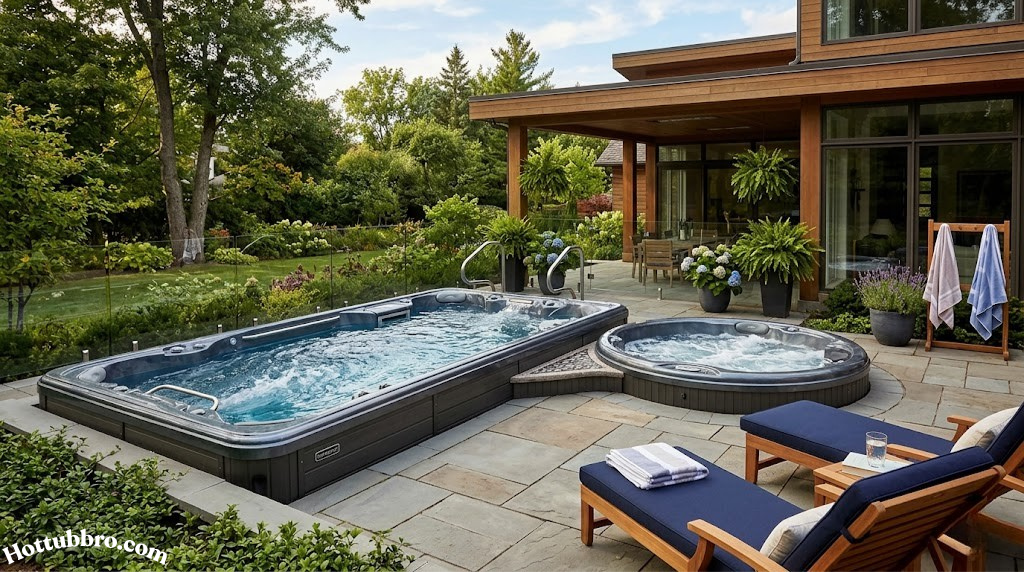
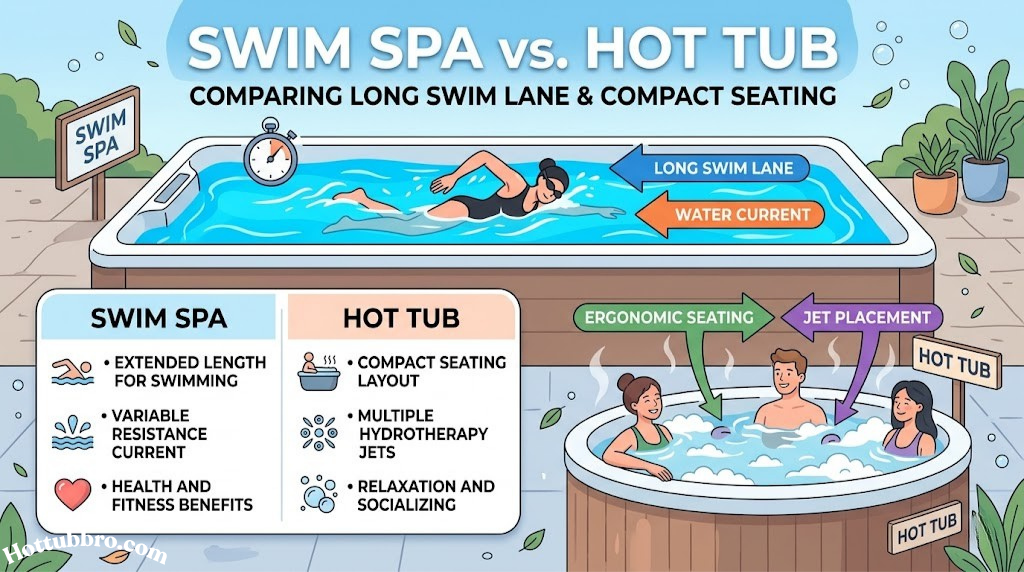
Both products live under the broad “spa” umbrella, but they’re designed around almost opposite goals. A hot tub is engineered to heat a relatively small volume of water to a high, steady temperature and hold a handful of people in a seated, jetted environment for soaking and hydrotherapy. A swim spa is engineered to move a much larger volume of water in a continuous current, creating resistance that a swimmer pushes against, while usually keeping a portion of that water cooler and more comfortable for sustained activity.
Think of a hot tub as a heated bowl. The jets are arranged around fixed seats, the pumps are sized to circulate and massage rather than propel, and the whole unit is built to be filled, heated once, and then maintained at that temperature for weeks. A swim spa, by contrast, is closer to a short, deep lap lane with a built-in current generator at one end. Many swim spas also include a separate seating area with hot tub-style jets, which is why people often describe them as “a pool and a hot tub in one shell.”
The construction differs too. Most hot tubs — especially portable and inflatable models — use lightweight acrylic, vinyl, or reinforced PVC shells with a smaller footprint that can sit on a deck, patio, or reinforced section of yard. Swim spas are almost always hard-shell acrylic or fiberglass units, built heavier and longer because they need to resist the structural stress of holding thousands of gallons of moving water. That structural difference is the root cause of nearly every other difference in this guide: cost, installation, energy use, and even how long each one lasts.
If you’re still getting a feel for what’s realistic at the more accessible end of the spectrum, it’s worth reading through how good inflatable hot tubs actually are in practice, since that’s the category most people compare against when they’re deciding whether a swim spa’s price tag is justified.
Hot Tub, In One Sentence
- A compact, heated soaking pod built for relaxation, hydrotherapy, and short social sessions.
- Smaller footprint, lower cost, faster setup, and simpler maintenance.
- Available in portable, inflatable, and hard-shell formats spanning a wide price range.
Swim Spa, In One Sentence
- A long, current-generating tank built for swimming, resistance exercise, and family pool-style use, often with a spa zone attached.
- Larger footprint, higher cost, longer installation, and more involved maintenance.
- Almost always hard-shell, with dedicated electrical and structural requirements.
Size & Space: How Much Room Do You Actually Need?
Space is usually the first thing that quietly rules one option out. A hot tub’s footprint is forgiving — most fit on an existing deck, patio slab, or even a reinforced corner of a balcony, since the unit itself is often only 6 to 8 feet across and a few feet tall. That makes a hot tub realistic for townhouses, smaller backyards, rooftop terraces, and rental properties where a permanent structure isn’t an option.
A swim spa is a different proposition entirely. Even the shorter models start around 12 feet long, and many run 16 to 20 feet, with a width of 7 to 9 feet. Add the clearance you’ll want for a step or platform on each end, plus room to walk around the equipment side for maintenance access, and you’re realistically looking at a dedicated zone of 20 feet by 12 feet or more. For many suburban lots, that’s the difference between “tucking it into a corner” and “this is now the defining feature of the backyard.”
Weight is the other half of the space question, and it’s easy to underestimate. A filled hot tub, even a larger one, typically weighs in the range of 2,000 to 4,000 pounds with water and occupants — heavy, but within what most decks and patios can handle, especially when the load is checked against joist spacing. A filled swim spa can weigh 10,000 to 20,000+ pounds. That’s not a “check the deck” conversation anymore; it’s a “talk to a structural engineer or excavator” conversation, particularly if you’re considering a basement, elevated deck, or sloped yard installation.
If a below-grade or indoor placement is on your mind for either option, it’s worth reviewing what’s actually involved before you fall in love with a specific spot — the guide on whether you can put a hot tub in a basement covers the structural checklist that applies in spirit to swim spas as well, just at a larger scale.
Hot Tub Space Realities
- Fits most decks, patios, and small yards without modification.
- Inflatable models can be set up and taken down seasonally.
- Weight is usually within range for standard residential structures.
Swim Spa Space Realities
- Needs a dedicated zone, often 20 ft x 12 ft including clearance.
- Almost always a permanent installation once placed.
- Weight typically requires a poured pad, gravel base, or engineered foundation.
Upfront Cost & Real Running Costs
Price is where the swim spa vs hot tub conversation usually gets decided, and it’s worth separating the sticker price from the cost of actually living with the thing for the next several years.
On the upfront side, hot tubs cover an enormous range. Inflatable and portable models sit at the accessible end, hard-shell entry-level units occupy the middle, and premium hard-shell hot tubs with full hydrotherapy jet packages sit at the top. Swim spas, by comparison, start where the upper end of the hot tub market leaves off and climb considerably higher, because you’re paying for a much larger shell, a more powerful current system, reinforced structure, and typically a more involved electrical setup.
Running costs follow the same pattern, but they’re easier to overlook because they don’t show up on a price tag. A hot tub’s smaller water volume means less energy to bring it up to temperature and less energy to maintain it, especially with a well-fitted cover. A swim spa’s heater is working against a much larger surface area and volume, and if you’re also running the current pump for exercise sessions, that adds meaningfully to the electric bill on top of heating.
| Cost Factor | Hot Tub | Swim Spa |
|---|---|---|
| Entry-Level Price Range | Budget-friendly, especially inflatable models | Significantly higher, even at the entry tier |
| Mid-to-High End | Moderate increase for hard-shell, multi-jet units | Steep increase for longer units with bigger current systems |
| Electricity (Heating) | Lower, due to smaller water volume | Higher, due to larger volume and surface area |
| Electricity (Exercise Use) | Not applicable | Additional draw when current pump runs for swimming |
| Chemicals & Water Care | Lower, smaller volume to balance | Higher, proportional to larger volume |
| Cover & Accessories | Lower cost, smaller surface area | Higher cost, custom-sized covers and lifters |
One practical way to approach this if you’re not ready to commit either way: start with a portable hot tub to get a real sense of how often you use warm water at all. The piece on whether inflatable hot tubs are worth it breaks down the value question at the lower end of the price spectrum, and it’s a useful gut check before scaling up to swim spa territory. Many of the most popular options in this category are reviewed in our roundup of the best inflatable hot tubs for jet power, size, and build quality.

Test the Hot Tub Side Before You Commit to a Swim Spa
A well-reviewed portable hot tub lets you experience daily warm-water soaking for a fraction of a swim spa’s cost — a smart first step if you’re undecided.
Check Current Price on AmazonInstallation, Site Prep & Permits
Installation is where the “it’s just a bigger hot tub” assumption usually falls apart. A portable or inflatable hot tub can often go from delivery box to filled and heating within a single afternoon: place it on a flat, stable surface, connect it to a standard outlet or, for some hard-shell models, a dedicated 240V circuit, fill it with a garden hose, and let the heater do its work. There’s a reason our step-by-step inflatable hot tub setup guide is a short read — the process genuinely is that straightforward for most models.
A swim spa installation is a project, not a setup. Because of the weight involved, almost every swim spa needs a level, reinforced pad — commonly a poured concrete slab, though gravel or composite pad systems are used in some cases. Delivery often requires a crane or specialized equipment to get the unit into position, especially if it has to clear a fence line or navigate a tight side yard. Electrically, swim spas virtually always need a dedicated 240V circuit sized for the heater and pumps, which usually means an electrician pulling new wiring from the panel.
Permits are the other variable, and they differ significantly between the two. Many portable and inflatable hot tubs fall under the radar of permitting requirements because they’re considered appliances rather than structures, though local fencing and safety codes around standing water can still apply regardless of size. Swim spas, because of their electrical load, foundation, and sometimes their classification as a pool-equivalent structure, are far more likely to require a permit. The guide on whether you need a permit to install a hot tub is a good starting point for understanding how local rules typically apply, and the same questions — electrical load, structural support, fencing — are simply asked at a larger scale for a swim spa.
If you’ve got your eye on a site that needs a stable base regardless of which option you choose, it’s worth getting that groundwork sorted early. For hot tubs specifically, the roundup of the best hot tub pads for inflatable spas covers options that protect decking and distribute weight evenly, which matters even for a “lightweight” footprint.
Hot Tub Installation
- Often same-day setup once the site is ready.
- Many models work with standard household power.
- Permits often not required, though local rules vary.
Swim Spa Installation
- Days to weeks, depending on site access and prep.
- Dedicated 240V electrical circuit almost always required.
- Permits more likely due to electrical, structural, and sometimes pool-code classification.
Health & Fitness: Hydrotherapy vs Swimming
Both products offer real wellness benefits, but they come from different mechanisms, and understanding that difference is useful for matching the right option to your actual health goals.
A hot tub’s primary mechanism is heat plus targeted water pressure. Warm water raises skin and muscle temperature, which can help relax tight muscles, ease joint stiffness, and support circulation in the soaked areas. Jets add a massage-like pressure that many people find effective for localized tension — shoulders, lower back, calves. This is the foundation of hydrotherapy, and it’s well covered in our piece on hot tubs and arthritis pain relief, which explains how heat and joint mobility interact.
A swim spa’s primary mechanism is resistance exercise in warm-to-moderate water. The current pushes against you as you swim, walk, or perform resistance movements, providing a cardiovascular workout with significantly less joint impact than running or land-based exercise. Many people use swim spas for low-impact rehabilitation, water walking, and aquatic resistance training, often year-round since the water is climate-controlled regardless of outdoor temperature. The exercise component is the genuine differentiator here — it’s simply not something a hot tub is built to provide.
Where the two overlap is recovery. Both a hot tub and a swim spa’s heated zone can play a role in post-exercise recovery, and the comparison of whether a hot tub is good after a workout for recovery and muscle relief applies equally to the spa side of a swim spa. The difference is that a swim spa lets you do the workout and the recovery in the same unit, while a hot tub is purely the recovery half of that equation.
It’s also worth being realistic about who should and shouldn’t be soaking in hot water regularly in the first place, regardless of which product you choose. The overview of who shouldn’t use a hot tub covers health conditions and situations where caution is warranted, and the same guidance applies to the heated zone of a swim spa.
Hot Tub Health Strengths
- Concentrated heat for muscle relaxation and joint stiffness.
- Targeted jet placement for localized tension relief.
- Quick, low-effort sessions fit easily into a daily routine.
Swim Spa Health Strengths
- Genuine cardiovascular and resistance exercise, low impact on joints.
- Climate-controlled swimming and water walking year-round.
- Combines a workout zone with a separate spa zone in one unit.

A Quality Cover Pays For Itself
Whether you land on a hot tub or eventually a swim spa, a well-insulated cover cuts heat loss dramatically between sessions — one of the cheapest upgrades for long-term running costs.
Browse Covers on AmazonRelaxation, Social Use & Daily Enjoyment
Cost and footprint tend to dominate the spreadsheet version of this decision, but the day-to-day experience is what actually determines whether you use the thing you bought. This is where the two products feel most different in practice.
A hot tub is built for stillness. You step in, the water is already at a high, consistent temperature, the jets are positioned for seated comfort, and the whole experience is designed around doing very little for twenty to thirty minutes. That simplicity is a feature, not a limitation — for evening wind-down, post-work decompression, or a quiet half hour after the kids are in bed, a hot tub’s small, enclosed, intensely warm environment is hard to beat. The question of how often you should use a hot tub and at what time of day is really a question about building that wind-down ritual into your week.
A swim spa’s relaxation mode is real, but it shares space with the swim lane, which changes the social dynamic. If part of the family wants to swim while others want to soak, a swim spa with a separate spa zone genuinely accommodates both at once — something a hot tub simply can’t do. On the other hand, if everyone wants the same thing at the same time (which, in practice, is usually “just relax”), a swim spa’s spa zone is typically smaller than a comparable hot tub’s seating area, so you may end up with less usable relaxation space than the overall size of the unit suggests.
There’s also a sensory difference worth mentioning: a swim spa’s current pump, even when not actively used for swimming, tends to be a more substantial piece of equipment than a hot tub’s circulation pump, and some users notice a more present hum or vibration. For a late-night soak where quiet matters, that’s a small but real consideration.
For many households, the honest answer is that a hot tub gets used more often simply because it requires less commitment per session — no setting up the current, no deciding whether tonight is a “swim night” or a “soak night.” It’s just on, it’s just ready, and that frictionless quality drives a lot of real-world usage frequency.
Water Chemistry & Maintenance Workload
The underlying chemistry is the same for both products — you’re managing sanitizer levels, pH, alkalinity, and filtration to keep water clear, balanced, and safe. What changes is the scale, and scale changes how much time and product each task takes.
A hot tub’s smaller water volume means test results swing faster in response to bather load and chemical additions, but the actual quantities involved — a capful of sanitizer here, a small adjustment to alkalinity there — stay manageable. Our general hot tub water chemistry guide and the more specific inflatable hot tub maintenance and filter cleaning guide cover the weekly rhythm most owners settle into: test, adjust, shock periodically, rinse or replace the filter on schedule.
A swim spa’s water volume means every one of those steps scales up proportionally. Shocking the water takes more product, balancing alkalinity after a rain event or heavy use takes more product, and the filtration system — while often more robust — has more surface area and debris to handle given the larger exposed water surface. The principles in our guide on how often to shock a hot tub apply directly, just with larger doses and, in many cases, a slightly more frequent schedule given the bigger surface area exposed to debris and sunlight.
One area where swim spas sometimes have an edge is sanitizer choice flexibility. Many swim spa owners look at saltwater versus chlorine systems because the larger water volume makes a salt system’s upfront cost easier to justify relative to the ongoing savings on chlorine purchases. For a hot tub’s smaller volume, the math on converting is less clear-cut, though it’s still done — the guide on how to convert a hot tub to saltwater walks through the process for those curious.
Filter maintenance is a recurring task for both, and it’s one that’s easy to neglect until water quality visibly suffers. The guide on how often to replace hot tub filters and the explainer on how hot tub filters work both apply to swim spas as well, with the caveat that a swim spa’s filter system is typically larger and may involve more than one filter cartridge or cassette.
| Maintenance Task | Hot Tub | Swim Spa |
|---|---|---|
| Water Testing Frequency | 2–3 times per week, typical | 2–3 times per week, typical, with more attention after heavy use |
| Chemical Quantities | Small doses, lower product cost | Larger doses scaled to volume, higher product cost |
| Filter Cleaning | Single cartridge, simple rinse cycle | Often multiple cartridges or larger filter system |
| Draining & Refilling | Faster, less water to heat back up | Slower, significant reheat time after a full refill |
| Sanitizer Flexibility | Saltwater conversion possible, less common | Saltwater systems more common given volume |
Cloudy or foamy water frustrates owners of both product types, and the underlying causes are usually the same regardless of size. If you’ve ever wondered why hot tub water gets cloudy or how to get rid of hot tub foam, those troubleshooting steps transfer directly to a swim spa’s water, just applied across a larger volume.

Skip The Guesswork On Water Balance
A reliable digital water tester takes the uncertainty out of weekly maintenance for either a hot tub or a swim spa, helping you catch imbalances before they become visible problems.
View Water Testers on AmazonEnergy Usage & Efficiency
Energy use is one of the clearest, most consistent gaps between the two products, and it comes down to basic physics: heating and maintaining the temperature of more water takes more energy, every time.
A hot tub’s heater cycles on periodically to maintain its set temperature, with most of its energy draw concentrated in the initial heat-up and in recovering temperature after the cover is removed for a session. The question of whether inflatable hot tubs use a lot of electricity comes up often, and the honest answer is “less than people fear, especially with a good cover,” because the water volume is small enough that even an inefficient setup doesn’t translate to a huge bill.
A swim spa’s heater is working against a much larger volume and a much larger surface area exposed to ambient air, which means more heat loss to fight against even when the unit is covered. On top of that, running the current pump for an exercise session draws meaningfully more power than a hot tub’s circulation pump ever does — swim spa current systems are sized to move large volumes of water with enough force to swim against, which is simply a bigger motor doing more work.
Amperage is a good proxy for understanding this difference at a glance. The explainer on how many amps a hot tub uses walks through typical draws for hot tub heaters and pumps; swim spas generally sit at the higher end of that range or beyond it, which is part of why a dedicated 240V circuit — often a higher-amperage circuit than many hot tub setups require — is standard for swim spas.
The good news is that efficiency improvements help both products, and proportionally they help a swim spa more in absolute dollar terms simply because there’s more to save. A well-fitted, well-maintained cover, a unit sited out of direct wind exposure, and keeping the set temperature reasonable rather than maximal are the three highest-impact, lowest-effort efficiency moves for either product.
Hot Tub Energy Profile
- Smaller volume means lower baseline heating cost.
- Many models run comfortably on standard household circuits.
- Cover efficiency has an outsized impact relative to overall cost.
Swim Spa Energy Profile
- Larger volume and surface area mean higher baseline heating cost.
- Current pump adds a separate, significant draw during exercise sessions.
- Dedicated higher-amperage circuit is standard, not optional.
Climate, Seasons & Winter Performance
How well each option handles a cold climate often ends up being the deciding factor for buyers in northern regions, and it’s an area where size cuts both ways.
A hot tub’s smaller volume heats and recovers temperature relatively quickly, which is genuinely useful in winter — if the cover is left open briefly or the heater has to catch up after a power blip, it doesn’t take long to get back to a comfortable soaking temperature. The roundup of the best inflatable hot tubs for winter, focused on insulation and heating power, highlights how much variation exists between models on this exact point, and the more general question of whether you can use an inflatable hot tub in winter comes down almost entirely to insulation quality and heater wattage relative to the climate.
A swim spa’s larger surface area means more exposed water fighting to lose heat to cold air, and its larger volume means that once temperature does drop, recovery takes proportionally longer. Well-built swim spas address this with thicker insulation, full-foam or vacuum-sealed cabinets, and more powerful heaters, but the underlying physics — more surface area, more heat loss — doesn’t go away. In genuinely cold climates, a swim spa’s heater may run close to continuously through winter just to hold temperature, which circles back directly to the energy cost discussion above.
For households comparing multiple 4-person-class hot tubs specifically for cold-weather use, the comparison of 4-person hot tub heating and insulation efficiency is a useful way to see how much insulation quality varies even within a single size category — and that variation matters even more once you’re talking about a swim spa’s much larger insulated surface.
If freezing temperatures are a real concern regardless of which option you choose, a cover isn’t optional — it’s the single biggest lever you have. The guide to the best hot tub covers for material, insulation, and durability applies the same selection criteria that matter for a swim spa cover, just scaled up in size and typically requiring a lifter mechanism given the larger, heavier cover involved.
| Cold-Climate Factor | Hot Tub | Swim Spa |
|---|---|---|
| Heat Recovery Speed | Faster, due to smaller volume | Slower, due to larger volume |
| Surface Heat Loss | Lower, smaller exposed surface | Higher, larger exposed surface |
| Insulation Importance | Important, but more forgiving | Critical, directly affects running cost |
| Winter Cover Handling | Manageable by hand for most models | Often requires a cover lifter due to size and weight |
Built For Year-Round Use, Including Cold Months
If winter performance is a priority and a swim spa’s footprint isn’t realistic right now, a well-insulated hot tub closes much of that gap for a fraction of the investment.
See Winter-Ready Hot TubsDurability, Lifespan & Resale Value
Lifespan expectations differ significantly depending on construction type, and this is one area where “swim spa vs hot tub” is really shorthand for “hard-shell vs portable,” since most swim spas are hard-shell by default while hot tubs span the full range.
Hard-shell hot tubs and swim spas, built with acrylic shells, foam or full-cabinet insulation, and commercial-grade components, are designed for long-term outdoor use and, with proper water care and periodic component servicing — pumps, heaters, jets — can remain functional well past a decade. The structure itself rarely fails first; it’s usually a component like a pump or heater element that eventually needs replacement, and those are serviceable rather than reasons to replace the whole unit.
Portable and inflatable hot tubs operate on a different timeline. Their materials — reinforced PVC or vinyl bladders, smaller pumps, simpler heaters — are built for value and convenience rather than decades of service. With careful use, proper storage during off-seasons, and prompt attention to small issues like finding and patching a leak before it grows, these units commonly deliver several years of regular use, which for many owners is exactly the right amount of commitment for the price.
Resale value follows a predictable pattern. Hard-shell units, including swim spas, tend to hold value reasonably well in local secondhand markets because buyers can inspect the shell, test the equipment, and trust that a functioning unit has years of life left — our used hot tub buying guide covers what to look for from the buyer’s side, and the same checklist applies to a used swim spa. Portable and inflatable hot tubs have a much thinner secondhand market; most owners simply use them until they’re no longer worth patching, then replace them, which is part of why their lower upfront cost makes sense as a “use it up” purchase rather than a long-term asset.
One more durability factor that’s easy to overlook: a hard-shell swim spa, once installed on its pad with electrical connections in place, is effectively part of the property. That permanence cuts both ways — it’s a long-term investment that can be a selling point for a home, but it’s also not something you can relocate if your circumstances change. A portable hot tub’s flexibility — the ability to move it, store it, or simply not replace it if your needs change — is a form of value in itself, even if it doesn’t show up on a depreciation schedule.
Hot Tub Lifespan Notes
- Hard-shell models: a decade or more with proper care.
- Portable/inflatable models: several years of regular use is typical.
- Flexible — can be relocated, stored seasonally, or simply not replaced.
Swim Spa Lifespan Notes
- Hard-shell construction built for long-term outdoor durability.
- Components are serviceable; the shell itself rarely fails first.
- Permanent installation — a long-term property feature, not a portable purchase.
Which One Fits Your Life? (Decision Guide)
By this point, the factual differences are clear — what’s left is matching those facts to your actual situation. Rather than asking “which is better,” it helps to ask a handful of more specific questions about how you’d actually use either one.
| If This Sounds Like You… | Lean Toward |
|---|---|
| You want a daily wind-down ritual, not a workout | Hot Tub |
| You have a smaller yard, deck, or patio with limited space | Hot Tub |
| You’re not ready for a permanent, high-cost backyard structure | Hot Tub |
| You want year-round, climate-controlled exercise at home | Swim Spa |
| You have a larger property with room for a dedicated zone | Swim Spa |
| You want one feature to serve both fitness and relaxation needs across the household | Swim Spa |
| You’re unsure how often you’ll actually use warm water at home | Hot Tub (start here, then reassess) |
That last row deserves a bit more attention, because it’s the situation a lot of readers are actually in. If you genuinely don’t know whether you and your household will use a backyard water feature three times a week or three times a season, a swim spa’s cost, space, and permanence make it a risky way to find out. A hot tub — particularly a portable one — lets you answer that question for a much smaller financial and structural commitment, and if the answer turns out to be “we use this constantly and wish we had more room to move,” that’s valuable information for a future swim spa decision.
It’s also worth thinking honestly about who’s going to be the primary user. If hydrotherapy and joint relief for one or two people is the main driver, the broader picture in are hot tubs healthy and the more specific look at negative effects of hot tubs related to heat and blood pressure can help set realistic expectations about session length and frequency — useful context regardless of which size unit you’re considering, since the heated-water guidance is identical for both.
Finally, don’t underestimate routine. A hot tub that’s three steps from the back door gets used. A swim spa that requires fifteen minutes of prep before a swim session, even if it’s objectively the “better” feature on paper, can end up underused if it doesn’t fit naturally into how your household already moves through an evening or weekend.
Top Picks & Smart Buying Tips
If the comparison above has you leaning toward the hot tub side — whether as a final decision or as a starting point before a future swim spa — a few practical buying tips will help you get more value from whichever model you choose.
Start by looking at jet count and pump power relative to the size of the unit, not just the headline numbers. Our review of the Lay-Z-Spa St Moritz and the breakdown of the Coleman SaluSpa’s build, durability, and value metrics both illustrate how jet placement and pump sizing affect the actual feel of a soak more than the raw jet count alone. If you’re torn between two popular value-tier models, the head-to-head Intex PureSpa vs Coleman SaluSpa comparison walks through the differences that matter most for everyday use.
Timing your purchase can also make a meaningful difference to price. The guide on the best time of year to buy a hot tub covers seasonal pricing patterns that apply whether you’re buying a portable model now or planning ahead for a swim spa down the road.
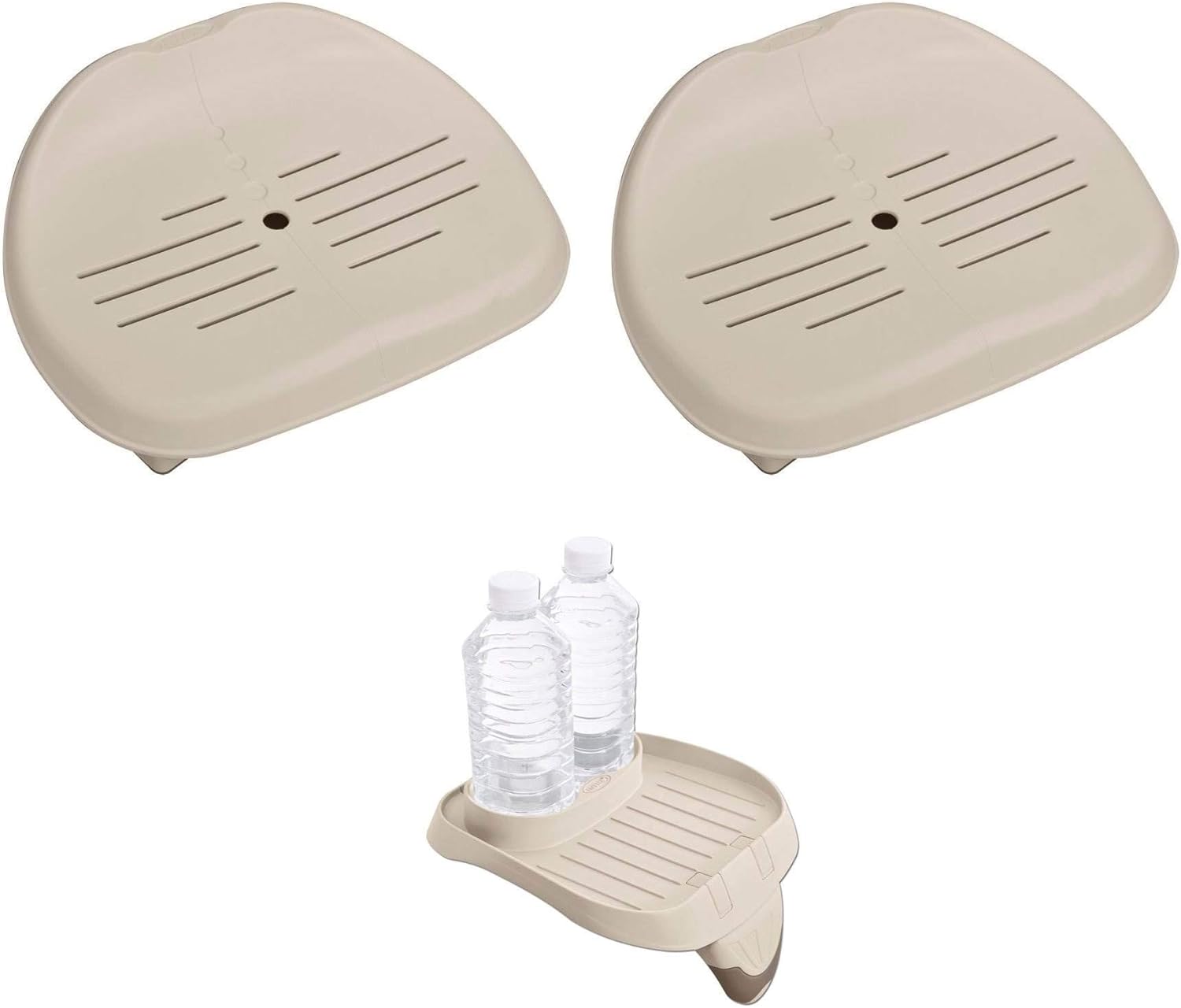
Once you’ve narrowed down a model, think about the accessories that turn “a hot tub sitting in the yard” into “a hot tub we actually use.” A stable pad protects decking and keeps the unit level, a properly fitted cover is the single biggest factor in running costs, and a reliable water tester removes the guesswork from weekly maintenance. If mobility matters — getting in and out comfortably, especially for older household members or anyone managing joint pain — the guide to choosing a hot tub booster seat by tub type and use case is worth a look, and it’s a far smaller investment than anything on the swim spa side of this comparison.
Whatever you choose, take maintenance seriously from week one. A unit that’s neglected early on develops the cloudy water, biofilm, and odor issues covered in our guide to biofilm in hot tubs far faster than one that’s kept on a consistent care routine from the start — and that’s true at any size, hot tub or swim spa.

A Well-Rounded Starting Point For Most Households
A solid value-tier portable hot tub gives you the relaxation and hydrotherapy benefits covered throughout this guide, with the flexibility to scale up later if a swim spa ends up making sense for your home.
Shop Top-Rated Hot TubsFrequently Asked Questions
Is a swim spa worth the extra money compared to a hot tub?
It depends on how you’ll use it. If daily fitness swimming, resistance training, and family pool-style play matter alongside warm-water relaxation, a swim spa’s extra cost buys a genuinely dual-purpose feature. If your priority is simply unwinding, soothing sore muscles, and soaking with family or friends, a hot tub delivers that experience for a fraction of the price, space, and running cost.
Can a swim spa double as a hot tub?
Most swim spas include a separate seating or “spa” zone with jets that can be heated to hot tub temperatures, so many models function as both a cooler swim lane and a warm soaking area. Heating the entire larger water volume to true hot tub temperatures can take longer and cost more than running a dedicated hot tub, so the experience is similar but not identical.
How much bigger is a swim spa than a hot tub?
A typical portable hot tub footprint runs roughly 6 to 8 feet in diameter, while a swim spa is usually 12 to 20 feet long and 7 to 9 feet wide. In practical terms, a swim spa needs two to four times the footprint of a hot tub, plus additional clearance for access, decking, and equipment.
Do swim spas cost more to run than hot tubs?
Generally, yes. Swim spas hold significantly more water, which means more energy to heat and maintain temperature, larger pumps for the swim current, and proportionally more chemicals to balance the water. Monthly running costs are typically higher than a hot tub, though the gap narrows with good insulation, a quality cover, and an efficient heat pump.
Can you actually swim laps in a swim spa, or is it just resistance?
Most swim spas use a continuous current generated by powerful jets or a paddlewheel, so you swim in place against moving water rather than swimming lengths back and forth like in a lap pool. This still provides a genuine cardiovascular and resistance workout, and current strength is usually adjustable to suit different fitness levels.
Which is easier to maintain, a swim spa or a hot tub?
A hot tub is easier and faster to maintain simply because there’s less water to test, balance, and treat, and a smaller surface area is exposed to debris. A swim spa’s larger volume means water testing, shocking, and filter cleaning take more time and slightly more product, though the underlying chemistry principles are identical for both.
Do I need a permit for a swim spa versus a hot tub?
Permit requirements vary by city and county, but swim spas are more likely to trigger electrical, plumbing, and sometimes structural permits because of their size, weight, and dedicated 240V electrical needs. Many portable plug-and-play hot tubs fall below the threshold that requires a permit, though local fencing and safety codes can still apply to either.
Can an inflatable hot tub work as a budget alternative to a swim spa?
An inflatable hot tub isn’t a substitute for the swimming and exercise function of a swim spa, but as a low-cost way to get warm-water relaxation, hydrotherapy, and social soaking, it’s a practical entry point for anyone who decides the hot tub side of this comparison fits their needs and budget better.
How long do swim spas and hot tubs typically last?
A well-maintained hard-shell hot tub or swim spa can last well over a decade with proper water care, cover use, and periodic component replacement such as pumps and heaters. Inflatable and portable hot tubs have a shorter realistic lifespan — often a few years of regular use — depending on build quality, climate, and how carefully they’re stored and maintained.
Is a hot tub better for arthritis and joint pain than a swim spa?
For pure heat-based joint relief, a hot tub’s higher, more consistent water temperature and concentrated jet placement are often more directly soothing for arthritis and stiff joints. A swim spa can still offer warm-water relief in its spa zone, and its cooler swim section adds low-impact movement that some people with joint conditions find beneficial for mobility, so the right choice depends on whether heat or gentle movement is the priority.
Can you use a swim spa in winter the same way as a hot tub?
Both can be used in winter if they’re rated for cold-weather operation and properly insulated, but a swim spa’s larger water volume and surface area mean its heater works harder and runs longer to maintain temperature in freezing conditions. A hot tub generally recovers heat faster and is more forgiving for occasional winter use.
What’s the typical installation timeline for each?
A portable plug-and-play hot tub can often be set up and filled within a single day once the site is prepared. A swim spa installation usually takes longer — from a few days to a couple of weeks — because it may involve a dedicated electrical circuit, a reinforced pad or foundation, and sometimes specialized delivery access depending on the site.
Should I buy a hot tub now and upgrade to a swim spa later?
This is a common and practical approach. Starting with a portable hot tub lets you confirm how often you’ll actually use warm water therapy, test the right location in your yard, and build the habit before committing to the larger investment, footprint, and electrical work a swim spa requires.
Swim Spa vs Hot Tub: The Bottom Line
There’s no universal winner here, and that’s actually good news — it means the decision comes down to your space, your budget, and how you’ll genuinely use the water, rather than one product being objectively better than the other. A hot tub wins on accessibility: lower cost, smaller footprint, faster setup, and a relaxation experience that’s easy to fold into a daily routine. A swim spa wins on versatility: real exercise, climate-controlled swimming, and a combined fitness-and-relaxation feature for households with the space and budget to support it.
If you’re still weighing the two, starting with a portable hot tub is a low-risk way to find out how much your household actually values warm-water time at home — and if the answer is “a lot,” that’s valuable information for a future swim spa decision. If the answer is “this is exactly what we needed,” you’ve solved the problem for a fraction of the cost.
Explore Hot Tubs on Amazon