Aleko Hot Tub Reviews: Budget Bargain or Waste of Money?
We dive deep into the Aleko brand to see if these affordable spas can compete with the giants like Coleman and Intex.
If you have been browsing the internet for an affordable entry into the world of hydrotherapy, you have undoubtedly stumbled upon Aleko hot tubs. With price tags that often undercut major competitors and designs that look strikingly distinct from the sea of round, blue blobs, Aleko presents an intriguing option.
But the world of inflatable and portable spas is fraught with cheap knockoffs and poor heating elements. Is Aleko the real deal? Can a brand known for selling everything from driveway gates to chicken coops really engineer a reliable hot tub?
In this comprehensive review, we are analyzing everything from their popular inflatable models to their high-end cedar wood-fired tubs. We’ll compare them against the industry leaders discussed in our Best Inflatable Hot Tubs of 2025 list, dissect their durability, and help you decide if an Aleko tub is worth your hard-earned cash.
To put together this review, we went beyond spec sheets and marketing copy. We cross-referenced Aleko’s own product documentation and owner’s manuals against hundreds of verified purchase reviews on Home Depot and Walmart, plus independent complaint boards, to identify the patterns that actually matter once a tub leaves the box and spends a season in someone’s backyard. That means this review covers not just what Aleko says its tubs can do, but what real owners report actually happens—the good, the mediocre, and the occasional genuine frustration.
Brand Overview: Who is Aleko?
Unlike Intex or Bestway, which are massive conglomerates focused heavily on pools and inflatables, Aleko is a Washington-based importer that deals in a vast array of home and garden products. This “generalist” approach makes some buyers nervous. Can a company that sells sliding gate openers also master the nuances of how an inflatable hot tub works?
However, Aleko has carved out a niche by offering unique aesthetics. While most brands stick to the standard round shape, Aleko offers square, oval, and even rectangle inflatable tubs, often in bold colors like black and copper. Furthermore, they are one of the few entry-level brands offering affordable cedar wood-fired hot tubs, appealing to the off-grid and eco-conscious crowd.
Founded in 2005 and headquartered in Kent, Washington, Aleko has grown from a small import operation into one of the more recognizable names in budget home and outdoor goods across the US and Canada. That broad catalog—driveway gates, awnings, saunas, gazebos, hot tubs, and more—is exactly the double-edged sword we mentioned above. On one hand, it means Aleko isn’t a single-product company betting everything on getting hot tubs right; on the other, it means the hot tub division doesn’t get the singular focus that a dedicated spa manufacturer can offer. That tension shows up repeatedly throughout this review, from build quality to customer support responsiveness.

Aleko 4-Person Square Inflatable Hot Tub
Break away from the round tub norm with this spacious square design.
Check Price on AmazonAleko Hot Tub Model Lineup: Every Shape, Size, and SKU Explained
One of the most confusing parts of shopping for an Aleko is the model naming system. Unlike Coleman or Bestway, which slap a single marketing name on a tub and call it a day, Aleko uses an alphanumeric SKU that actually tells you a lot about what you’re buying—if you know how to read it. Once you understand the code, comparison shopping across Amazon, Home Depot, and Walmart becomes far easier, since the same physical tub is often listed under near-identical SKUs at all three retailers with different bundled accessories.
The prefix tells you the shape and category. HTIR stands for Hot Tub Inflatable Round. HTIO is Hot Tub Inflatable Oval. HTISQ is Hot Tub Inflatable Square. The number that follows (4 or 6) indicates the advertised person capacity, and the letters at the end (BRW, GYBR, BKWH, and so on) refer to the colorway—brown, gray, black and white, and similar combinations. So a model labeled HTISQ6BRWH is a square, 6-person tub in a brown and white finish, while HTIR4GRW is a round, 4-person tub in gray.
Round Inflatable Models
The round lineup is where Aleko competes most directly with Coleman and Bestway. These tend to be the least expensive tubs in the catalog and are the easiest to find in-stock during peak summer demand.
| Model / SKU | Capacity | Water Capacity | Jets |
|---|---|---|---|
| HTIR4BRW / HTIR4GRW / HTIR4WHBK | 4-Person | ~210 gallons | 120-130 |
| HTIR6BKW / HTIR6BRW / HTIR6GYBR | 6-Person | ~265 gallons | 130 |
Square Inflatable Models
This is the range that gives Aleko its identity in the market. The square silhouette is what draws in shoppers who are tired of round tubs eating up corner patio space.
| Model / SKU | Capacity | Water Capacity | Jets |
|---|---|---|---|
| HTISQ4BR / HTISQ4BKWH / HTISQ4WHGY | 4-Person | ~160 gallons | 100-130 |
| HTISQ6BRWH / HTISQ6GY / HTISQ6GYBK / HTISQ6BKWH | 6-Person | ~250-265 gallons | 130 |
Oval “Intimate” Models
The 2-person oval tubs are the smallest and cheapest tubs in the entire Aleko catalog, and they are consistently the best-reviewed models in the lineup, likely because a smaller water volume heats faster and puts less strain on the single heating element.
| Model / SKU | Capacity | Water Capacity | Jets |
|---|---|---|---|
| HTIO2BKW / HTIO2BRWH / HTIO2BDIAMOND | 2-Person | ~145 gallons | 100 |
What’s Actually Included in the Box
Across nearly every inflatable model and retailer, the standard bundle includes the tub itself, a fitted top cover, an inflation hose, a set of filter cartridges (commonly three), a filter cartridge cover, a ground cloth to place underneath the tub, a rubber drain plug, and a basic vinyl repair kit for small punctures. It’s worth confirming this list against the specific listing you’re buying, since third-party marketplace sellers occasionally bundle fewer filters or omit the ground cloth to hit a lower advertised price—read the fine print on “what’s included” rather than assuming parity across every listing with a similar photo.
What These Tubs Actually Cost
Pricing fluctuates constantly with seasonal sales, but as a rule of thumb: 2-person oval models typically start in the $500-$600 range, 4-person round and square models land between $500 and $650, and the largest 6-person square tubs run from roughly $550 to $750 depending on the retailer and whether a discount is active. Home Depot and Walmart frequently run 15-20% off promotions on Aleko tubs during the spring and early summer, so it rarely makes sense to buy one at full list price if you can wait a few weeks for a sale window.
One practical tip worth internalizing before you start comparison shopping: the same physical tub is frequently listed under a slightly different SKU suffix depending on the retailer (an “-HD” suffix at Home Depot, an “-AP” suffix on Aleko’s own site, no suffix at all on Amazon), even though the base code and the tub itself are identical. Don’t assume a different-looking listing means a different product—cross-reference the base SKU (the HTIR, HTIO, or HTISQ portion plus the size and color code) before concluding one retailer has a meaningfully different tub than another.
Deep Dive: Aleko Inflatable Hot Tubs
Let’s look at the core of their lineup: the inflatable series. These are the models competing directly with the Coleman SaluSpa series.
Design and Aesthetics
This is Aleko’s strong suit. Their square inflatable hot tubs utilize corner space much better than round tubs. If you have a small patio, a square tub sits flush against a wall or in a corner, maximizing your footprint. The aesthetics are generally sharper and more modern than the “puffy” look of some competitors.
Heating Performance
Most Aleko inflatables come with a 1500W heater, which is industry standard. They claim to heat up to 108°F (42°C), which is slightly higher than the standard 104°F cap on most US models like the Intex PureSpa. For heat seekers, those extra 4 degrees matter.
However, heating time is typical for 110V plug-and-play spas: expect a rise of 2-3°F per hour. If you are planning to use this in colder months, you absolutely must read our guide on using inflatable hot tubs in winter, as Aleko tubs—like most inflatables—struggle to hold heat in sub-freezing temps without extra insulation.
To put the 2-3°F-per-hour figure in concrete terms: filling from a garden hose at a typical 60°F to a target of 104°F represents a 44-degree climb, which lands you somewhere around 15-22 hours of heating time under ideal conditions, and closer to 24 hours or more in cooler ambient temperatures or with a less-insulating cover in place. Owners filling with warm water from an indoor tap, or topping off an already-warm tub after a water change, naturally cut that time substantially. This is exactly why patience during the very first fill is the most common early complaint we see in reviews that ultimately turn positive once the tub reaches temperature and stabilizes.
The Bubble Experience
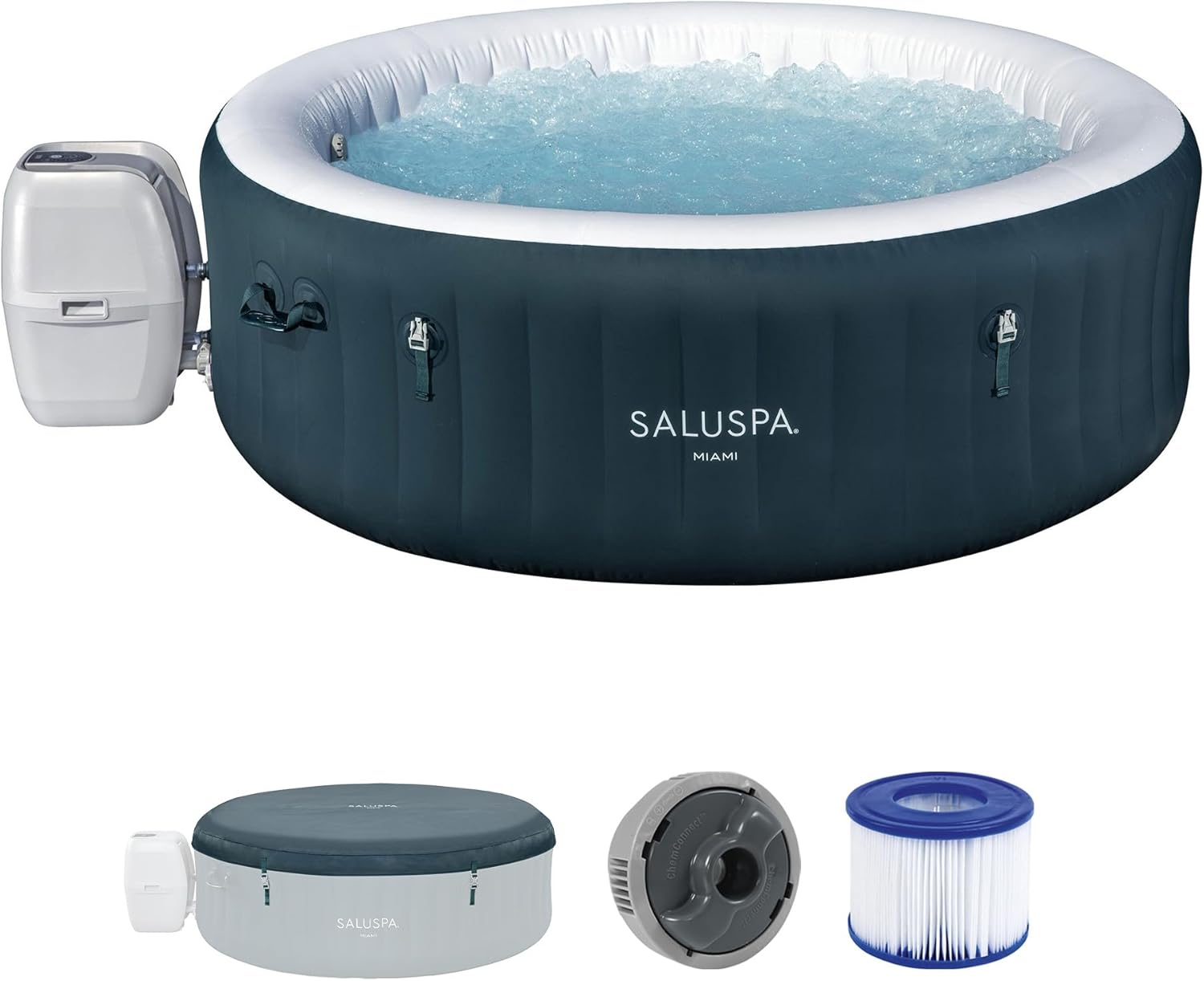
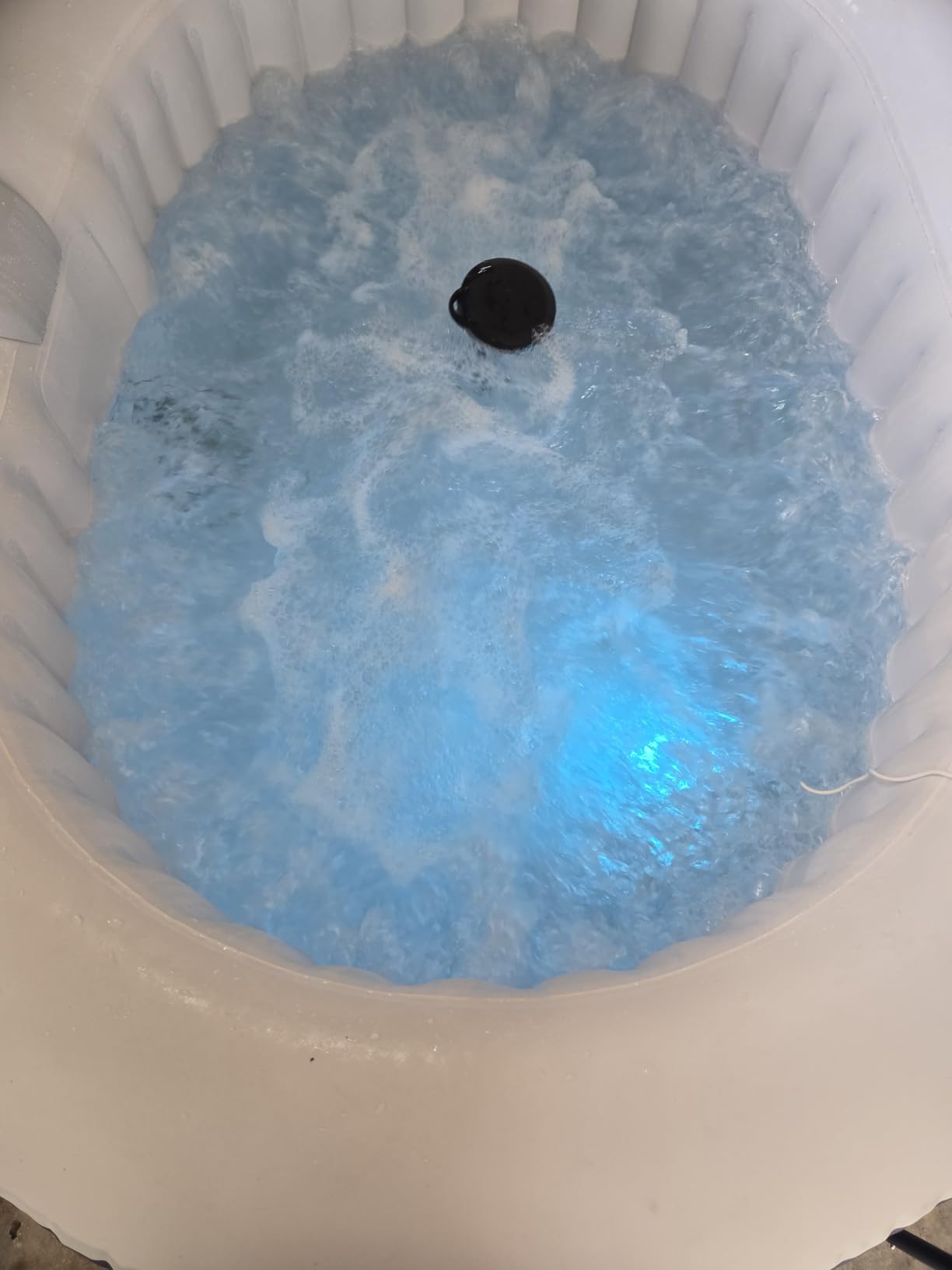
Aleko tubs generally feature 100–130 high-powered air jets. These are not hydro-massage jets (which use water pressure); they are air bubblers. The sensation is light, effervescent, and relaxing. It is comparable to the Bestway SaluSpa Miami experience. It won’t massage deep tissue knots, but it reduces stress effectively.
Square vs. Round vs. Oval: Which Shape Should You Choose?
Since shape is Aleko’s defining differentiator, it deserves its own dedicated breakdown rather than a passing mention.
Choose Square If…
You have a corner spot on a patio or deck and want to maximize usable floor space around the tub. Square tubs also tend to look more intentional and modern next to rectangular deck boards or paver patterns, and they typically offer the most interior seating room per square foot of footprint since there’s no wasted curved space in the corners.
Choose Round If…
You want the widest selection of accessories, the easiest resale value (round is still the dominant shape across every competing brand, so used-market buyers are more familiar with it), and the lowest price point in the Aleko catalog. Round tubs also distribute water pressure most evenly around the wall, which some owners feel translates to a very slightly more stable, less “boxy” feel at the corners during use.
Choose Oval If…
You’re buying primarily for one or two people. The 2-person oval models are Aleko’s smallest, cheapest, and—based on the pattern in owner reviews—generally the most reliable tubs in the lineup, likely a byproduct of the smaller water volume being easier for a single heating element to manage consistently.
Safety Considerations Before You Buy
A few safety fundamentals apply across the entire Aleko inflatable lineup, and they’re worth internalizing before your first soak rather than discovering them mid-setup.
- GFCI protection is mandatory, not optional. The power cord includes a built-in ground fault circuit interrupter, and it should never be bypassed or defeated. If it trips repeatedly, that’s a sign of a genuine electrical fault, not a nuisance to work around.
- Never use a standard household extension cord. If an extension is unavoidable, manufacturer guidance calls for a 12/3-gauge cord rated for outdoor use; anything thinner risks a voltage drop that can strain the heater and pump, and in the worst case, creates a fire hazard.
- Cycle the control box periodically. Manufacturer guidance recommends switching the unit off roughly every 48 hours to let the electronics fully cool and reset, rather than leaving it powered continuously for weeks at a stretch.
- Supervise children closely around both tub types. On the inflatable line, the water is hot enough to scald young children quickly; on the wood-fired line, the exposed firebox on external-stove models is a genuine burn hazard, which is one reason the internal-stove design is often recommended for families.
- Keep pets away from the material. Claws are the single most common cause of punctures reported by owners. If you have a dog or cat that free-roams your patio, consider a physical barrier during the hours the tub is inflated and unattended.
- Store pool and spa chemicals away from the tub itself, in a cool, dry, ventilated spot separate from the electrical control box. Chlorine and bromine products should never be mixed with each other or stored near sources of heat or open flame, which is a particular consideration for wood-fired tub owners keeping chemicals near a wood stove.
The Unique Seller: Aleko Wood-Fired Hot Tubs
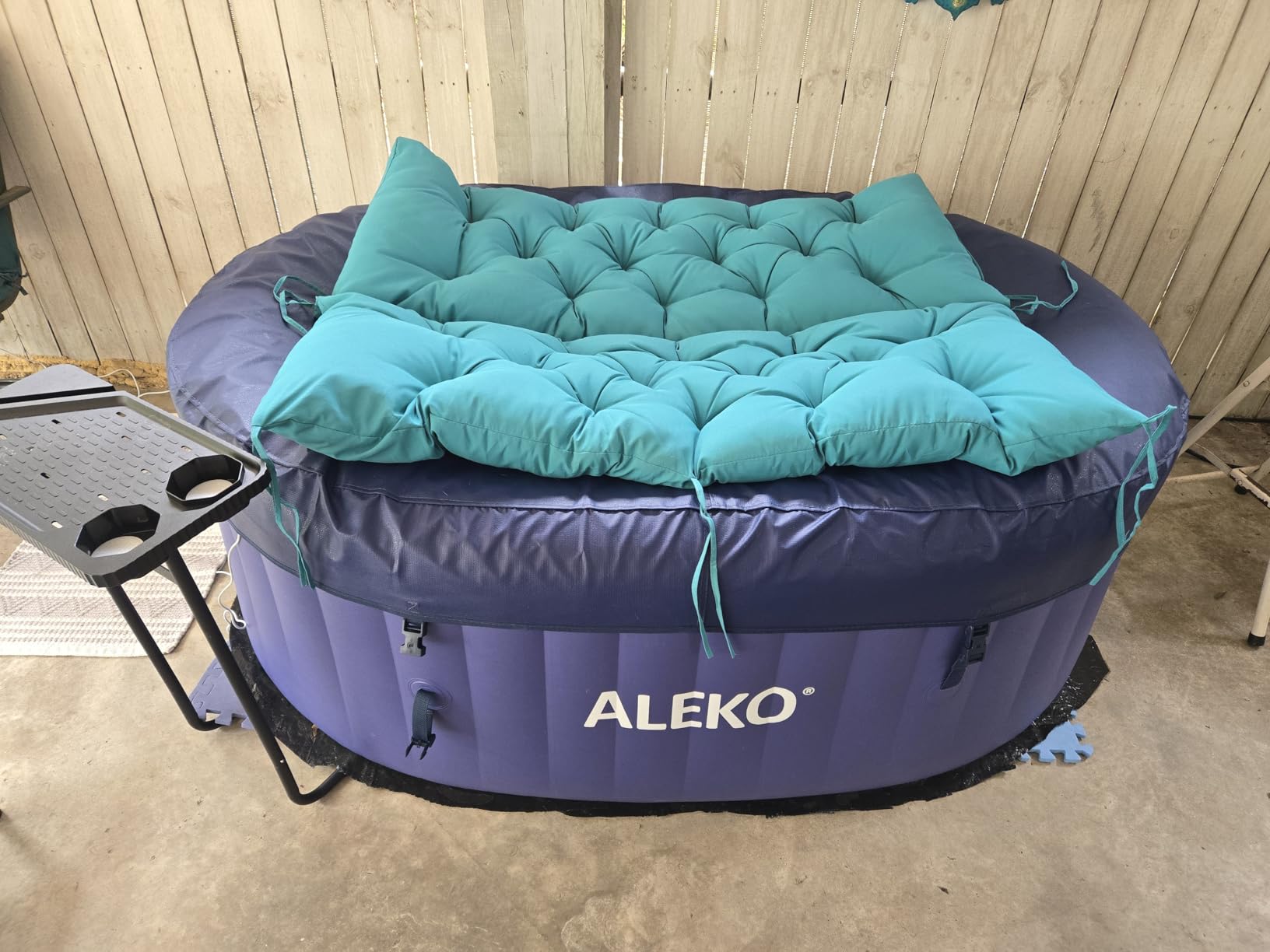
We cannot review Aleko without mentioning their wood-fired options. These are permanent or semi-permanent structures made of red cedar. They require no electricity for heating, relying instead on a wood stove submerged or attached to the tub.
- Pros: Zero electricity costs, incredible smell of cedar and woodsmoke, rustic aesthetic, gets much hotter than electric tubs (if you keep feeding the fire).
- Cons: High maintenance (cleaning ash), temperature regulation is manual (too hot? add cold water), and setup is complex.
If you are off-grid, this is a winner. But for the average suburban backyard, the inflatable series is far more practical.
Internal Stove vs. External Stove: Which Should You Choose?
Aleko’s wood-fired range splits into two heater configurations, and the difference matters more than it might first appear. The external stove models sit outside the tub wall and connect via two pipes, which makes maintenance and ash removal simple since you never have to reach into the water. The internal stove models sit inside the tub itself, fully enclosed and covered, which heats more efficiently for the same size stove and is generally considered the safer option around children, since there’s no exposed firebox at the water’s edge. The tradeoff is that internal-stove models take up a small amount of interior soaking space.
Specs You Should Know Before Buying
Aleko’s flagship pine wood-fired hot tub and ice bath models hold roughly 422 gallons of water and are built to accommodate 4-5 adults, with a tub diameter around 70.9 inches and a sidewall height of about 35.4 inches. Both the internal and external stove versions include a wooden paddle for stirring the water to even out temperature, a fitted cover, and a set of steps for getting in and out. The stainless-steel stove itself is rated with heating capacity equivalent to a 10-15kW electric heater, and most owners report the water reaching soaking temperature in roughly two to three hours from a cold fill, depending on outdoor temperature and wood quality.
Dual-Purpose: Hot Tub and Cold Plunge in One
A genuinely clever feature of the wood-fired line is that the same tub doubles as a cold-plunge or ice bath. Skip the fire, fill with cold water, add ice, and you have a recovery tub for athletes or cold-exposure enthusiasts—no separate purchase required. This dual functionality is something none of the electric inflatable models in Aleko’s lineup can offer.
What It Costs and What’s Included
Expect to pay in the neighborhood of $2,800-$3,300 for a complete wood-fired hot tub and ice bath kit, which typically bundles the tub itself, the stainless-steel chimney (usually shipped in separate pieces for assembly), the wooden paddle, connecting pipes and clamps, a fitted cover, and a staircase. Most retailers advertise roughly an hour of total assembly time for the tub and heater combined, and financing options through services like Affirm are commonly available given the higher price point compared to the inflatable range.
Ongoing Maintenance Reality Check
Because there is no filtration pump running continuously, wood-fired tubs rely much more heavily on manual water management. Untreated water is generally only safe to leave sitting for one to two weeks before bacterial growth becomes a concern; with proper chemical treatment and consistent water testing, that window extends to one to three months. If you’re coming from an inflatable tub with an always-on filter pump, budget extra mental energy for actively managing water chemistry rather than letting an automated system do it for you.
Aleko vs. The Competition
How does Aleko stack up against the titans of the industry? Let’s compare.
Aleko vs. Coleman SaluSpa
The Coleman SaluSpa is arguably the gold standard for budget tubs. In our Coleman SaluSpa review, we praised its durability (TriTech material). Aleko uses a similar reinforced PVC/polyester laminate.
Winner: Coleman typically wins on reliability and customer support availability. Aleko wins on unique shapes (Square/Oval) and higher max temperature capability (108°F vs 104°F).
Aleko vs. Intex PureSpa
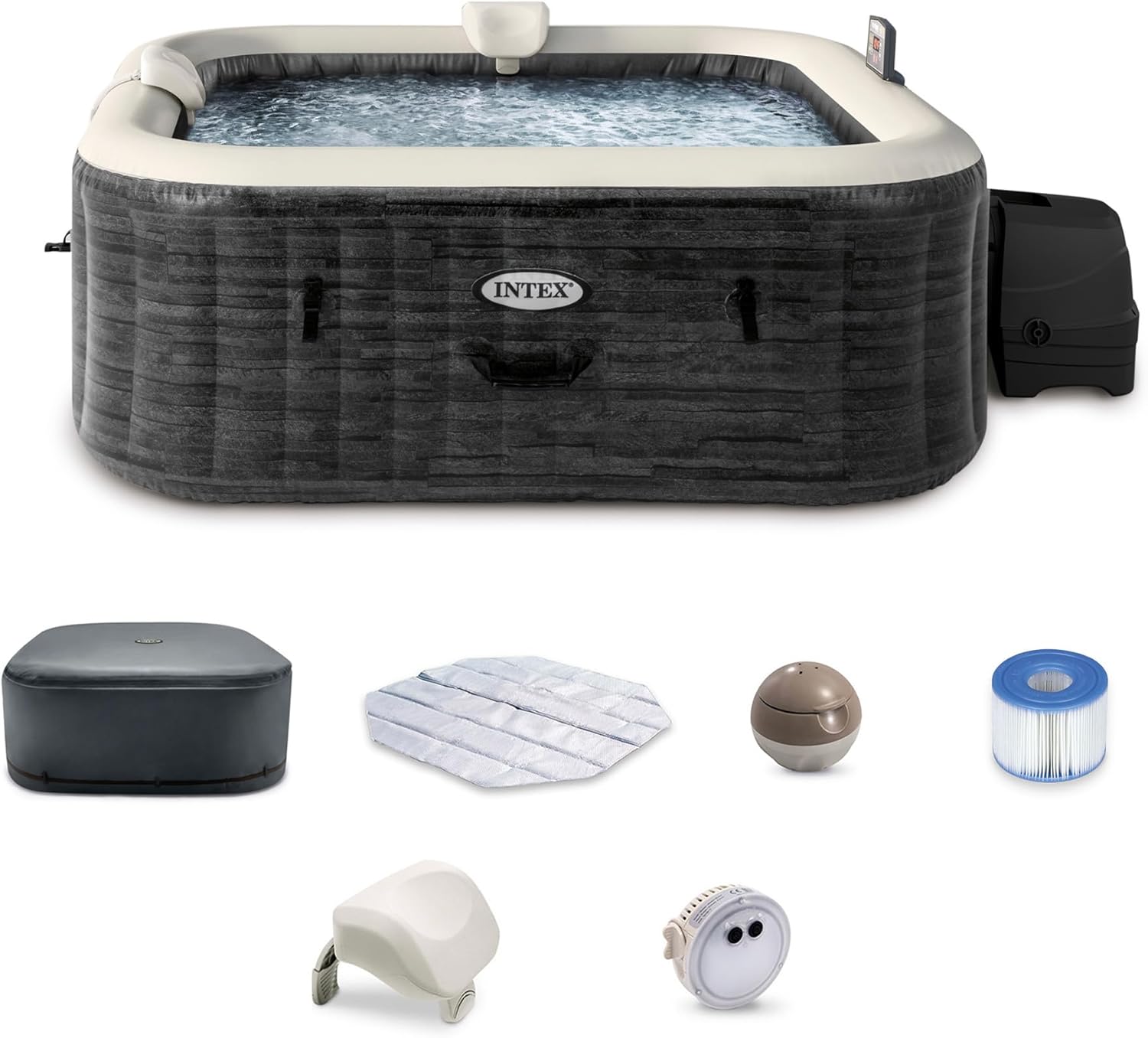
Intex offers “Fiber-Tech” construction which is incredibly rigid. When we did our Intex vs. Coleman comparison, Intex won on structural integrity. Aleko’s walls are sturdy enough to sit on, but users often report that Intex feels slightly more premium in build quality.
Aleko vs. Bestway SaluSpa Miami
The Bestway SaluSpa Miami competes directly with Aleko’s round lineup at a similar price point, and both brands share a broadly similar two-layer PVC construction philosophy. The practical difference tends to show up in retail availability rather than the tub itself: Bestway parts and filters are stocked almost everywhere, from Target to neighborhood pharmacies, while Aleko’s filter cartridges require a more deliberate online order. If minimizing mid-season shopping trips matters to you, that’s a point in Bestway’s favor even if the soak itself feels nearly identical.
Aleko vs. Generic Amazon-Only Brands (SereneLife, Vevor, and Similar)
A wave of lesser-known brands—SereneLife, Vevor, WEJOY, and various unbranded listings—compete directly with Aleko’s price point, and it’s fair to ask why you’d pick a named brand at all if the specs look similar on paper. The honest answer is customer support infrastructure and parts continuity. Aleko has an established RMA process, a real return policy documented on its own site, and enough retail presence at Home Depot and Walmart that a failed unit can often be exchanged in person rather than shipped back and forth. Many of the smaller Amazon-only brands offer none of that—if the seller disappears from the marketplace or discontinues the listing, you may have no path to replacement parts or warranty service at all. For a purchase in this price category, that support layer is arguably worth more than a marginal spec difference.
Aleko vs. Traditional Hard-Shell (Acrylic) Hot Tubs
It’s worth stepping back and comparing Aleko against the acrylic hot tub category entirely, not just other inflatables. A hard-shell spa from a brand offering true hydro-massage jets, multi-year warranties, and true four-season insulation will outperform any inflatable tub on every durability and performance metric—at five to ten times the price and with a permanent installation footprint. Aleko (and the inflatable category broadly) exists specifically to serve the buyer who wants a taste of the hot tub lifestyle without that level of investment or commitment. Judged against acrylic spas, Aleko naturally comes up short; judged against its actual peer group of budget inflatables, it’s a fair to good value.
Performance Evaluation
Setup and Installation
Aleko promotes “tool-free” setup. You simply connect the inflation hose to the tub and use the motor to inflate it. It takes about 10-15 minutes. This is on par with the industry. If you are new to this, check our general guide on inflatable hot tub setup.
Filtration and Maintenance
Here is a weak point. Some users report that Aleko filters are harder to find locally than Intex filters, which are available at almost any Walmart. You may need to order Aleko filters in bulk online. The filtration system works, but you must stay on top of it.
Always ensure you know how often to replace hot tub filters to prevent strain on the pump.
Durability
Are they durable? For the price, yes. However, like all inflatables, they are susceptible to punctures. If you have pets, you might want to look at hot tub safety regarding claws. The warranty on Aleko liners is typically 6 months, which is standard but not generous.
What the Tub Is Actually Made Of
Peeling back the marketing language, Aleko’s standard inflatable models use a two-layer PVC wall construction: an outer layer rated around 0.66mm (264 gauge) and a slightly thinner inner layer around 0.60mm (240 gauge). The fitted cover is polyurethane with an aluminum foil underside designed to reflect heat back into the water rather than let it escape upward, which is the same basic principle used across nearly every budget inflatable brand on the market. This is a perfectly reasonable, industry-standard construction for the category—it’s comparable in spirit to what you’ll find in a Bestway SaluSpa, though not as heavily reinforced as Coleman’s proprietary TriTech material discussed elsewhere in this review.
Aleko has also begun rolling out a newer “Diamond” line of 2-person tubs built with 3-layer puncture-resistant PVC fabric rather than the standard 2-layer construction, paired with an energy-saving cover that the company claims cuts energy usage by roughly 50% compared to a standard cover. If puncture resistance and running cost are your top priorities and you don’t need seating for more than two people, this newer line is worth comparing against the standard round and square models before you buy.

Essential Add-On: Maintenance Kit
Don’t let your Aleko water turn green. Grab a full chemical starter kit.
Check Price on AmazonAleko Hot Tub Error Codes & Troubleshooting Guide
If your control panel is flashing letters instead of a temperature, don’t panic—these plug-and-play spas use the same handful of fault codes across nearly every model in the inflatable lineup. Below is a breakdown of what each one means and what to try before you call support.
| Code | What It Means | What To Do |
|---|---|---|
| FC | Filter Change reminder. The filter pump has been running continuously for roughly 168 hours. | This is not a malfunction. Clean or replace the filter cartridge, then reset the control panel to clear the alert. |
| HL | High Limit. The internal sensor has detected water temperature above the safe operating ceiling, typically triggered near 115°F. | Unplug the unit and allow the water to cool. If the code returns after the water has clearly cooled down, the high-limit sensor itself has likely failed and the unit needs service. |
| E1 / E2 | Sensor communication error, often related to a disconnected or faulty temperature probe. | Power cycle the unit by unplugging it for a full 10 minutes. If the code persists, the sensor wiring likely needs to be inspected by a technician. |
| Blank Display / No Power | Tripped GFCI (ground fault) breaker built into the power cord, or a fault in the household outlet. | Press the reset button on the plug itself. Test the outlet with a different appliance. Never bypass the built-in GFCI—it’s there to prevent electrocution. |
The Most Common Real-World Failure: The Heater Simply Stops
Beyond the official error codes, the single most frequently reported issue across owner reviews on Home Depot, Walmart, and third-party review sites isn’t a code at all—it’s the heater quietly failing to reach or hold temperature after a few weeks or months of use. Owners often describe filling the tub, waiting the expected day or two, and finding the water stuck 10-15 degrees below the target setting, or losing heat rapidly the moment the jets are switched on. In many of these cases, the bubble jets themselves are the culprit: because the air pump draws in room-temperature (or cold outdoor) air and pushes it through the water, running the bubbles for extended periods will passively cool the tub even while the heater is technically working correctly. If your tub won’t hold temperature, try running the heater alone for several hours with the jets off before assuming the heating element has failed.
Why the Circuit Board Is the Real Weak Point
When a heater failure isn’t caused by jet-driven cooling, it frequently traces back to the control box’s circuit board rather than the heating coil itself. This is worth knowing before you contact support, because replacement circuit boards are a common repair part, and knowing to ask for one specifically can shortcut a lot of back-and-forth with customer service.
What Real Owners Are Actually Saying: The Complaint Patterns
We promised a brutally honest review, so let’s talk about the pattern that shows up over and over again in verified purchase reviews across Home Depot, Walmart, and independent complaint boards. This isn’t cherry-picked negativity—it’s the recurring themes that emerge once you read through dozens of owner experiences.
Pattern #1: A Meaningful Number of Units Fail Within the First Few Months
Across multiple retailers, a recurring storyline appears: the tub works well initially, then the heater or pump stops functioning somewhere between two weeks and six months of ownership. Several owners report going through two or even three replacement units in a row before either giving up or receiving a refund. This doesn’t mean every unit fails—plenty of reviews describe years of trouble-free use—but the failure rate reported in the wild is high enough that it shows up as the dominant complaint theme rather than an occasional outlier.
Pattern #2: The Warranty Window Is Short, and Timing Matters
Because Aleko’s standard hot tub warranty runs 180 days (about six months) from the purchase date rather than from first use, owners who buy in the fall for spring setup, or who delay installation due to weather or a remodel, sometimes discover their warranty has already expired by the time a problem surfaces. This is arguably the single most avoidable disappointment in the entire ownership experience—set the tub up and test it thoroughly within the first few weeks of purchase, not months later.
Pattern #3: Filter Sourcing Frustrates New Owners
A theme that comes up constantly, especially among Walmart shoppers: buyers assume they can grab replacement filters off a nearby store shelf the way they would for an Intex or Coleman tub, then discover Aleko’s screw-in cartridges aren’t stocked locally and have to be ordered online, either directly from Aleko or via generic “universal” compatible cartridges sold on Amazon. It’s a minor inconvenience once you know about it in advance, which is exactly why we’re flagging it here before you buy.
Pattern #4: When Support Works, People Say So
It’s not all bad news. A fair number of reviews specifically praise Aleko’s customer service for replacing failed heaters or entire units without a fight, sometimes even after the formal warranty window had technically lapsed. The complaint pattern isn’t “Aleko refuses to help”—it’s more often “the product needed help in the first place.” Response speed does seem to vary, and some owners report needing to follow up more than once before a resolution ships.
The Bottom Line on Reliability
Treat an Aleko inflatable hot tub the way you’d treat any budget appliance in this category (this is equally true of Bestway and generic-brand tubs, not just Aleko specifically): register your warranty immediately, set it up and stress-test it right away, keep your original packaging until you’re sure it works, and budget mentally for the possibility that you may need to use the warranty at least once. If you go in with that expectation, the ownership experience is far less likely to feel like a letdown.
It’s also worth noting that review volume itself skews the picture somewhat. Owners who experience a problem are statistically more motivated to leave a review than owners who quietly enjoy years of trouble-free soaking, which is true of virtually every product category online, not just hot tubs. Reading the complaint patterns above should inform your expectations and your setup habits, not necessarily talk you out of the purchase entirely—thousands of Aleko tubs are in active, satisfied use at any given time.
Pros and Cons: The Honest Breakdown
✅ The Pros
- Unique Designs: Square and oval shapes fit patios better.
- High Heat: Some models heat up to 108°F (check specific model specs).
- Price: Often cheaper than equivalent Intex models.
- Included Cover: Comes with a fitted cover to retain heat.
- Portability: Easy to drain and pack away.
❌ The Cons
- Brand Support: Customer service can be slower than major brands.
- Parts Availability: Filters can be harder to source locally.
- Heater Efficiency: Struggle in very cold winters without extra insulation.
- Instruction Manuals: Often translated and can be vague.
Health and Wellness: What Regular Soaking Can (and Can’t) Do
Aleko’s own marketing leans heavily on wellness language—relief from joint pain, stress reduction, better sleep—and it’s worth putting that in perspective rather than taking it at face value. Warm water immersion is well established as a source of temporary muscular relaxation and stress relief; the heat increases blood flow to soft tissue and can ease the kind of everyday tension that builds up after physical activity or a long day. Many people also find the ritual of a warm soak genuinely helpful for winding down before bed.
What an inflatable hot tub is not, however, is a substitute for medical treatment. The air-jet bubble system in Aleko’s inflatable line produces a gentle, effervescent sensation rather than the targeted, high-pressure hydro-massage jets found in true hard-shell spas, so if you’re hoping for deep tissue-style therapy for a specific chronic condition, the inflatable category broadly (not just Aleko) is likely to underdeliver relative to expectations. If you’re managing a diagnosed condition, it’s worth checking with your doctor about whether frequent hot water immersion is appropriate for you specifically, particularly if you have cardiovascular concerns, are pregnant, or take medication that affects blood pressure or temperature regulation.
With that caveat in place, for the average person looking for a low-cost way to build a relaxing evening or weekend ritual, an Aleko tub delivers on the basic promise: warm water, gentle bubbles, and a reason to step outside and unwind. Manage your expectations accordingly and the experience tends to land well.
Who Should Buy an Aleko Hot Tub?
1. The Shape-Conscious Buyer: If you absolutely need a square tub to fit a specific corner of your deck, Aleko is one of the few budget options available.
2. The Heat Lover: If 104°F just isn’t enough for you, the models that push to 108°F offer that extra therapeutic sting.
3. The Budget Shopper: If you find a sale where an Aleko is $100 cheaper than a Coleman, it is a worthy purchase. The differences are not vast enough to ignore that kind of savings.
4. The Vacation Rental Host: An inflatable hot tub is a genuinely effective amenity upgrade for a short-term rental listing—photos with a hot tub consistently draw more bookings in cooler-climate destinations. That said, think carefully before installing one at a property you can’t personally monitor closely.
However, if you are looking for absolute peace of mind regarding warranty and parts availability, you might want to stick to the mainstream models listed in our guide to the best blow-up hot tubs.
A Note for Vacation Rental and Airbnb Hosts
Because Aleko’s tubs show up so often on rental property listings, it’s worth addressing this use case directly rather than lumping it in with residential ownership. The economics are attractive on paper: a sub-$700 tub can meaningfully boost a listing’s appeal and nightly rate in a cooler-climate market, and the setup itself takes under half an hour.
The risk calculus changes significantly, though, once you’re not the one using the tub day to day. Guests are unlikely to follow the filter cleaning schedule, may run the jets constantly (accelerating the heating problems discussed earlier), and won’t know to avoid extension cords or report an early warning sign like a slow air leak. If you’re considering an inflatable tub for a rental property, a few adjustments are worth making: post laminated, simple instructions at the unit itself covering the extension cord warning and basic temperature controls, build filter replacement into your regular turnover checklist rather than waiting for a guest complaint, and strongly consider budgeting for the tub to need a warranty claim or full replacement within its first year of heavy multi-guest rotation, given the failure patterns we’ve covered throughout this review. Treat it as a consumable amenity with a limited lifespan rather than a permanent fixture, and it will rarely disappoint.
Final Buying Checklist
Before you add an Aleko tub to your cart, run through this list to make sure you’re buying the right configuration for your situation.
- Shape: Square for corner patio space, round for the lowest price and widest accessory compatibility, oval for solo or couple use with the best reliability track record.
- Retailer: Prioritize the longest return window at a comparable price—typically Home Depot or Walmart’s 90-day policies over Amazon’s shorter standard window or Aleko’s own 30-day window.
- Timing: Watch for the 15-20% seasonal discounts that Home Depot and Walmart run through spring and early summer rather than buying at full list price.
- California residents: Confirm shipping eligibility before ordering, since Aleko does not ship inflatable hot tubs to California.
- Backup filters: Add a multi-pack of replacement cartridges to your order so you’re not caught mid-season without one.
- Setup timeline: Plan to unbox and fully test the unit within the first two weeks of arrival, not months later, to maximize your effective warranty coverage.
- Off-grid or wood-fired interest: If you want zero ongoing electricity cost and don’t mind manual temperature management, compare the internal vs. external stove wood-fired models rather than defaulting to the inflatable line.
Aleko Hot Tub Warranty & Return Policy: What’s Actually Covered
Warranty terms are the least glamorous part of any purchase, but they matter enormously with a product category that has a documented pattern of early failures. Here’s what Aleko’s published policy actually covers, broken down in plain English.
How Long Is the Warranty?
Most Aleko product categories carry a standard 1-year limited warranty, but hot tubs are a notable exception: both inflatable and wood-fired hot tubs are covered by a shorter 180-day limited warranty, which works out to roughly six months from the date of purchase. This is the figure that matches what we mentioned earlier regarding liner coverage—it’s an industry-standard window for this product category, not something unique to Aleko, but it is shorter than the 1-year+ warranties offered on some higher-end acrylic spas.
What the Warranty Covers
The limited warranty generally covers manufacturing defects in materials and workmanship: a heating element that fails under normal use, a control box that malfunctions without user error, or a factory seam that separates. It does not cover damage caused by improper storage, freezing, puncture from pets or sharp objects, chemical imbalance damage to internal components, or use with an unauthorized extension cord.
Return Policy: The 30-Day Window
Separate from the warranty, Aleko offers refunds and exchanges within the first 30 days of purchase directly through their site, provided the item, accessories, and original packaging are returned intact. If any component shows signs of use or damage, a 15% restocking fee typically applies; units returned in like-new condition can usually get a full refund. A Return Merchant Authorization (RMA) number is required inside the package for the return to be processed, so don’t skip that step if you go this route.
Retailer Return Windows Differ From Aleko’s Own Policy
If you bought through Home Depot or Walmart rather than directly from Aleko, remember that the retailer’s own return window applies to the initial purchase (commonly 90 days at both retailers), which is separate from and in addition to Aleko’s manufacturer warranty. This is actually the best-kept secret of buying Aleko: purchasing through a big-box retailer with a generous return window gives you a longer no-questions-asked safety net than buying directly, even though the underlying product warranty is identical either way.
How to Actually File a Warranty Claim
- Keep your order confirmation. You’ll need proof of purchase date, since the 180-day clock starts there, not at first use.
- Document the problem with photos or video. Support teams for budget spa brands generally move faster when you can show the exact fault (a control panel error code, a visible tear, a heater that won’t engage).
- Be specific about the part, not just the symptom. If you suspect the circuit board rather than the heating coil (see our troubleshooting section above), say so—it can speed up the diagnosis.
- Register the product if a registration option is offered at setup. This creates a timestamp for your warranty window and can smooth over disputes about purchase date.
Should You Buy a Used Aleko Hot Tub?
Given the failure patterns discussed above, buying used deserves extra caution rather than blanket avoidance. If you’re considering a secondhand Aleko off a local marketplace listing, a few checks matter more than the usual “does it look clean” once-over.
- Ask to see it running, fully inflated and heating, before you buy. A tub that “just needs a good clean” but hasn’t been powered on in months is a common way for a failed heater or pump to hide in plain sight.
- Check the purchase date if the seller has it. Since the 180-day warranty is tied to original purchase date and typically isn’t transferable to a second owner anyway, don’t factor “remaining warranty” into your used-purchase price calculation.
- Inspect seams and fold lines closely for any hairline cracking, especially if the tub was ever folded and stored in cold conditions.
- Factor in the cost of a full new filter set since you have no way of knowing the maintenance history of the one currently installed.
Used pricing on Aleko tubs tends to run 40-60% below original retail, which can make sense if the unit demonstrably works—but given how inexpensive these tubs are new, especially during a sale window, the savings from buying used are often smaller than they first appear once you account for the risk.
Getting the Most Out of Your Aleko
If you decide to pull the trigger on an Aleko, here are the tips that make the biggest difference to long-term satisfaction:
- Insulate underneath: Never place it directly on cold concrete. Use hot tub pads to save on electricity.
- Upgrade the cover: The included cover is basic. Adding a thermal blanket or one of the best hot tub covers on top will drastically reduce your electric bill.
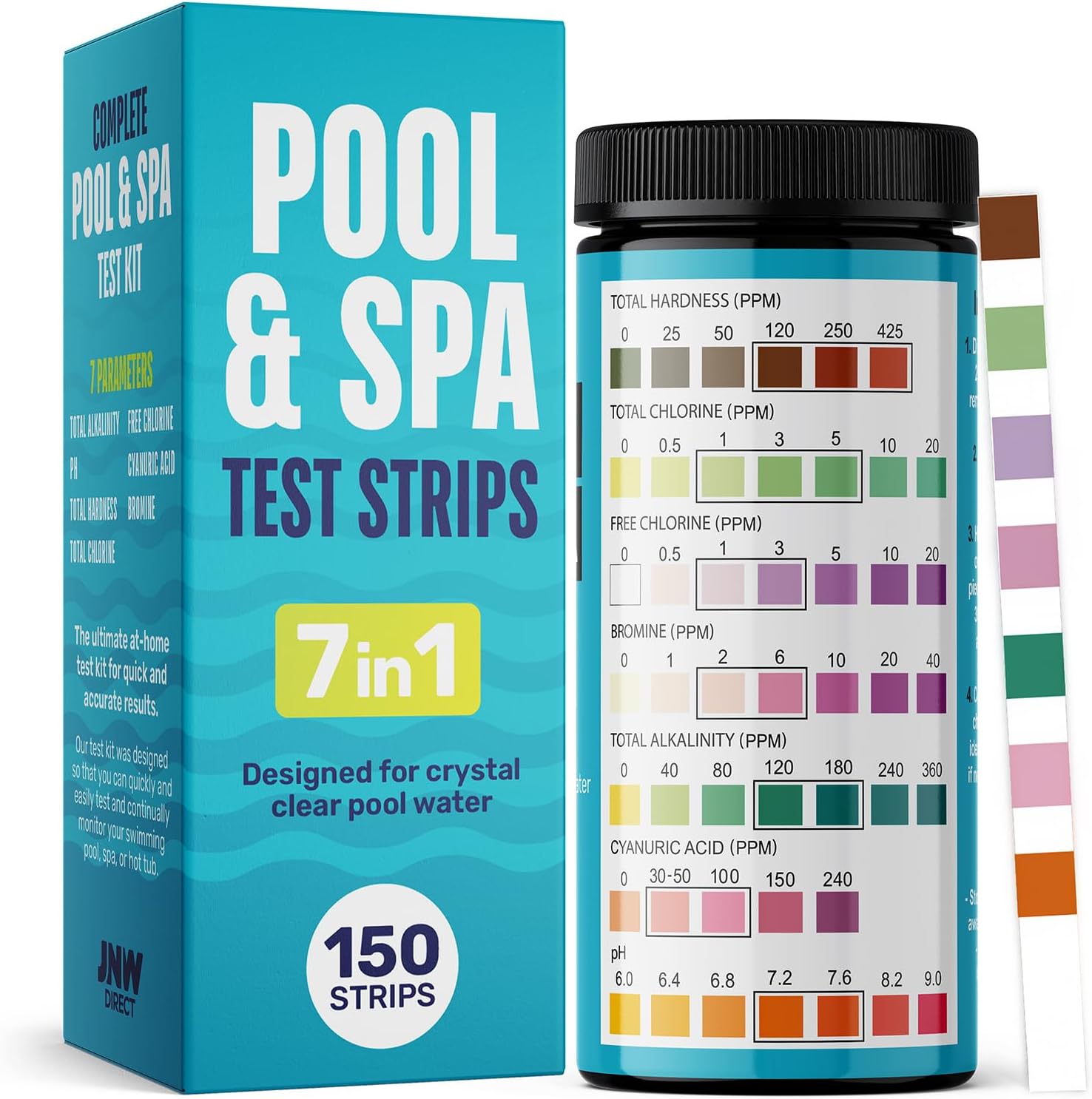
- Monitor water quality: Use a reliable tester. We recommend digital readers for accuracy—check out the best digital hot tub water testers.
- Register your warranty immediately and test the unit right away. Don’t let it sit in the box; the coverage clock is already running.
- Order a backup filter cartridge or two the same week you buy the tub. This removes the single most common mid-season annoyance before it ever becomes a problem.
- Buy through a retailer with a generous return window rather than the absolute lowest price, given the documented early-failure pattern discussed throughout this review.
- Keep a simple maintenance log—even just a note on your phone with the date of your last filter change and water test. It sounds excessive for a backyard hot tub, but it removes the guesswork that leads most owners to neglect the schedule.
Step-by-Step: Setting Up Your Aleko Inflatable Hot Tub
Aleko’s owner’s manual outlines a straightforward setup sequence, but a few steps trip up first-time owners more than others. Here’s the process from unboxing to first soak.
- 1. Choose a flat, stable, and level surface. Concrete, a reinforced deck, or a dedicated hot tub pad all work. Avoid gravel or uneven grass, which can stress the floor seams over time.
- 2. Unfold the tub and cover, right side up. Give the material time to relax at room temperature if it arrived folded tightly in cold weather, since cold PVC can be less pliable and more prone to cracking if handled too roughly.
- 3. Connect the inflation hose to the air outlet and open the corresponding air valve on the tub wall.
- 4. Press the Jet button to begin inflation. Most tubs reach full firmness in 10-15 minutes. Do not over-inflate—stop once the walls are firm to the touch and the tub holds its shape.
- 5. Remove the inflation hose and screw the valve tight to seal the air inside.
- 6. Screw the filter cartridge onto the water inlet by turning it clockwise until snug.
- 7. Fill with a garden hose up to the water line printed on the interior tub wall. Under-filling is one of the most common causes of heating problems, since the unit needs a minimum water level to activate the heater safely.
- 8. Plug directly into a grounded, dedicated outlet (never an extension cord) and power on. Expect a temperature rise of roughly 2-3°F per hour until you reach your target setting.
Winterizing and Storing Your Aleko Hot Tub
If you live anywhere that sees a real winter, you’ll eventually need to break down and store your Aleko rather than leave it filled and running through freezing temperatures. Manufacturer guidance advises against leaving any inflatable spa outdoors once temperatures drop below 40°F, since the plumbing and pump are not designed to handle freezing water.
The Draining Process
- Unplug the power pack completely before doing anything else.
- Remove the filter cartridge and set it aside to dry separately.
- Open the drain outlet on the exterior wall and let gravity empty the bulk of the water.
- Run the jet function briefly (2-3 minutes) after the water level drops low, which helps force residual water out of the internal plumbing lines rather than leaving it to sit and potentially freeze or grow mildew.
- Wipe down all interior and exterior surfaces to remove standing droplets, then let the tub air out for roughly 24 hours before folding.
Folding and Long-Term Storage
Fold the spa indoors rather than outdoors if winter has already arrived—cold PVC and vinyl liners become more brittle and are more prone to cracking at fold lines when folded in freezing temperatures. Store the folded tub and control box in their original packaging in a shaded, temperature-stable area such as a garage, basement, or shed, away from direct sunlight and away from rodents that may be attracted to the material. A wet/dry shop vacuum is genuinely useful here: running it briefly through the drain ports and pump lines helps clear out any lingering moisture that a simple drain-and-wipe cycle can miss.
Common First-Time Owner Mistakes
Having read through a wide cross-section of owner experiences, a handful of avoidable mistakes come up again and again. Sidestepping these alone will put you well ahead of the average first-time buyer.
- Buying and setting up months apart. Because the warranty clock starts at purchase, not first use, delaying setup shrinks your effective coverage window. Set it up and test it within the first couple of weeks.
- Running the bubble jets constantly while trying to reach temperature. As covered in our troubleshooting section, this actively works against the heater. Let the tub reach temperature with jets off, then turn bubbles on for your soak.
- Setting the target temperature too aggressively on day one. Large temperature-rise requests aren’t dangerous, but a more gradual approach tends to produce steadier, more predictable heating behavior.
- Skipping the ground cloth or floor pad. Setting the tub directly on rough concrete or gravel accelerates floor wear and increases puncture risk; it also allows more heat to bleed into the ground.
- Not testing water chemistry before first use. Tap water isn’t automatically balanced, and skipping the first chemical check is a fast route to cloudy or scale-forming water.
- Discarding the original packaging immediately. If a fault surfaces in the first days or weeks, having the original box on hand makes both a retailer return and a warranty exchange dramatically simpler.
- Ignoring the FC filter reminder. It’s tempting to silence the alert and keep going, but running with a saturated filter strains the pump and degrades water clarity faster than expected.
Filter Maintenance Schedule: Keeping Your Water Clear
Filtration is the area where Aleko owners most often trip themselves up, mostly because the maintenance cadence is more frequent than people expect coming from a traditional pool.
| Task | Recommended Frequency |
|---|---|
| Rinse filter cartridge with a garden hose | Every 2-3 days of regular use |
| Deep-soak filter overnight in filter cleaning solution | Every 120 hours of continuous filter pump operation |
| Replace filter cartridge entirely | Roughly once per month, more often with heavy use |
| Full water change | Every few days to a couple of weeks, depending on bather load and chemical maintenance |
The control panel will display an FC alert and sound a warning tone once the filter pump has logged around 168 hours of continuous operation, which functions as a built-in reminder rather than a sign of malfunction. Simply clean or swap the cartridge and the unit will reset itself.
Sourcing Replacement Filters
Aleko’s standard cartridge is a blue, screw-in style sold individually or in multi-packs directly through Aleko and via Amazon. Several third-party brands also manufacture “universal” cartridges explicitly marketed as compatible with Aleko, alongside other inflatable brands like RELXTIME and Wave Spas, which can be a cheaper option if you don’t mind a non-OEM part. Buying a multi-pack up front is the easiest way to avoid the mid-summer scramble of hunting for a compatible filter when your local big-box store simply doesn’t stock the Aleko-specific size on its shelves.
Water Chemistry Targets
Aleko’s own manual recommends keeping pH between 7.2 and 7.8, total alkalinity between 80 and 120 ppm, and free chlorine (or equivalent sanitizer) between 3 and 5 ppm. Test your water at least once a week, and more often with heavy bather load. Critically, avoid any sanitizing product containing calcium, since calcium deposits can scale the internal heating pipes and damage the control box—a failure mode that typically is not covered under warranty since it stems from chemical misuse rather than a manufacturing defect.
What Will It Cost to Run? Estimating Your Electric Bill
One of the most common questions we get about budget inflatable spas is what they actually add to a monthly power bill. Here’s a rough framework using Aleko’s published wattage figures.
A typical Aleko inflatable tub draws about 1200 watts for the heater and roughly 600 watts for the bubble jets, for a combined power pack rating around 1800 watts. The heater doesn’t run continuously once at temperature—it cycles on and off to maintain your set point, similar to a refrigerator or space heater. As a loose estimate, expect the heater to run in short bursts totaling somewhere around 4-8 hours per day once stabilized at temperature, with more runtime required during the initial heat-up period or in colder climates.
At a national average residential electricity rate, that translates to a modest few dollars a day in ongoing costs once the tub is up to temperature, with the biggest spike happening during the initial 20-24 hour heat-up from cold tap water. The single biggest lever you have to reduce that cost is insulation: an insulating pad underneath the tub and a quality thermal cover on top (see our tips below) can meaningfully cut how often the heater needs to cycle on, especially in cooler climates or during shoulder seasons.
Recommended Accessories and Upgrades
A handful of add-ons make a disproportionate difference to the day-to-day experience of owning an Aleko tub, beyond what ships in the box.
- Insulating floor pad: Placed underneath the tub, this reduces heat loss into cold concrete or ground and can meaningfully cut heater runtime.
- Upgraded thermal cover or floating solar blanket: The stock cover is functional but basic. A dedicated thermal layer placed directly on the water’s surface, underneath the hard cover, traps significantly more heat.
- Digital water tester: Test strips are fine, but a digital reader removes the guesswork of matching colors on a chart, which matters given how much water chemistry affects both comfort and warranty-relevant component longevity.
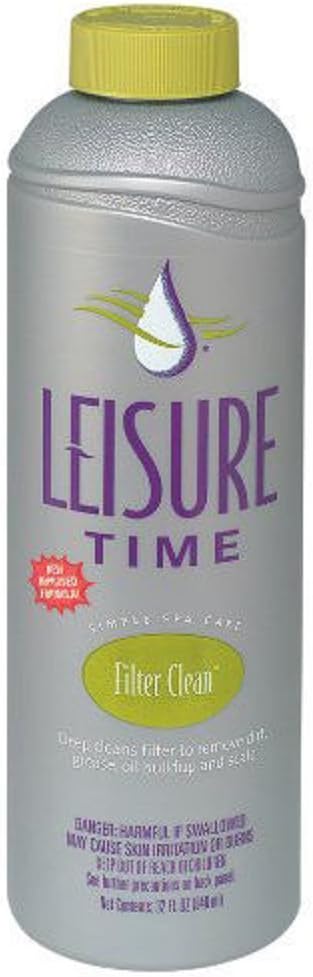
- Chemical starter kit: A complete kit with sanitizer, pH increaser/decreaser, and a clarifier saves you from piecing together products individually, and helps new owners avoid the “cloudy green water” learning curve.
- Underwater LED light kit: A purely aesthetic upgrade, but a popular one among owners looking to create more of an evening-spa atmosphere.
- Extra filter cartridges (bought in bulk): Given the once-a-month replacement cadence and the sourcing friction discussed above, ordering a 6 or 12-pack up front removes one entire category of mid-season hassle.
Where to Buy: Amazon vs. Home Depot vs. Walmart vs. Aleko Direct
The same physical tub is frequently available across all four channels, and where you buy matters almost as much as which model you choose.
Amazon
Typically the fastest shipping option and often runs competitive seasonal pricing, plus the broadest selection of colorways and bundle configurations. Amazon’s own return window applies, which is generally shorter and more restrictive than Home Depot’s or Walmart’s for large items.
Home Depot
Frequently discounts Aleko tubs by 15-20% off list price and offers free ship-to-store pickup, plus a 90-day return window on most items—a real advantage given the failure patterns discussed earlier in this review. Financing options are also commonly available for the pricier wood-fired models.
Walmart
Generally the most budget-friendly channel and also offers a 90-day return policy on most hot tub purchases, making it a strong option if peace of mind matters more to you than shaving off the last few dollars.
Buying Directly From Aleko
Ordering direct sometimes unlocks financing through services like Affirm, particularly useful for the wood-fired range given the higher price point, and gives you the most direct line to customer service for warranty claims. The tradeoff is a stricter 30-day return window compared to the big-box retailers.
Shipping and Delivery: What to Expect
Inflatable tubs and their wood-fired counterparts ship very differently, and knowing the difference helps you plan around delivery day.
Inflatable Models
These typically ship via standard parcel carrier in a single box, with order processing taking roughly 12-24 hours on business days and standard ground shipping adding another 3-5 business days. Expedited and overnight options are commonly available if ordered before the early afternoon cutoff, for an added fee.
Wood-Fired Models
Given the weight and bulk of a full wood-fired tub kit, these frequently ship via LTL (less-than-truckload) freight, which can take considerably longer—commonly 7-20 business days—and may require you to be present for a curbside or threshold delivery rather than a simple porch drop-off. Factor this into your planning if you’re hoping to have a wood-fired tub ready for a specific weekend or event.
What to Do If a Box Arrives Damaged
Inspect the packaging before you sign for delivery whenever possible. If there’s visible damage, note it explicitly on the delivery receipt using the word “damaged” rather than simply accepting the package—several retailers and Aleko’s own policy require that specific notation to process a replacement or repair reimbursement without a fight. Photograph the damage before you even open the box, and again once you’ve unpacked it, in case you need to file a claim.
Frequently Asked Questions
Like most plug-and-play tubs, it heats at about 2-3°F per hour. If you fill it with cold hose water (60°F), it will take roughly 20-24 hours to reach 104°F.
They can be used in winter, but they are not specifically “winterized” like some high-end hard-shell tubs. You will need to keep the heater running constantly to prevent freezing. See best inflatable hot tubs for winter for better cold-weather options.
No. Most manufacturers strictly advise against extension cords due to voltage drop and fire risk. Plug it directly into a grounded outlet. For power details, read how many amps does a hot tub use.
Yes, for the price point. They offer a legitimate spa experience for under $600. While they may lack the polish of high-end brands, the value proposition is strong. For a broader look at value, read are inflatable hot tubs worth it.
Remove the cartridge and rinse it with a garden hose every few days. Soak it in filter cleaner every two weeks. Replace it monthly. Neglecting this leads to cloudy water. Learn more at why does hot tub water get cloudy.
FC stands for Filter Change. It’s a built-in reminder that triggers after roughly 168 hours of continuous filter pump operation, not a malfunction. Clean or replace the cartridge, then reset the panel and it will clear.
The most common cause is the bubble jets running for extended periods, which pull in room-temperature air and cool the water faster than the heater can compensate. Try running the heater alone with the jets off. If the tub still won’t climb, check that the water level meets the printed fill line, since underfilling can prevent the heater from engaging properly.
Aleko hot tubs, including both inflatable and wood-fired models, carry a 180-day limited warranty from date of purchase—roughly six months. This is shorter than Aleko’s standard 1-year warranty on most other product categories.
Aleko’s blue screw-in cartridges are sold directly through Aleko and on Amazon, often in multi-packs of 6 or 12. Several third-party brands also sell “universal” cartridges marketed as Aleko-compatible. Don’t expect to find them at a typical Walmart or Home Depot store shelf—they’re rarely stocked in person.
The wood-fired hot tub and ice bath models are explicitly designed for dual use. Skip lighting the stove, fill with cold water, and add ice for cold-exposure therapy. The inflatable electric models are not designed or marketed for cold plunge use.
Expect a modest few dollars a day in electricity once the tub is stabilized at temperature, with the highest usage occurring during the initial 20-24 hour heat-up. Adding an insulating floor pad and a thermal cover meaningfully reduces ongoing heater cycling and cost.
No. Aleko does not ship inflatable hot tubs to California residents due to the state’s energy-efficiency requirements for portable spas. Check our Best Inflatable Hot Tubs of 2025 guide for compliant alternatives if you live in California.
An external stove sits outside the tub wall and connects via pipes, making ash cleanup simpler. An internal stove sits fully enclosed inside the tub, heating more efficiently and offering a safer, fully covered firebox around children, at the cost of a small amount of interior soaking space.
Inflatable models ship via standard parcel carrier in roughly 3-5 business days after a 12-24 hour processing window. Wood-fired models often ship via LTL freight and can take 7-20 business days due to their size and weight.
Aleko is a real, established company founded in 2005 and based in Kent, Washington, with genuine retail distribution through Amazon, Home Depot, and Walmart. Reputation-wise, it sits in the same tier as other budget inflatable brands: a reasonable value proposition paired with a documented pattern of early component failures on a meaningful minority of units, which is largely offset by a workable warranty and return process if you use it promptly.
Yes, though the window depends on where you bought it. Aleko’s own site offers a 30-day return window with a possible 15% restocking fee if the unit shows use or damage. Home Depot and Walmart typically offer a more generous 90-day return window on the same tubs.
Final Verdict: Should You Buy an Aleko?
Aleko hot tubs occupy a solid middle ground in the market. They are the “mavericks” of the inflatable world, offering shapes and styles that others don’t, often at aggressive price points. While their customer service infrastructure may not match the massive scale of Intex or Bestway, the product itself delivers on its promise: hot water, bubbles, and relaxation.
If you want a square tub or need that extra heat capability, Aleko is a fantastic choice. Just be prepared to be a bit more proactive with sourcing filters and maintaining the unit.
Zooming out across everything we’ve covered in this review—the model lineup and real-world pricing, the documented failure patterns and how to protect yourself with the right retailer and warranty timing, the wood-fired range as a genuinely distinct off-grid option, and the maintenance habits that separate happy owners from frustrated ones—the throughline is consistent: Aleko is a fair-value budget brand, not a premium one, and it rewards buyers who go in informed. The tub itself is perfectly capable of years of enjoyable use. Whether yours ends up in that category or in the pile of early-failure complaint reviews often comes down to a few controllable factors: which retailer you buy from, how quickly you set it up and test it, and whether you stay ahead of filter and water-chemistry maintenance rather than reacting to problems after they start.
Overall Rating: 4.2 / 5 Stars

Top Pick: Aleko 2-Person Oval Hot Tub
Perfect for couples with limited space. Intimate, efficient, and stylish.
Check Today’s Price on Amazon