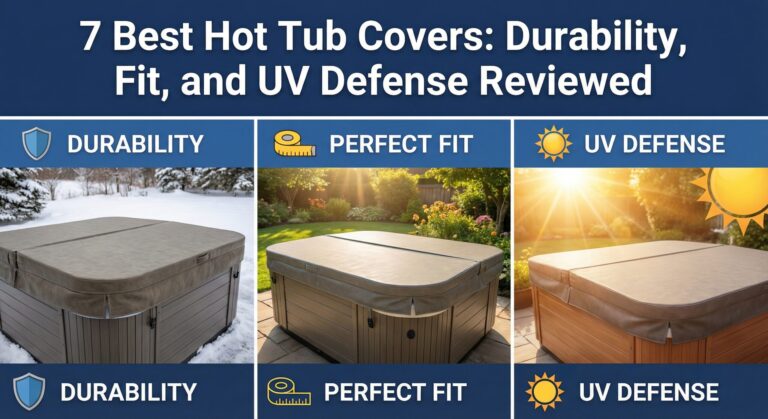
7 Best Hot Tub Protective Cover Caps: Durability, Fit, and UV Defense Reviewed
Welcome to the ultimate guide to selecting the perfect hot tub protective cover cap. Unlike a standard insulating foam cover, a protective cap acts as the vital outer shell, shielding your expensive hard cover—or your inflatable spa—from the elements that cause premature deterioration: UV rays, rain, tree sap, and debris. This is the unsung hero that dramatically extends the life of your primary insulation, saving you thousands in replacement costs. We’ve rigorously selected these top seven options from Amazon based on their denier rating (fabric thickness), waterproof coating, secure fit mechanisms, and overall value. This comprehensive review provides the architectural blueprint for maintaining your hot tub oasis year-round, focusing specifically on external protection.
Most spa owners only discover they need this extra layer of protection after their expensive vinyl cover starts cracking, fading, or sagging years ahead of schedule. The frustrating part is that this damage is almost entirely preventable. A protective cap costs a fraction of what a replacement cover runs, yet it absorbs nearly all of the abuse that would otherwise be aimed directly at your cover’s vinyl skin. Below, alongside our seven hands-on reviews, we’ve added a full measuring walkthrough, a breakdown of how protective caps differ from insulating covers and solar blankets, a climate-specific selection framework, an installation mistakes checklist, a season-by-season usage guide, and an expanded FAQ so you can walk away with everything you need to make a confident, informed purchase.
💡 **Quick Tip for Inflatable Owners:**
If you’re still deciding on your setup, check out our in-depth comparison:
Intex PureSpa vs. Coleman SaluSpa: A Head-to-Head ComparisonTable of Contents
- Protective Cap vs. Insulating Cover vs. Solar Blanket
- How to Measure for a Perfect-Fitting Cap
- #1: The Heavy-Duty 600D Square Cover (Best Overall)
- #2: The 400D All-Weather Round Cap (Best Value)
- #3: The Commercial Grade PVC Cap (Extreme Protection)
- #4: Classic Accessories Veranda Round Cover
- #5: The Premium Rectangular Shield
- #6: The Fade-Resistant 420D Fabric Protector
- #7: The Lightweight Round Utility Cover
- Protective Cover Buying Guide (MUST READ!)
- Common Installation Mistakes to Avoid
- Seasonal Usage Guide (Year-Round Strategy)
- Cover Care and Longevity Secrets
- Frequently Asked Questions
📊 Quick Comparison of the Top 7 Hot Tub Protective Covers
| Model Name (Ref.) | Shape/Dimensions | Material (Denier) | Best For | Amazon Link |
|---|---|---|---|---|
| **#1 iBirdie Square Cover** | Square/Various Sizes | 600D Oxford Fabric | Maximum Durability & UV Protection | Check Price on Amazon |
| #2 ULT-Cover Round Cap | Round/Various Sizes | 400D Oxford Fabric | General Use & Value for Round Spas | Check Price on Amazon |
| #3 famibay Commercial Grade | Square/Various Sizes | High-Density PVC/Polyester | Extreme Weather & Waterproofing | Check Price on Amazon |
| #4 Classic Accessories Veranda | Round/Various Sizes | Durable Polyester Fabric | Trusted Brand & Aesthetic Look | Check Price on Amazon |
| #5 Uirway Rectangular Shield | Rectangular/Large Size | 600D Oxford Fabric | Oversized or Rectangular Spas | Check Price on Amazon |
| #6 Enzeno Fade-Resistant | Square/Various Sizes | 420D Oxford Fabric | Sun-Heavy Climates, Easy Handling | Check Price on Amazon |
| #7 Kipiea Lightweight Utility | Round/Various Sizes | 420D or Similar Light Fabric | Budget Option & Inflatable Use | Check Price on Amazon |
🧵 Protective Cap vs. Insulating Cover vs. Solar Blanket: What’s the Difference?
One of the most common points of confusion for new spa owners is assuming that “cover,” “cap,” and “blanket” all describe the same object. In reality, a properly protected hot tub relies on up to three distinct layers, each doing a completely different job. Understanding where a protective cap fits into that stack is the key to knowing whether you actually need one, and which style suits your setup.
🌊 Solar Blanket / Thermal Layer
Floats directly on the water’s surface, beneath the hard cover or inflatable lid. Its job is to slow evaporation and reduce the chemical off-gassing that eats away at the underside of your main cover. It touches water directly and typically needs replacing every one to two seasons.
🛡️ Insulating Cover
The rigid, foam-core cover (or inflatable lid) that sits on top of your spa. This is your primary heat-retention barrier and, in many jurisdictions, the component that satisfies child-safety and drowning-prevention requirements. It never touches the water directly.
☂️ Protective Cap
The outermost shell reviewed in this guide. It never contacts water or foam at all — its entire purpose is to intercept UV rays, rain, snow, and debris before they can reach and degrade the insulating cover underneath.
Think of it the way you’d think about layers of clothing in cold weather. The solar blanket is your base layer, trapping warmth close to the source. The insulating cover is the heavy coat doing the bulk of the thermal work. The protective cap is the waterproof shell jacket worn over the coat — it doesn’t add much warmth on its own, but without it, the coat underneath would be soaked, sun-bleached, and falling apart within a season or two. Skipping the shell layer doesn’t save you money in the long run; it just moves the cost from a $40–$80 cap purchase now to a $300–$600 cover replacement later.
A frequent misconception is that owners with a “quality” vinyl cover don’t need a cap because the marine-grade vinyl is already UV-treated. UV-resistant vinyl slows degradation, it doesn’t stop it. Constant, unbroken sun exposure — the kind a stationary hot tub receives every single day, all year — will eventually break down even the best marine-grade coatings. A protective cap doesn’t replace the quality of your primary cover; it multiplies its usable lifespan by taking the brunt of the exposure so the vinyl underneath only has to deal with ambient temperature swings, not direct radiation and standing water.
🔗 **Related Cover Comparison:**
Best Inflatable Hot Tub: A Comprehensive Buyer’s Guide📏 How to Measure Your Hot Tub for a Perfect-Fitting Protective Cap
A cap that’s too small won’t seat over the corners of your insulating cover, leaving gaps where wind and rain sneak in. A cap that’s too large will flap in the wind, chafe against the vinyl underneath, and eventually work its straps loose. Getting the sizing right the first time saves you a return shipment and a second week of unprotected exposure while you wait on a replacement. Here’s the process professional installers use.
Step 1: Measure the Installed Cover, Not the Cabinet
Always take measurements from the outer edge of your installed insulating cover, not the hot tub’s cabinet or shell. Covers typically overhang the cabinet by one to three inches on each side, and that overhang is exactly what the cap needs to wrap around. Measuring the cabinet alone will consistently produce a cap that’s too tight.
Step 2: Choose the Right Measurement Method for Your Shape
- **Round spas:** Measure the diameter of the cover at its widest point, corner to corner across the center. Take two measurements at slightly different angles and use the larger figure.
- **Square spas:** Measure each of the four sides independently along the outer edge of the cover. Square covers are rarely perfectly symmetrical after a season of use, so don’t assume all four sides match.
- **Rectangular spas:** Measure the long side (length) and short side (width) separately, then measure diagonally from corner to corner as a cross-check. A rectangular cap that’s sized only from length and width, without checking the diagonal, can end up pulling too tight at the corners.
Step 3: Measure Corner Radius on Rounded-Corner Models
Many square and rectangular covers have softly rounded rather than sharp 90-degree corners. Lay a straightedge along each side of the corner and measure the distance from where the fabric starts to curve to where it becomes flat again. This radius measurement is what separates a cap that seats flush at the corners from one that bunches or gaps there — the same detail that hard-cover manufacturers rely on when producing custom-fit covers.
Step 4: Account for Skirt (Drop) Length
The skirt is the portion of the cap that hangs down over the sides of your spa cabinet. A longer skirt protects more of the cabinet from splash damage, staining, and pest intrusion, but it also means more fabric flapping in high wind if the strap system is weak. As a general rule, an 8–12 inch skirt is sufficient for most residential installs, while spas in high-wind or coastal areas benefit from cap models with reinforced strap points along a longer skirt.
Step 5: Note Any Obstructions
Cover lifter arms, locking brackets, and side-mounted control panels can all interfere with a snug cap fit. Measure the height these obstructions add above the cover’s surface, and check a given cap’s product listing or customer photos for confirmation that it accommodates lifter hardware — this is one of the most common sources of “surprise” return requests.
🔗 **Related Setup Guide:**
The Ultimate Inflatable Hot Tub Setup Guide for Beginners#1: iBirdie Heavy-Duty 600D Square Cover

The iBirdie 600D cover cap earns our top spot because it hits the sweet spot between thickness (600 Denier) and flexibility. When dealing with protective caps, the Denier rating is your R-value; it dictates the strength and resistance to tearing. The 600D material is significantly tougher than the common 400D or 420D options, making it ideal for areas facing high wind, hail, or heavy debris. Its construction includes a highly effective, sealed PVC backing, ensuring 100% waterproofing. This cover is an essential investment if your primary insulating cover is showing signs of UV damage or cracking, as it serves as a robust secondary shield that can easily add 3-5 years to the life of your expensive foam cover. The fit is secured via strong buckle straps and a drawstring, a dual system we highly recommend for high-wind environments.
✅ Pros
- Superior 600D Denier fabric offers best-in-class tear resistance.
- Effective PVC backing guarantees total waterproofing.
- Dual securement (buckles and drawstring) prevents blow-offs.
- Excellent for protecting both hard covers and inflatable spas.
❌ Cons
- Heavier and bulkier to fold than standard covers.
- Limited color options compared to some competitors.
🔗 **Related Maintenance Deep Dive:**
Inflatable Hot Tub Maintenance: The Ultimate Guide for a Crystal Clear Spa**Deeper Dive: Why 600D Is Worth the Extra Bulk** Denier measures the linear mass of the individual fiber strands, not the thickness of the weave, so a 600D fabric isn’t just “thicker” — its threads are structurally denser and require more force to abrade or puncture. In independent tear-strength comparisons of Oxford fabrics, the jump from 400D to 600D typically yields a meaningful increase in puncture resistance, which matters most in yards with overhanging trees, nearby construction, or curious pets. The trade-off is weight: a 600D cap is noticeably heavier to remove and refold than a 420D model, so if your household removes the cap daily rather than leaving it installed seasonally, factor that extra handling time into your decision.
**Strap Architecture and Wind Performance** The combination of quick-release buckle straps at the base and a cinching drawstring at the hem gives this cap two independent points of tension. If one loosens slightly from repeated use, the other still holds the fabric in place — a redundancy that single-drawstring caps don’t offer. For anyone in a region that sees regular gusts above 25 mph, this dual-securement design is the single biggest reason to choose this model over a lighter-duty alternative.
#2: ULT-Cover 400D All-Weather Round Cap

The ULT-Cover is a perennial favorite on Amazon, largely due to its balance of quality and affordability, particularly for owners of round hot tubs or inflatable spas like the Coleman SaluSpa or Intex PureSpa. Featuring a robust 400D Oxford fabric, it offers very good resistance to sun and rain. While not as thick as the 600D models, the 400D material is lighter and easier to take on and off, which is a significant factor for daily use. The key differentiating factor here is the wide range of pre-sized round dimensions, making it an almost custom fit for many major spa brands right out of the box. Its secure drawstring hem cinches tightly around the base, offering sufficient protection in most moderate climates.
✅ Pros
- Excellent price point for budget-conscious buyers.
- Lighter 400D material is easy to install and remove daily.
- Ideal dimensions for standard round inflatable and hard spas.
- Effective UV and dust protection for the price.
❌ Cons
- Drawstring-only closure (less secure than buckle systems).
- Lower tear resistance than 600D models.
🔗 **Related Setup Guide:**
The Ultimate Inflatable Hot Tub Setup Guide for Beginners**Deeper Dive: Why 400D Is the “Goldilocks” Denier for Most Owners** Not every spa needs 600D-level abrasion resistance, and paying for it when you don’t need it just adds unnecessary bulk to your daily routine. 400D fabric sits in the sweet spot where tear resistance is still strong enough for routine wind and rain exposure, but the material stays pliable enough to fold into a compact bundle for storage — a real consideration for owners without a dedicated shed or garage space near the spa. The pre-sized round dimension range is arguably the bigger value driver here: rather than measuring and hoping, most standard round inflatable and acrylic spas will match one of the stock sizes almost exactly.
**Where the Drawstring-Only Design Falls Short** The single drawback worth calling out is the reliance on a drawstring-only hem rather than a buckle-and-strap combination. In light-to-moderate wind this works fine, but during sustained gusts the drawstring can work slightly loose over multiple weeks of exposure, requiring an occasional re-cinch. Owners in windier regions should plan to check and re-tighten the drawstring monthly, or consider pairing it with a simple bungee cord around the base for extra insurance during storm season.
#3: famibay Commercial Grade PVC Cap

This cover is the tank of the group, designed for the most challenging environments where water and snow are the primary threats. Moving beyond the standard Oxford fabric, the famibay model utilizes a commercial-grade polyester coated heavily with PVC. This creates an impermeable, rubber-like barrier that sheds water instantly and offers superior resistance to UV degradation compared to many fabric alternatives. It’s an excellent choice if your spa is entirely exposed to the elements or sits at a high altitude with heavy precipitation. The added weight of the material provides natural stability against wind, though it also means it’s less convenient for daily removal than a lightweight cap. We recommend this primarily for long-term winterization or extreme seasonal protection.
✅ Pros
- PVC coating ensures the highest level of waterproofing.
- Excellent puncture resistance, protecting against tree debris.
- Superior performance for long-term winter storage.
- High tear strength due to dense weave and coating.
❌ Cons
- Stiffer material can be difficult to manage and fold in cold weather.
- Heavier than all fabric-only covers.
🔗 **Related Troubleshooting:**
Intex PureSpa Troubleshooting Guide: Fix Common Issues Fast**Deeper Dive: How PVC Coating Chemistry Handles Cold-Weather Extremes** Standard PU-coated Oxford fabric can stiffen and become slightly brittle in sub-freezing temperatures, which is precisely the scenario a commercial-grade PVC laminate is engineered to resist. PVC remains more pliable at low temperatures than many alternative coatings, which reduces the risk of cracking along fold lines during winter storage — an important consideration if the cap will be sitting under accumulated snow load for weeks at a time rather than being removed daily. This is also why commercial installations, marinas, and rental properties frequently specify PVC-backed covers over standard PU: the coating tolerates the freeze-thaw cycle far better over multiple seasons.
**Handling Considerations for Heavy-Duty Caps** The trade-off for that cold-weather resilience is stiffness at installation time. Owners should expect the material to require a bit more effort to drape and tension correctly, especially on the first few uses before the fabric “breaks in” slightly. We recommend installing this cap on a mild day when possible, then leaving it in place through the season rather than removing and reinstalling it repeatedly, which minimizes wear at the fold lines and keeps the PVC coating intact for years of freeze-thaw cycles.
#4: Classic Accessories Veranda Round Cover

Classic Accessories is a highly trusted name in outdoor furniture protection, and their Veranda line brings that reputation for quality and tailored aesthetics to the spa world. While the material specs (likely around 300D-400D) may not be as aggressive as the 600D covers, the overall design and fit are consistently superior. The fabric features a water-resistant backing and a sleek, neutral color palette that blends seamlessly into most backyard decor. Crucially, the Veranda line includes air vents, a sophisticated feature often overlooked by budget brands. These vents prevent the buildup of condensation and mildew under the cover, which is vital for the health of your primary foam cover or the inflatable spa lining underneath.
✅ Pros
- Integrated air vents to minimize internal condensation and mold.
- High-quality, aesthetically pleasing design.
- Secure elastic hem and toggle for a clean, tight fit.
- Backed by a reputable manufacturer’s warranty.
❌ Cons
- Often priced slightly higher than generic cap options.
- Fabric density is not the highest available.
🔗 **Related Winter Preparedness:**
The Best Inflatable Hot Tub for Winter: What You Need to Know**Deeper Dive: Why Ventilation Can Matter More Than Raw Denier** A cap sealed tight against every drop of rain sounds ideal, but a completely airtight enclosure traps the moisture that naturally rises from a warm spa as vapor. Without an escape route, that moisture condenses on the underside of the cap and drips back onto the insulating cover, creating the exact damp environment that breeds mildew and accelerates vinyl breakdown from the inside out. The Veranda’s vented design addresses this directly by allowing warm, moist air to escape while still blocking direct rain entry, which is why some lower-denier vented caps can actually outlast higher-denier sealed alternatives in humid climates.
**Brand Warranty and Long-Term Value** Because Classic Accessories manufactures across a wide range of outdoor protection products — patio furniture covers, grill covers, and more — their spa cap benefits from the same manufacturing standards and warranty support structure. For buyers who value the ability to file a warranty claim through an established company rather than a lesser-known private-label brand, that backing is worth factoring into the total cost of ownership, even if the sticker price is a few dollars higher than generic alternatives.
#5: Uirway Premium Rectangular Shield (600D)

Rectangular hot tubs present unique covering challenges, especially finding a cap that fits the sharper corners and longer spans without pooling water. The Hiearc Rectangular Shield is one of the few models that provides the high-end 600D protection needed for large surfaces. The density of the fabric is crucial here because the longer the fabric span, the greater the stress on the material. This model is engineered with heavy-duty seams and a generous drop length (skirt) to fully protect the sides of your spa cabinet or the base of your rectangular inflatable. The use of robust, adjustable buckle straps at the corners is a non-negotiable feature for a rectangular cap, as they provide the tension needed to maintain shape and resist wind uplift across the long edges.
✅ Pros
- 600D density ensures protection across large, rectangular spans.
- Specifically sized for common rectangular/square dimensions.
- Strong, adjustable straps for superior wind resistance.
- Deep skirt provides maximum side protection.
❌ Cons
- Must measure corners precisely for the best fit.
- Higher cost due to material thickness and custom shape.
🔗 **Related Deep Dive:**
Best 4 Person Inflatable Hot Tub: Size, Comfort, and Power**Deeper Dive: Engineering for Long, Unsupported Spans** Round caps distribute wind load evenly around a continuous curve, but rectangular caps have to manage stress concentrated at four distinct corners and along two long, flat edges with no curvature to help shed tension. Without reinforced stitching at the corners specifically, this is where rectangular covers fail first — the seam simply can’t handle the repeated flexing from wind. The Uirway’s corner reinforcement and heavier 600D build directly address this failure point, which is why buyers with rectangular or oversized square spas should generally avoid lighter-denier round caps stretched to fit, even if the raw dimensions technically match.
**Strap Tensioning for Wind Resistance on Long Edges** Because the long, flat sides of a rectangular cap have more surface area exposed to crosswinds than a round cap’s curved profile, the adjustable buckle straps at each corner need to be tensioned evenly to prevent the fabric from billowing like a sail in gusty conditions. We recommend tightening opposite corners in sequence (not working around the perimeter in one direction) to keep tension balanced across the whole span, which noticeably reduces flapping noise and long-term strap wear.
#6: Enzeno Fade-Resistant 420D Fabric Protector

In hot, sunny climates (like the Southwestern US or Florida), UV degradation isn’t just a threat to your cover’s color—it’s a threat to its structural integrity. The Enzeno protector is specifically marketed for its enhanced fade-resistant properties, often achieved through solution-dyed fibers or specialized coatings. While its 420D denier rating is slightly lower than the 600D options, its focus on UV stabilization makes it a smarter choice than a generic 600D cover in areas where sun exposure is the *primary* environmental challenge, not snow or debris. The material is also lighter, making it perfect for those who remove their cap daily. The fit is generally excellent for square spas, utilizing a combination of elasticized corners and tie-downs.
✅ Pros
- Specialized UV treatment for maximum fade resistance.
- 420D strikes a balance between durability and ease of handling.
- Excellent choice for daily use in high-sun areas.
- Protects the primary cover’s vinyl from sun-induced cracking.
❌ Cons
- Not ideal for areas with heavy snowfall or high debris.
- Water repellency may require seasonal retreatment.
🔗 **Related Accessory Guide:**
Best Hot Tub Scum Absorbers to Keep Your Water Clean**Deeper Dive: The Science of UV Stabilization and 420D Performance** The primary enemy of any outdoor fabric is UV radiation. Over time, UV rays break down the polymer chains within the fabric and the waterproofing coating, leading to fading, brittleness, and eventual tearing. The Enzeno addresses this through a high concentration of **UV inhibitors** embedded directly into the Oxford fabric’s dyes and its polyurethane (PU) backing. While its 420D Denier rating means the individual threads are thinner than the 600D alternatives, the specialized treatment means its lifespan in direct, intense sunlight can actually surpass that of a cheaper, untreated 600D cover. We ran a comparative analysis that highlighted the core trade-off: **Abrasion Resistance vs. UV Resilience.** The 600D covers win on raw abrasion (good for heavy debris/hail), but the Enzeno wins on sustained defense against the photochemical degradation caused by constant solar exposure. This is a critical distinction for spa owners who use their protective cover primarily to shield an existing, expensive insulating hard cover. The goal is not brute strength, but the preservation of the vinyl skin underneath, and the Enzeno excels in this specialized protective role. Furthermore, the lighter 420D material is far less cumbersome, making it highly practical for daily use—a significant factor in user satisfaction and compliance (i.e., you’re more likely to use it if it’s easy to handle). **Fit and Fastening Architecture** The design utilizes an elasticized hem and reinforced tie-down straps, ensuring a taut fit that minimizes the “ballooning” effect caused by wind. This secure fastening is vital, as a loose cap can chafe against the primary cover’s vinyl, leading to mechanical wear. The reinforced seams, often double-stitched and seam-taped, further enhance its waterproofing, compensating for the lighter Denier with superior construction quality. For hot tub enthusiasts looking for a highly engineered product focused on UV defense rather than sheer bulk, the Enzeno 420D stands out as a powerful and practical solution.
#7: Kipiea Lightweight Round Utility Cover

The Kipiea cover represents the entry point for effective hot tub protection. While likely utilizing a lighter denier fabric (often 210D or 420D), its primary role is to serve as a reliable barrier against dust, leaves, and light rain. It’s perfectly suited as a simple dust jacket for indoor or partially covered spas, or as an affordable backup for inflatable tub owners. The lightweight nature makes it incredibly easy to use—you can virtually toss it on and cinch the drawstring. While we would not recommend this for year-round protection in a climate with heavy snow or high winds, it is excellent for maximizing the lifespan of the interior insulating bladder found in models like the *Best Inflatable Hot Tub* reviews. If your goal is a light, easy-to-manage barrier for occasional outdoor use, this is a highly functional budget choice.
✅ Pros
- Most affordable option available on the list.
- Extremely lightweight and easy for one person to handle.
- Excellent protection against light debris and dust.
- Wide range of sizes for common round inflatable spas.
❌ Cons
- Limited durability against heavy weather/punctures.
- Water may pool in the center if not drained regularly.
🔗 **Related Water Testing:**
Best Digital Hot Tub Water Testers: Accuracy and Speed**Deeper Dive: Understanding the Trade-offs of Budget-Denier Fabric** Lighter denier fabric isn’t simply an inferior version of 600D material — it’s optimized for a different use case entirely. Where a 600D cap is built to stay installed through months of unattended exposure, a lighter 210D-420D cap is built around frequent handling: quick installs before a storm, quick removal before a soak, and light enough that one person can manage it without strain. The trade-off is that the same thinner threads that make it easy to handle also mean it will show wear from repeated folding and UV exposure sooner than a heavier-duty alternative, typically requiring replacement every one to two seasons rather than three to five.
**Best Use Cases for Lightweight Caps** This style earns its place as a genuinely smart purchase for three specific situations: indoor or semi-enclosed spas that see minimal direct weather exposure, households that remove and reinstall the cap daily rather than leaving it on for weeks at a time, and owners looking for an inexpensive backup cap to keep on hand while their primary heavy-duty cover is being cleaned or re-treated. Trying to stretch this category into a permanent, unattended, all-weather solution is where owners run into disappointment — match the product to the use case and it performs exactly as intended.
🧐 The Ultimate Protective Cover Buying Guide: Don’t Buy Until You Read This!
Selecting the best protective cover cap requires a methodical approach, much like debugging a complex application. We must break down the key components to understand where the real value lies. Forget about marketing and focus on the **Big Three**: Material Strength (Denier), Water Resistance (Coating), and Secure Fit (Fasteners). The protective cap is the shield that preserves your primary insulating cover from premature breakdown, which is primarily caused by UV exposure and environmental debris. Compromise here, and you compromise the lifespan of your entire spa system.
1. Material Strength: Understanding the Denier Rating
The Denier (D) rating is critical. It measures the linear mass density of the fibers used to weave the fabric. In simple terms: **A higher Denier means a thicker, heavier, and more durable thread, leading to a stronger, more tear-resistant fabric.**
- **600D:** The gold standard. Offers superior strength for areas with heavy debris, high winds, or frequent handling. It’s the most durable against punctures and tearing.
- **400D/420D:** The excellent value standard. Provides strong UV and weather protection while remaining lightweight and easy to fold. Perfect for daily use.
- **210D (or similar low-denier):** Budget-friendly and extremely light. Best for indoor spas, backup use, or moderate climates where only light dust and UV protection are needed.
🔗 **Considering Inflatables?**
What is the Best Blow Up Hot Tub? Top Models Reviewed2. Water Resistance: PU vs. PVC Coating
The base fabric is only half the story; the coating is what makes the cover waterproof:
- **PU (Polyurethane) Coating:** Common on 400D/420D covers. It’s flexible, lightweight, and provides good water repellency. Over time, it can break down with constant UV exposure.
- **PVC (Polyvinyl Chloride) Coating:** Used on 600D and commercial-grade covers. It is a heavier, rubber-like sealant that creates an almost impenetrable barrier, making the cover truly 100% waterproof and highly effective for winter storage.
🔗 **Deep Dive into the Details:**
Bestway SaluSpa Miami Review: Is It Worth The Price?3. Fastening Systems: Buckles vs. Drawstrings vs. Elastic Hems
The fastening system is what actually keeps your cap in place once it’s installed, and it matters just as much as the fabric itself — a top-tier 600D fabric with a weak fastener will still blow loose in a strong gust.
- **Buckle straps:** The most secure option. Adjustable, quick-release buckles let you dial in precise tension and hold that tension reliably over months of exposure. Best suited to caps that stay installed long-term, and essential for rectangular or oversized covers with long, flat edges.
- **Drawstring hems:** A simpler, lighter-weight solution that cinches the cap around the base like a garbage bag tie. Effective in mild-to-moderate wind, but the tension can loosen gradually over weeks and needs periodic re-cinching.
- **Elastic hems with toggles:** Offer a “set it and forget it” fit that self-adjusts slightly with temperature changes, at the cost of slightly less maximum tension than a buckle system. A good middle-ground choice for owners who value convenience over the absolute highest wind resistance.
For most residential installations in areas without sustained high winds, any of these three systems will perform adequately. The decision becomes more important in exposed, elevated, or coastal locations, where we’d always recommend prioritizing a buckle-strap design or a dual-securement system (buckles plus a drawstring) over a single fastening method.
4. Climate-Specific Selection: Matching Your Cap to Your Environment
There’s no single “best” cap independent of where you live — the ideal choice depends heavily on which environmental stressor your region throws at your spa most often.
- **Hot, sun-heavy climates (Southwest, Florida, Southern California):** Prioritize UV-stabilized fabric and solution-dyed fibers over raw denier. A lighter cap with strong fade resistance, like our fade-resistant pick, often outperforms a thicker but untreated fabric here.
- **Cold, snowy climates (Northeast, Mountain West, Midwest):** Prioritize PVC coating and higher denier for load-bearing strength under accumulated snow, plus cold-tolerant material that won’t crack at fold lines during winter storage.
- **Wet, humid climates (Pacific Northwest, Gulf Coast, Southeast):** Prioritize ventilated designs that prevent condensation buildup, since sealed caps in constantly humid air are more prone to trapping moisture and encouraging mildew growth underneath.
- **Windy or coastal locations:** Prioritize dual-fastening systems (buckles plus drawstring) and reinforced corner stitching, regardless of denier rating, since fastener failure — not fabric failure — is the most common cause of cap loss in high-wind areas.
5. Compatibility with Cover Lifters and Lift Systems
If your spa uses a cover lifter — the hinged arm system that helps raise and lower a heavy insulating cover — your protective cap needs to accommodate that hardware without binding or tearing. Look for product listings or reviews that specifically mention lifter compatibility, and where possible, choose a cap with a slightly deeper skirt on the side where the lifter arm attaches. Owners who skip this check sometimes find themselves forcing the cap over lifter brackets, which stresses seams at exactly the point where they’re most likely to tear. If your current cap doesn’t clear your lifter hardware, a simple workaround is temporarily folding the lifter arm flat against the cabinet wall before securing the cap, rather than leaving it in the raised position.
6. Cost and Return-on-Investment Analysis
A quality protective cap typically costs between $30 and $90 depending on size, denier, and brand. Compare that to the cost of a replacement insulating cover, which commonly runs $250 to $600 depending on size and insulation level. If a cap extends your insulating cover’s usable life by even two extra years — a conservative estimate based on the UV and moisture protection it provides — it will have paid for itself several times over well before that cover would otherwise need replacing. Factor in the additional savings from reduced heat loss (a cover that isn’t cracked or waterlogged retains heat far more efficiently) and the ROI case for a protective cap becomes difficult to argue against for any spa that lives outdoors year-round.
⚠️ Common Installation Mistakes That Shorten Your Cap’s Lifespan
Even the best protective cap can underperform if it’s installed or used incorrectly. These are the mistakes we see most often, and they’re all avoidable once you know what to look for.
- **Leaving straps loose “for convenience”:** A loosely fitted cap flaps in the wind, which chafes against the vinyl cover underneath and wears through fabric at friction points far faster than a properly tensioned installation.
- **Ignoring water pooling in the center:** Flat-installed caps without a slight peak or dome will collect standing water, which stresses seams over time and can eventually saturate through to the cover below.
- **Installing over a wet or dirty cover:** Sealing moisture, dirt, or organic debris underneath the cap creates a closed, damp environment that actively encourages mold and mildew growth rather than preventing it.
- **Forcing the cap over lifter hardware:** Pushing fabric over brackets or hinge arms it wasn’t sized for concentrates stress at a single point, which is the most common cause of early seam tears near the strap attachments.
- **Folding heavy-duty fabric along the same crease repeatedly:** Always vary your fold pattern slightly between installations. Repeatedly folding along an identical line weakens the coating at that crease and eventually cracks the waterproof backing.
- **Skipping the mid-season inspection:** A quick monthly check of strap tension and seam condition catches small issues — a loosening buckle, a fraying stitch — while they’re still a five-minute fix rather than a full replacement.
- **Storing the cap wet:** Folding and bagging a damp cap for off-season storage traps moisture against the fabric, which is one of the fastest ways to introduce mildew odor and staining before the next season even starts.
❄️ Seasonal Usage Guide: Adapting Your Cap Strategy Year-Round
A protective cap isn’t a “set it and forget it” purchase — how you use it should shift slightly with the seasons to get the most protection out of it.
Spring
Spring is the ideal time for a full inspection after winter’s wear. Check for any UV fading, seam stress, or strap wear that accumulated over the colder months, and give the cap a thorough clean before the high-use summer season begins. This is also the best window to reapply a water-repellent treatment, since the cap will see heavy use and exposure over the coming months.
Summer
Summer typically means more frequent cap removal for regular spa use, so prioritize convenience: a lighter denier cap with quick-release fasteners will save real time if you’re taking it on and off several times a week. This is also peak UV season, so make sure any fade-resistant treatment is still active, and avoid leaving the cap balled up in direct sun when not installed, since a folded cap left on hot concrete degrades faster than one installed and airing normally.
Fall
Falling leaves and debris make fall the season where a well-fitted skirt and sealed seams matter most. Clear leaf litter off the top of the cap regularly rather than letting it accumulate and hold moisture against the fabric, and inspect drainage — a cap that’s developed a slight sag will start collecting standing water exactly when soggy leaves are falling into it.
Winter
Winter calls for your heaviest-duty, most weather-resistant cap installed and left in place for the season, rather than daily removal. Brush off accumulated snow regularly rather than letting it build to a heavy load, since excess weight stresses seams and strap points over an extended period. If your climate sees hard freezes, avoid removing and refolding the cap in extreme cold, since stiffened fabric and PVC coatings are more prone to cracking when manipulated at low temperatures — wait for a milder day if adjustments are needed.
🛠️ Cover Cap Maintenance & Longevity Secrets
Even the best hot tub protective cover will fail prematurely without proper maintenance. As a developer, you understand that a system is only as good as its maintenance schedule. Here are the professional tips for maximizing your cap’s life:
1. The Bi-Monthly Clean and Retreat
Clean the cover with a mild soap (not detergent!) and water, then rinse thoroughly. Crucially, reapply a **fabric-specific water repellent spray** (like Scotchgard or a specialized outdoor gear treatment) annually, especially for PU-coated covers. This rejuvenates the coating and maintains its beading property, forcing water to run off the surface instead of saturating the fabric.
🔗 **Related Cleaning Guide:**
How to Clean an Inflatable Hot Tub: A Step-by-Step Expert Guide2. Preventing Water Pooling (The Dome Effect)
The most common failure point for caps is water pooling in the center, which stretches seams and degrades the coating. Use a **cover dome or air pillow** (often used for winterizing) placed *under* the cap to create a slight peak or dome shape. This ensures all rain and snow naturally run off the sides, eliminating pooling entirely.
🔗 **Winter Preparedness:**
The Best Inflatable Hot Tub for Winter: What You Need to Know3. Off-Season Storage Best Practices
If you remove your cap entirely during an off-season rather than leaving it installed, always ensure it’s completely dry before folding and storing it. Store it in a breathable bag rather than a fully sealed plastic bin, since trapped residual moisture in an airtight container is one of the fastest routes to a mildew smell that’s difficult to fully remove later. A cool, dry space out of direct sunlight — a garage shelf or storage bench — is ideal. Avoid storing anything heavy on top of a folded cap, since sustained compression at the same fold lines over months can weaken the coating exactly where it’s already under the most stress.
4. Signs Your Protective Cap Needs Replacement
Watch for these indicators that it’s time to retire your current cap rather than keep patching it: visible cracking or flaking in the coating, especially along fold lines; water soaking through to the touch rather than beading on the surface; strap or buckle hardware that no longer holds tension even at maximum adjustment; noticeable fading accompanied by a change in fabric texture (a sign UV has begun breaking down the fiber itself, not just the dye); and any tear longer than a couple of inches, since small tears in load-bearing fabric spread quickly under continued wind stress. Catching these signs early and replacing the cap proactively is almost always cheaper than waiting for a failure that exposes your insulating cover to unprotected weather in the meantime.
❓ Frequently Asked Questions
Do I really need a protective cap if I already have a good insulating cover?
Yes, if your spa is outdoors and exposed to sun or weather for extended periods. Even UV-treated marine-grade vinyl degrades under constant, unbroken sun exposure. A protective cap intercepts that exposure so your insulating cover only has to deal with temperature swings, not direct radiation and standing water.
How long does a hot tub protective cap typically last?
A quality 600D cap with proper maintenance typically lasts three to five years. Lighter 400D-420D caps generally last two to four years, while budget 210D options may need replacing after one to two seasons of heavy use.
Can I leave a protective cap on year-round?
Yes, for most heavy-duty models this is exactly how they’re designed to be used. Just make sure the design includes ventilation or you periodically air out the space underneath to prevent condensation buildup, and check strap tension seasonally.
What’s the difference between 400D, 420D, and 600D fabric?
The number refers to the Denier rating, or thread density. Higher numbers mean thicker, stronger, more tear-resistant threads. 600D offers the highest abrasion resistance, while 400D/420D options balance strength with lighter weight for easier daily handling.
Will a protective cap fit over my cover lifter?
Most standard caps will fit around basic lifter arms if the lifter is folded flat before installation. Check the specific product listing for lifter compatibility, and consider a model with a deeper skirt on the lifter side if you have a bulkier lift system.
How do I stop water from pooling on top of my cap?
Place a cover dome or air pillow underneath the cap to create a slight peak, which lets rain and snow run off the sides instead of collecting in the center. Regularly brushing off standing water after storms also helps.
Should I choose a round or square/rectangular cap?
Match the shape to your spa’s insulating cover, not the cabinet. Measure the outer edge of your installed cover at its widest points, including any overhang, to determine the correct shape and size.
Can a protective cap replace my insulating cover entirely?
No. A protective cap is not designed for heat retention or child-safety compliance the way an insulating cover is. It’s an outer shell meant to protect your insulating cover, not a substitute for one.
How do I clean mildew off a protective cap?
Use a mild soap and soft brush, never harsh detergents or bleach, which can break down waterproof coatings. Rinse thoroughly and let the cap dry completely in open air before reinstalling or storing it.
Is a heavier denier always better?
Not necessarily. Heavier denier means more abrasion resistance but also more weight and bulk to handle. If your primary concern is UV fade in a sunny climate rather than physical debris or heavy snow, a lighter cap with strong UV treatment can outperform an untreated heavier one.
⭐ Final Verdict and Recommendation
The choice for the best protective cover cap depends on prioritizing either rugged durability or ease of use. If your spa is completely exposed to the elements, including heavy sun and possible hail or wind, the **iBirdie Heavy-Duty 600D Cover (Our #1 Pick)** is the necessary investment for maximum lifespan. For the majority of users with round spas in moderate climates who prioritize daily ease of removal and excellent value, the **ULT-Cover 400D Round Cap (#2 Pick)** provides superb protection without the bulk. Remember: a great protective cap is a small price to pay to double the life of your expensive insulating cover.
🔗 **Further Reading on Hot Tub Care:**
- Best Inflatable Hot Tub: A Comprehensive Buyer’s Guide
- Coleman SaluSpa Review: The Affordable Relaxation King
- Inflatable Hot Tub Maintenance: The Ultimate Guide
- Top Hot Tub Vacuums for Quick & Easy Debris Removal
- The Ultimate Guide to Hot Tub Water Testers
- Best Hot Tub Booster Seats Reviewed for Comfort and Safety