The Best 4-Person Inflatable Hot Tubs: The Ultimate Guide
Welcome to the “Goldilocks Zone” of inflatable hot tubs. The 4-person spa is, without a doubt, the most popular, practical, and versatile size on the market. It’s not so large that it dominates your backyard and your utility bill, yet it’s not so small that it feels cramped. It’s the perfect solution for couples who want the freedom to stretch out, for small families creating memories, or for relaxing with a friend or two on a cool evening.
But with this popularity comes a flood of options. How do you choose? As obsessive hot tub testers who have inflated, filled, and evaluated dozens of models, we’ve spent countless hours in this specific category. We know what separates a truly great compact spa from a disappointment. This guide is the culmination of our hands-on research, designed to help you find the absolute best 4-person inflatable hot tub for your home, budget, and lifestyle.
Our Top 4-Person Inflatable Hot Tubs at a Glance
| Image | Model | Our Rating | Key Feature | Best For | Price |
|---|---|---|---|---|---|
 |
1. Coleman SaluSpa Honolulu AirJet | 4.9 / 5.0 | Exceptional Durability | Overall Value & Reliability | Check Amazon |
 |
2. Intex PureSpa Greywood Deluxe | 4.8 / 5.0 | Premium Features | Style & Tech Upgrades | Check Amazon |
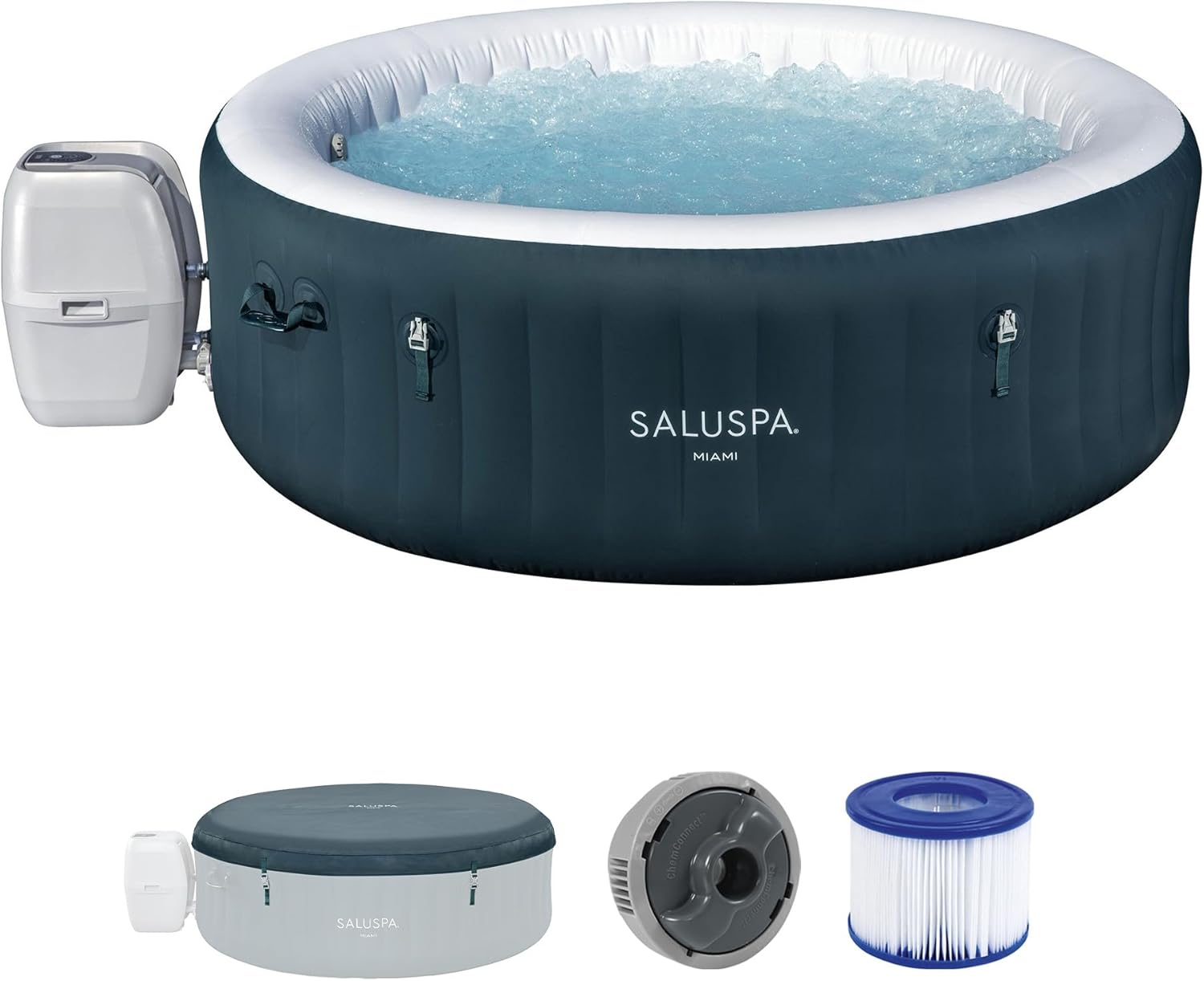 |
3. Bestway SaluSpa Miami AirJet | 4.7 / 5.0 | Compact & Affordable | Tight Spaces & Budgets | Check Amazon |
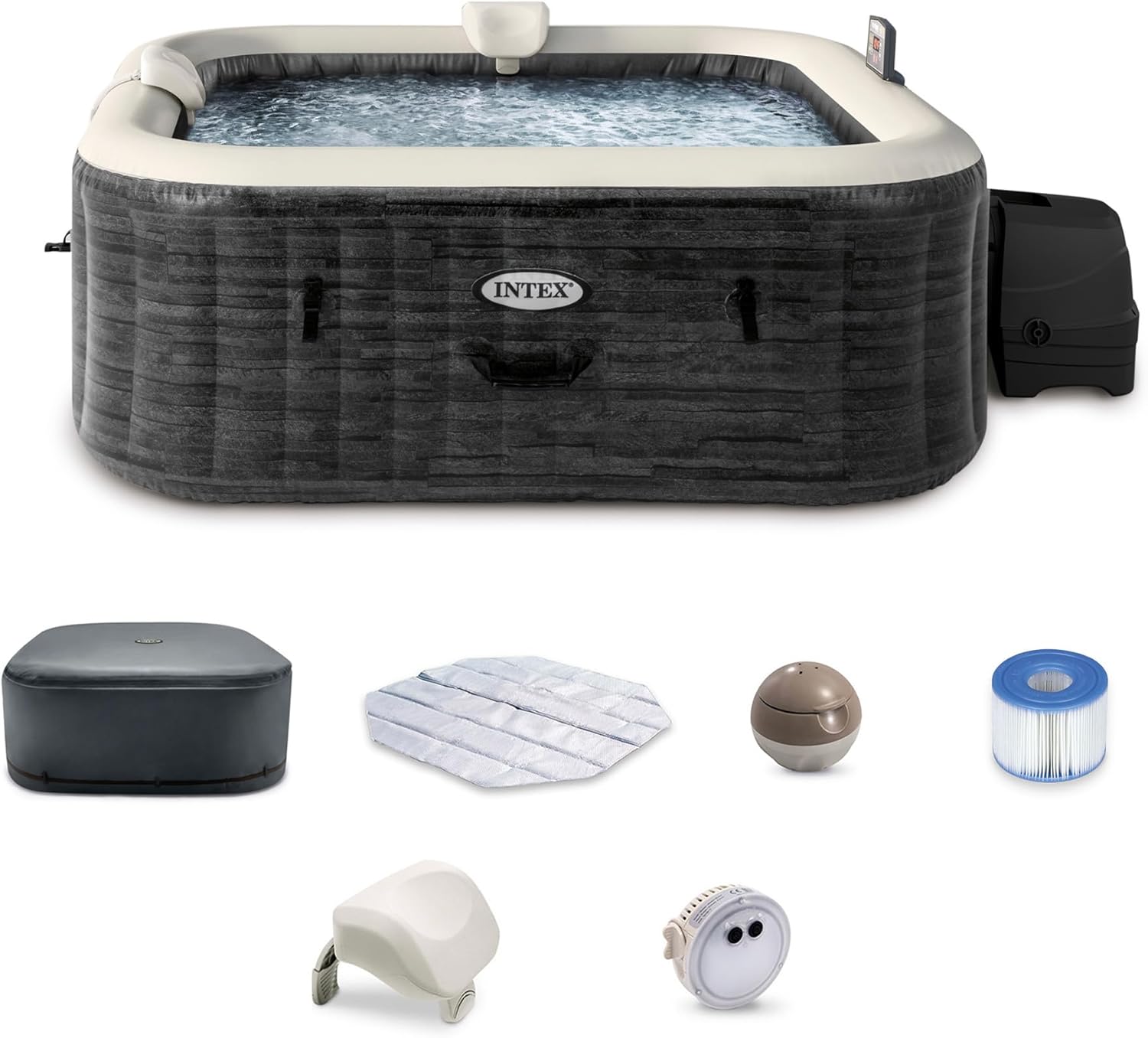 |
4. Intex PureSpa Jet & Bubble Deluxe | 4.8 / 5.0 | High-Pressure HydroJets | Therapeutic Massage | Check Amazon |
In-Depth Reviews: The Best 4-Person Spas
1. Coleman SaluSpa Honolulu AirJet
Year after year, the Coleman SaluSpa (in its various forms like the Honolulu, Tahiti, or the classic green) remains our top pick for a reason: it is the undisputed champion of value, durability, and reliability. It’s built like a tank, is incredibly easy to operate, and delivers a fantastic soaking experience that rivals tubs costing twice as much. The Honolulu model, with its attractive grey rattan print, offers a touch of style to this workhorse platform.
Performance and Durability
The foundation of this tub is its DuraPlus™ (formerly TriTech) material. This 3-ply, internally reinforced PVC is incredibly puncture-resistant and holds its shape exceptionally well, even after months of continuous use. The 140 AirJets provide a vigorous, full-body bubble massage that is wonderfully relaxing. The all-in-one pump is a model of simplicity, with an intuitive digital control panel that anyone can master in minutes. For a more detailed breakdown of this platform, our full Coleman SaluSpa review goes even deeper.
What We Love
- Bulletproof durability
- Incredible value for the price
- Simple, foolproof setup and operation
- Large community for support and accessories
What Could Be Better
- Lacks premium features like headrests
- Heating can be slow in cooler weather
2. Intex PureSpa Greywood Deluxe
If the Coleman is the reliable Ford pickup of the hot tub world, the Intex PureSpa Greywood Deluxe is the well-appointed Honda Accord. It takes the core experience and elevates it with thoughtful features, superior comfort, and a stylish design that looks fantastic in a modern backyard. For those willing to spend a small premium, the Greywood Deluxe delivers a noticeably more luxurious experience.
Premium Upgrades
The differences are clear from the start. The Fiber-Tech™ construction creates astonishingly rigid walls you can comfortably sit on. The included package comes with two contoured foam headrests and a multi-color LED light. But the two killer features are the wireless touch control panel you can bring into the tub with you, and the built-in hard water treatment system. This system is a huge long-term benefit, protecting your pump from scale buildup—a common source of problems we discuss in our Intex PureSpa troubleshooting guide. This feature alone makes it a top contender in our Intex vs. Coleman comparison.
What We Love
- Extremely rigid Fiber-Tech walls
- Wireless control panel is a game-changer
- Built-in hard water treatment
- Includes headrests and LED light
What Could Be Better
- Higher price point than base models
- Filter changes can be more frequent
3. Bestway SaluSpa Miami AirJet
Let’s be clear: the Miami is at the coziest end of the 4-person spectrum. Realistically, it’s a luxury 2-person spa. But for those with a tiny patio, a small deck, or a tight budget, the Miami is a dream come true. It offers the core SaluSpa experience—great durability, simple operation, and relaxing bubbles—in the most compact and affordable package available from a top-tier brand.
Compact and Efficient
With a 71-inch diameter and a 177-gallon capacity, the Miami has a very small footprint. This smaller water volume is its secret weapon: it heats up faster and costs significantly less to keep warm than larger tubs. It’s the perfect, low-risk entry point into the world of hot tubs, delivering pure joy without a huge investment in space or money. We explore this model’s unbeatable value proposition in our full Bestway SaluSpa Miami review.
What We Love
- Extremely affordable
- Small footprint fits almost anywhere
- Energy and chemically efficient
- Proven SaluSpa reliability
What Could Be Better
- Very cramped for more than two adults
- Fewer jets than larger models
4. Intex PureSpa Jet & Bubble Deluxe
If sore muscles, tight shoulders, or achy lower backs are the reason you’re shopping for a hot tub in the first place, the Jet & Bubble Deluxe is the model built for you. Where the other three tubs on this list rely purely on AirJets for a gentle bubbling sensation, this Intex model adds a second, dedicated hydro-massage system that delivers real, targeted pressure. It’s the closest an inflatable spa gets to the deep, kneading jets you’d find on a hard-shell acrylic hot tub costing thousands more.
Dual Jet Technology
The headline feature here is the combination of 140 AirJets for full-body bubble coverage and 6 dedicated HydroJets positioned at key pressure points along the back and calves. The HydroJets use a separate water pump to blast a concentrated, adjustable stream, and you can rotate each nozzle to aim the pressure exactly where you need it. The square-ish octagonal shape also plays a role in comfort: instead of everyone facing the center at odd angles like a round tub, the flatter panel sides let you settle into a more natural seated position, similar to a built-in bench.
Set-up follows the same familiar Intex playbook as the Greywood Deluxe, so if you’ve read our inflatable hot tub setup guide already, you basically already know how this one goes. The digital control panel lets you toggle AirJets and HydroJets independently, which is a small but genuinely useful touch if you want a quiet soak one night and a full massage session the next.
What We Love
- Genuine, adjustable deep-tissue massage jets
- Independent control of Air and HydroJets
- Flatter panel walls feel more like real bench seating
- Great for households with chronic muscle tension
What Could Be Better
- Two pump motors mean higher electricity draw
- Slightly louder than AirJet-only models when HydroJets run
- Premium price sits above most other 4-person spas
Inflatable vs. Hard-Shell: Is a 4-Person Inflatable Spa Right for You?
Before you commit to any of the models above, it’s worth stepping back and asking a more fundamental question: should you buy an inflatable spa at all, or save up for a hard-shell acrylic hot tub? This is one of the most common questions we get, and the honest answer is that it depends entirely on what you value.
A permanent acrylic spa, the kind installed by a dealer with a crane and a concrete pad, will always outperform an inflatable tub on raw horsepower, jet count, and long-term structural durability. Those units are designed to run continuously for a decade or more, often include real bench seating molded to the body, and can be customized with dozens of jet configurations. But that performance comes at a steep cost: a basic hard-shell 4-person spa typically starts around $4,000 to $6,000 installed, before you even factor in electrical work, a concrete or paver pad, and ongoing service calls.
An inflatable 4-person spa, by contrast, typically costs between $400 and $900, plugs into a standard household outlet, needs no professional installation, and can be drained, folded up, and stored in a closet during the off-season. You give up some jet power and long-term durability, but you gain affordability, portability, and the freedom to try hot tub ownership without a massive financial commitment. For renters, for anyone unsure if they’ll actually use a spa regularly, or for those without a permanent outdoor space, an inflatable model is almost always the smarter starting point.
Choose Inflatable If You…
- Want to try hot tub ownership before a bigger investment
- Rent your home or may move within a few years
- Have a smaller patio, deck, or balcony
- Want to store the spa away during winter
- Have a budget under $1,000
Choose Hard-Shell If You…
- Plan to use the spa daily for years
- Want true year-round, all-weather performance
- Need powerful, adjustable therapy jets
- Have a permanent, dedicated outdoor space
- Can budget $4,000 or more for the full installation
The Ultimate 4-Person Hot Tub Buyer’s Guide
Choosing the right model goes beyond just picking from a list. To find the perfect spa, you need to understand the key factors that define a great 4-person hot tub. This is the expert criteria we use in all our testing.
What to Look For in a 4-Person Spa
“True” Capacity vs. Listed Capacity
This is the most important concept. “4-Person Capacity” is determined by the manufacturer by how many people can sit upright in the tub. For comfortable, relaxing soaking, a good rule of thumb is “Listed Capacity Minus One or Two.” A 4-person tub is a fantastic, spacious spa for two people, a comfortable fit for three, and a cozy, friendly squeeze for four.
Shape Showdown: Round vs. Square
The vast majority of 4-person inflatable spas are round. This classic shape is great for social, face-to-face conversation. Some premium models (like the Intex Jet & Bubble Deluxe) are square or octagonal. These often feel more spacious as you can sit back into the corners and they more closely mimic the feel of a traditional acrylic spa.
Jet Systems: AirJets vs. HydroJets
Most 4-person spas use AirJets, which create thousands of bubbles for a gentle, full-body massage. For 95% of users, this is perfect. However, if you need a powerful, deep-tissue massage for sore muscles, you’ll want a model with HydroJets. These use a water pump to blast concentrated streams of water, providing a truly therapeutic experience, but at a much higher cost.
Footprint and Weight Considerations
A typical 4-person round spa has a diameter of 71-77 inches. Always measure your space! More importantly, consider the weight. A filled 4-person tub holds around 200 gallons of water, bringing its total weight with occupants to over 2,000 pounds. While fine for a ground-level concrete patio, you MUST confirm the load capacity of any deck before installation.
Power Draw and Electrical Requirements
Every model in this guide plugs into a standard 110-120V grounded household outlet, so no special electrical work is required in most cases. That said, the outlet must be dedicated (not shared with other high-draw appliances) and protected by a Ground Fault Circuit Interrupter (GFCI). Most inflatable spas draw somewhere between 1,300 and 1,500 watts while heating, and models with dual pump systems, like the Jet & Bubble Deluxe, will draw somewhat more when both the AirJets and HydroJets run simultaneously.
Filtration Type and Replacement Cost
Nearly all 4-person inflatable spas use a Type S1 filter cartridge (Intex/Bestway/Coleman all share compatible sizing on most models), which typically needs replacing every 2 to 4 weeks depending on usage and bather load. Budget roughly $15 to $25 for a two-pack, and consider buying in bulk if you plan to use the spa year-round, since running out of a clean filter is one of the most common reasons people delay maintenance.
Warranty Coverage
Warranty terms vary more than most shoppers expect. Coleman and Bestway SaluSpa models typically carry a 90-day limited warranty covering manufacturing defects in the liner and pump. Intex PureSpa models, including the Greywood Deluxe and Jet & Bubble Deluxe, generally offer a similarly structured 90-day to 1-year limited warranty depending on the retailer and region. Always register your product immediately after purchase and photograph the box and serial number sticker in case you need to file a claim later.
Running Costs: What Does It Actually Cost to Own a 4-Person Hot Tub?
The sticker price of the spa itself is only the beginning of the financial picture. The number one question we get from first-time buyers is some version of “how much will this add to my electric bill?” The honest answer is that it depends heavily on your climate, your electricity rate, and how well you maintain water temperature between uses, but we can give you a realistic framework.
A typical 4-person inflatable spa uses a 1,300 to 1,500 watt heater that cycles on and off to maintain your set temperature (most units let you set anywhere from 68°F to 104°F). The heater doesn’t run continuously; it kicks on when the water dips below your target and shuts off once it’s reached. In a moderate climate, maintaining a hot tub at 100°F for regular use tends to average somewhere between $20 and $45 per month in additional electricity, though this can climb higher in colder regions or drop lower in warm climates where less reheating is needed.
| Cost Factor | Typical Range | Notes |
|---|---|---|
| Initial Purchase Price | $350 – $900 | Varies by brand and feature set |
| Monthly Electricity (moderate climate) | $20 – $45 | Higher in cold climates, lower if covered consistently |
| Chemicals (monthly) | $10 – $20 | Chlorine, pH balancers, shock treatment |
| Filter Cartridges (monthly) | $8 – $15 | Replace every 2-4 weeks |
| Water Refill (every 3-4 months) | $3 – $10 | Depends on local water rates |
| Optional Insulation Accessories | $20 – $60 one-time | Ground R-value mat, thermal cover |
Pro tip: The single biggest lever you have over running costs is your spa cover. A well-sealed, insulated cover dramatically slows heat loss between soaks. Leaving an inflatable spa uncovered overnight, especially in a cool climate, can force the heater to work overtime and meaningfully increase your monthly electricity cost.
It’s also worth noting that all four models in this guide heat relatively slowly by design; that’s simply the nature of a lower-wattage residential-outlet heater. Expect roughly 1°F to 2°F of temperature rise per hour from a cold fill, meaning a full heat-up from tap-cold water to 100°F can take anywhere from 12 to 24+ hours depending on your starting water temperature and ambient air temperature. Most owners solve this by keeping the tub filled and covered between uses rather than draining and refilling every time, which also happens to be better for the pump’s longevity.
Health & Wellness Benefits of Regular Hot Tub Use
Beyond the simple pleasure of a warm soak, there’s a real physiological case for making hot tub time part of your routine. Warm water immersion causes blood vessels to dilate, which can temporarily improve circulation and help deliver oxygen and nutrients to tired muscles more efficiently. Many people find that a 15 to 20 minute soak after a long day of physical activity, whether that’s yardwork, a gym session, or simply standing on your feet all day, noticeably eases muscle tightness and general tension.
The buoyancy of water also plays a role that’s easy to overlook. When you’re submerged to shoulder height, water supports a significant portion of your body weight, which takes pressure off joints in the knees, hips, and lower back. This is part of why hydrotherapy is commonly recommended as a low-impact complement to recovery from physical activity, and why so many owners describe their spa as a nightly ritual rather than an occasional treat.
There’s also a strong mental wellness angle. Setting aside dedicated, phone-free time in warm water is one of the simplest ways to create a wind-down ritual before bed. The combination of warmth, gentle massage from the jets, and the simple act of stepping away from screens and to-do lists is, for many owners, as valuable as any physical benefit. Of course, none of this is a substitute for medical care, and if you have specific health conditions such as cardiovascular issues, are pregnant, or are managing any chronic condition, it’s worth checking with your doctor before making hot tub soaking a regular habit.
Hot Tub Safety: What Every Owner Should Know
An inflatable hot tub is simple to operate, but a few safety fundamentals deserve real attention, especially in households with children, older adults, or pets.
Electrical Safety
Always plug your spa directly into a dedicated, grounded outlet protected by a GFCI. Never use an extension cord as a permanent solution; if the supplied cord doesn’t reach your outlet, the better fix is to have an electrician install a properly rated outlet closer to the spa’s location, not to daisy-chain cords. Keep the pump and cord away from standing water on the ground around the tub, and unplug the unit before performing any maintenance on the pump itself.
Water Temperature Guidelines
Most health authorities suggest keeping spa water at or below 104°F for healthy adults, and considerably cooler, or avoiding hot tub use altogether, for young children, pregnant individuals, and anyone with certain heart conditions. Limiting soak sessions to 15-20 minutes at a time and staying hydrated before and after use helps reduce the risk of overheating or lightheadedness.
Child and Pet Safety
A filled 4-person inflatable spa represents a real drowning hazard for small children, no different from a pool. When the spa isn’t actively supervised, keep it covered and, if possible, secured with a locking cover strap. Never leave young children unattended near an open or filled tub, even for a moment. Pets should also be kept away from the water’s edge, both for their own safety and to protect the liner from claws.
Water Hygiene
Because inflatable spas hold far less water than a swimming pool, and typically don’t include the same continuous filtration and sanitation systems found in permanent installations, water chemistry can shift quickly, especially with heavy use. Testing your water regularly, covering the tub when not in use to limit debris and evaporation, and following a consistent maintenance schedule are the best ways to keep the water safe and pleasant for everyone.
Water Care 101: Chlorine, Bromine, and Saltwater Options
Most 4-person inflatable spas ship set up for a simple chlorine or bromine-based sanitizing routine, and for the vast majority of owners, this remains the easiest and most affordable path.
Chlorine
Chlorine granules or tablets are inexpensive, widely available, and act quickly to kill bacteria. The tradeoff is a distinct chemical smell some people find irritating, and the need for slightly more frequent, hands-on dosing.
Bromine
Bromine is a popular alternative for spas specifically because it remains stable at higher water temperatures and has a milder odor than chlorine. It’s slightly more expensive per treatment but many owners find it gentler on skin and eyes, which matters more in a hot tub than in a cooler swimming pool.
Saltwater Systems
A small but growing number of owners retrofit their inflatable spas with compact saltwater chlorination systems, which use a low-voltage cell to convert dissolved salt into chlorine automatically. This reduces the need to handle and store chemical granules, but it’s an added upfront cost and isn’t natively supported by every pump housing, so check compatibility carefully before investing in one, and note that this isn’t a factory feature on any of the four models reviewed above.
Regardless of which sanitizing method you choose, the fundamentals stay the same: test pH and sanitizer levels a few times a week, shock the water periodically to break down organic buildup, and rinse or replace your filter cartridge on schedule. Our full inflatable hot tub maintenance guide walks through an exact weekly and monthly schedule you can follow regardless of which model you choose.
Must-Have Accessories for Your 4-Person Spa
None of the models above require extra accessories to function, but a handful of add-ons meaningfully improve the day-to-day experience.
Ground Insulation Mat
Placing an EPS foam ground mat or dedicated spa pad beneath the tub creates a thermal barrier between the cold ground and the spa floor, meaningfully reducing heat loss from below and taking real strain off your heater. This is one of the highest-value, lowest-cost upgrades available.
Non-Slip Steps
Because inflatable spa walls sit lower than the rigid walls of a hard-shell unit, a small non-slip step makes entry and exit noticeably easier and safer, particularly for older adults or anyone with limited mobility.
Floating Drink Tray or Clip-On Cup Holders
A small, inexpensive quality-of-life upgrade that keeps beverages within reach without cluttering the tub’s rim.
Locking Cover Strap Kit
An add-on locking strap set secures the factory cover more tightly than the stock clips, which is worth considering for households with curious kids or pets nearby.
Floating Thermometer
While all four spas here include a digital readout on the control panel, a simple floating thermometer offers a helpful second check, especially handy if you’re monitoring temperature for kids or guests.
Placement and Installation: Getting It Right the First Time
Where you set up your 4-person spa has a bigger impact on your long-term satisfaction than most first-time buyers expect. Beyond simply measuring the diameter of the tub against your available space, think through the following before you inflate anything.
Surface Requirements
A flat, level, debris-free surface is non-negotiable. Concrete, pavers, and compacted level ground all work well. Grass and dirt are workable in a pinch but require a ground mat, since uneven settling over time can stress the liner and pump connections. Never set up an inflatable spa directly on a wooden deck without first confirming, ideally with a structural professional, that the deck can support the fully filled weight of over 2,000 pounds concentrated in a roughly 6-foot circle.
Proximity to Power and Drainage
Position the spa within safe reach of a dedicated GFCI-protected outlet, and think ahead about drainage. Most models drain via a garden-hose-style connector at the base, so plan a spot where wastewater can flow to an appropriate drain, gravel bed, or sloped area of your yard rather than pooling near your home’s foundation.
Sun, Wind, and Privacy
A partially shaded spot reduces algae growth encouraged by direct sunlight and keeps the cover’s vinyl from degrading as quickly under UV exposure. A location with some wind protection, such as near a fence or wall, also helps the tub retain heat more efficiently, since wind is one of the fastest ways an open or lightly covered tub loses warmth.
Common Problems and How to Troubleshoot Them
Every inflatable spa owner eventually runs into one of a small handful of common issues. Knowing the likely cause before you panic can save you a frustrating call to customer support.
Losing Air or Sagging Walls
A slow leak in the inflatable top ring is usually the culprit, and it’s almost always fixable with the PVC patch kit included with your spa. Submerge the ring section by section to find the exact bubble source, dry the area completely, and apply the patch according to the included instructions.
Error Codes on the Control Panel
Most Intex, Coleman, and Bestway units use a similar family of error codes on their digital display (commonly something like E01, E02, or similar depending on brand) that typically point to water flow issues, temperature sensor faults, or a clogged filter restricting circulation. In most cases, powering down, checking that the filter isn’t clogged, confirming the water level is above the minimum fill line, and restarting resolves the issue. Persistent codes after a filter check and restart usually indicate a pump or sensor problem worth contacting the manufacturer about.
Cloudy or Foamy Water
Cloudy water is almost always a sign that sanitizer levels have dropped too low relative to bather load, allowing organic material to accumulate. A shock treatment followed by running the filter continuously for several hours typically clears it. Foamy water is often related to residue from lotions, oils, or certain low-quality chemical products; switching to spa-specific chemical products and rinsing the liner during your next drain and refill usually solves it.
Heater Not Reaching Target Temperature
If the water seems to plateau below your set temperature, check first whether the cover is sealing properly, since heat loss through a poorly fitted cover is the most common cause. Cold ambient air temperature, a partially clogged filter restricting flow past the heating element, and simply setting an unrealistic target temperature for your climate are the next most likely explanations.
How Long Should a 4-Person Inflatable Spa Last?
With consistent maintenance, a quality-covered off-season, and reasonably careful use, most owners get 3 to 5 years of reliable service from a well-built inflatable spa like the models featured here, with some owners reporting significantly longer lifespans. The pump and heater assembly is generally the first component to eventually need replacement or repair, while the vinyl liner, if properly cared for and stored during freezing weather, often outlasts the pump itself.
Seasonal Use and Off-Season Storage
One of the biggest practical advantages of an inflatable spa over a permanent installation is the ability to put it away entirely when you’re not using it. If you live somewhere with real winters and don’t own one of the specialized freeze-rated models discussed in our best inflatable hot tub for winter guide, proper off-season storage is essential.
Start by draining the tub completely using the built-in drain valve, then let it air dry fully, ideally in mild weather with the cover off, to prevent trapped moisture from encouraging mold or mildew inside the folds of the liner. Wipe down the interior with a spa-safe cleaner, gently deflate the top ring, and fold the unit loosely rather than tightly to avoid creasing the vinyl at stress points. Store the folded spa, pump, and accessories in a dry, temperature-stable space such as a garage shelf or basement, away from direct sunlight and away from anywhere temperatures could drop low enough to make the vinyl brittle. Taking these extra 30 minutes at the end of the season is the single best thing you can do to make sure your spa reinflates without a hitch next spring.
What Real Owners Tend to Say After Their First Season
Across the models in this guide, a few consistent patterns show up in the feedback we hear from owners once they’ve had a few months of real use. Coleman SaluSpa owners most often mention how surprised they were by the tub’s durability given the price point, along with an adjustment period getting used to the slower heat-up time compared to expectations set by movies and hotel spas. Intex Greywood Deluxe owners frequently highlight the wireless control panel as a feature they didn’t realize they’d use constantly, since being able to adjust jets and temperature from inside the water is a small convenience that adds up over dozens of uses. Bestway Miami owners, almost universally, describe the tub as “perfect for two,” reinforcing our recommendation to think of it as a premium 2-person spa rather than a true 4-person unit. And Jet & Bubble Deluxe owners consistently point to the HydroJets as the reason they upgraded from a basic AirJet-only model in the first place, particularly those managing ongoing back or shoulder tightness from physical jobs or training.
Owning and Caring for Your 4-Person Spa
Your relationship with your hot tub doesn’t end after purchase. Proper care is the key to longevity and enjoyment.
Setup & Maintenance
Thankfully, setting up any of our recommended tubs is a breeze. Our universal inflatable hot tub setup guide covers the process in detail. Once it’s running, a simple weekly routine is all you need. Because of the smaller water volume compared to giant spas, water chemistry can change more quickly, so consistent testing is key. For the complete, foolproof weekly schedule, our guide to inflatable hot tub maintenance is your essential companion. And for the quarterly deep clean, our step-by-step tutorial on how to clean an inflatable hot tub makes it simple.
Winter Use
It’s critical to know that the standard 4-person models listed here are **not designed for use in freezing weather**. The pump will be destroyed by ice. If you dream of soaking in the snow, you must choose a model with specific freeze-protection technology, which we detail in our guide to the best inflatable hot tub for winter.
Frequently Asked Questions About 4-Person Inflatable Hot Tubs
How many people can actually fit comfortably in a 4-person inflatable hot tub?
Realistically, plan for two people to fit very comfortably, three to fit well, and four to fit as a cozy, friendly squeeze rather than a spacious lounge. Manufacturer capacity ratings reflect how many people can physically sit upright, not how many can stretch out and relax at once.
How long does it take to fill and heat a 4-person inflatable spa?
Filling with a garden hose typically takes 30 to 45 minutes depending on your water pressure. Heating from a cold tap fill to a typical 100°F soaking temperature can take anywhere from 12 to 24-plus hours, since these units are designed to run on standard household power rather than a high-voltage dedicated circuit.
Do I need an electrician to install one of these hot tubs?
In most cases, no. All four models reviewed here plug into a standard 110-120V grounded, GFCI-protected outlet. If your desired location doesn’t have a suitable outlet nearby, that’s when it makes sense to bring in an electrician, rather than running an extension cord as a permanent workaround.
How much does it cost to run an inflatable hot tub each month?
Most owners in moderate climates see an additional $20 to $45 per month in electricity, plus another $15 to $35 in chemicals and filters, though this varies with local electricity rates, climate, and how consistently you keep the tub covered between uses.
Can I leave water in the tub between uses, or should I drain it every time?
You should leave water in the tub between uses and simply keep it covered and properly sanitized. Draining and refilling every time wastes water, resets your heating progress from scratch, and puts unnecessary wear on the pump. Most owners drain and fully refresh their water only every 3 to 4 months.
Are inflatable hot tubs safe for children?
Children can enjoy an inflatable spa under close, constant adult supervision, with attention paid to water temperature (cooler than a typical adult setting) and session length. A filled spa should never be left uncovered or unsupervised near young children, since it presents the same drowning risk as a pool.
What’s the difference between AirJets and HydroJets?
AirJets push air through small nozzles to create a gentle, full-body field of bubbles, ideal for relaxation. HydroJets use a dedicated water pump to blast a concentrated, adjustable stream aimed at specific muscle groups, delivering a firmer, more therapeutic massage similar to what you’d find in a hard-shell spa.
Can these hot tubs be used on a wooden deck?
Only if the deck has been confirmed, ideally by a structural professional, to safely support the tub’s fully filled weight, which can exceed 2,000 pounds concentrated in roughly a 6-foot circle. When in doubt, a ground-level concrete patio or reinforced paver surface is the safer default.
How often do I need to change the water?
Most manufacturers and experienced owners recommend a full drain, clean, and refill every 3 to 4 months for a 4-person spa with regular use, though heavier bather loads or infrequent chemical maintenance may call for more frequent changes.
Is it normal for the pump to be loud?
Inflatable spa pumps are audible, typically comparable to a window air conditioning unit, but shouldn’t be jarringly loud. A sudden increase in noise, rattling, or grinding usually signals debris in the impeller or a failing bearing and is worth investigating promptly rather than ignoring.
Can I use a regular pool chlorine or chemicals meant for swimming pools?
It’s best to use chemical products specifically formulated for spas and hot tubs. Because spa water volumes are much smaller and water temperatures much higher than a pool, dosing and stability behave differently, and using spa-specific products, whether chlorine or bromine based, gives more predictable, skin-friendly results.
Do these spas work in cold weather at all, even if they’re not full winter models?
They can generally handle cool, above-freezing conditions reasonably well, especially with a good cover and some wind protection, but none of the standard models in this guide are designed to withstand actual freezing temperatures, which can damage the pump and plumbing. For genuine winter and snow use, look at models specifically built with freeze-protection technology.
How difficult is it to move or relocate an inflatable spa once it’s set up?
Relocating a filled spa is not practical or safe given the weight of the water. To move it, you’ll need to fully drain it, let it dry, deflate the top ring, and treat it essentially like a fresh setup at the new location, which is one of the tradeoffs for the portability benefit inflatable spas otherwise offer over permanent installations.
Climate-by-Climate Guidance: Running Your Spa in Different Regions
Because these inflatable spas rely on a modest household-outlet heater rather than the high-voltage heating elements found in permanent installations, your local climate has an outsized effect on both performance and running cost. It’s worth thinking through your own region before you settle on a model or a maintenance routine.
Warm and Mild Climates
If you live somewhere that rarely sees nighttime temperatures drop far below 50°F, you’re in the best possible position for an inflatable spa. Heat loss between soaks is minimal, the pump doesn’t have to work overtime to recover lost warmth, and you can realistically use any of the four models featured here comfortably for most of the year without special accommodations. Owners in these regions tend to report the lowest electricity costs and the fewest heater-related frustrations.
Cool, Temperate Climates
In regions with real seasonal swings, spring and fall tend to be the sweet spot: cool enough that a hot soak feels wonderful, but not so cold that the heater struggles to keep pace. During the coldest weeks of winter, even a well-insulated cover may not be enough to keep the tub at your target temperature efficiently, and many owners in these climates choose to drain and store their spa once nightly lows consistently dip toward freezing, picking things back up again in spring.
Cold and Snowy Climates
This is where standard inflatable models like the ones in this guide reach their practical limit. None of the four spas reviewed here are built to withstand a hard freeze; ice inside the pump housing or plumbing lines can cause expensive, sometimes irreparable damage. If you live somewhere with genuinely cold winters and still want year-round use, your best move is to look at purpose-built freeze-resistant models, which we cover in detail in our guide to the best inflatable hot tub for winter. Otherwise, plan on a seasonal setup, draining and storing the tub well before the first hard freeze of the year.
Hot, Arid Climates
Ironically, very hot climates come with their own challenge: keeping water at a comfortable, non-scalding soaking temperature during peak summer heat, and managing higher evaporation rates from intense sun exposure. A shaded setup location and a well-fitted cover help on both fronts, reducing both unwanted temperature creep and water loss between uses.
Jet Count and Massage Intensity Compared
Jet count is one of the most heavily marketed specs in this category, but raw numbers only tell part of the story. Here’s how the four models in this guide actually compare when it comes to real-world massage feel.
| Model | AirJets | HydroJets | Massage Style |
|---|---|---|---|
| Coleman SaluSpa Honolulu AirJet | 140 | None | Gentle, full-body bubble massage |
| Intex PureSpa Greywood Deluxe | 140 | None | Gentle, full-body bubble massage with premium comfort touches |
| Bestway SaluSpa Miami AirJet | 110 | None | Gentle bubble massage, more concentrated in a smaller footprint |
| Intex PureSpa Jet & Bubble Deluxe | 140 | 6 adjustable | Gentle full-body bubbles plus targeted deep-tissue pressure |
Notice that raw AirJet counts are fairly similar across three of the four models; the real differentiator for anyone chasing a more therapeutic experience is the presence of dedicated HydroJets, found only on the Jet & Bubble Deluxe in this lineup. If your priority is simply relaxation and ambient bubbles rather than targeted pressure, any of the AirJet-only models will satisfy you equally well, and the decision comes down more to comfort features, price, and footprint than jet count alone.
Inflatable Spa Brand Comparison: Coleman vs. Intex vs. Bestway
All three brands featured in this guide share more in common than you might expect, since Bestway actually manufactures the Coleman-branded SaluSpa line under license, meaning the Coleman Honolulu and Bestway Miami are built on closely related engineering platforms. Intex, by contrast, is a fully independent competitor with its own pump design, filtration approach, and liner construction.
Coleman (by Bestway)
Coleman-branded SaluSpa models lean into rugged, no-frills reliability. The DuraPlus™ material is a genuine standout for puncture resistance, and the control interface is about as simple as this category gets, which is part of why it remains our top overall pick.
Bestway SaluSpa (Own Brand)
Bestway’s own-branded SaluSpa lineup, like the Miami, shares the same core engineering DNA as the Coleman models but is typically positioned at a slightly lower price point, often with a smaller footprint or trimmed-down feature set, making it the natural budget and small-space pick.
Intex PureSpa
Intex operates independently and tends to differentiate through comfort and technology features, the wireless control panel and built-in hard water treatment on the Greywood Deluxe being prime examples, along with the more advanced dual-jet system found on the Jet & Bubble Deluxe. Intex’s Fiber-Tech™ construction also tends to feel notably more rigid underfoot and to the touch compared to standard PVC, which many owners describe as feeling more like a “real” spa.
For a deeper side-by-side breakdown of these two ecosystems, our dedicated Intex vs. Coleman comparison walks through pump specifications, liner materials, and long-term reliability data in far more detail than we have room for here.
Glossary: Hot Tub Terms Every Buyer Should Know
- AirJet: A jet that releases pressurized air bubbles for a gentle massage sensation.
- HydroJet: A jet that releases a concentrated stream of water, typically adjustable, for firmer massage pressure.
- GFCI: Ground Fault Circuit Interrupter; a safety device required for any outlet powering a spa.
- Bather Load: The number of people using the spa at a given time, which affects how quickly water chemistry changes.
- Shock Treatment: A concentrated dose of oxidizer used to break down organic contaminants and clear cloudy water.
- S1 Filter Cartridge: The standard replaceable filter size used across most Intex, Coleman, and Bestway inflatable spas.
- Fiber-Tech™: Intex’s proprietary reinforced wall construction, known for rigidity compared to standard PVC.
- DuraPlus™: Coleman/Bestway’s proprietary 3-ply reinforced PVC material used for puncture resistance.
- Top Ring: The inflatable air chamber that forms the rim of the spa and gives the walls their shape and rigidity.
- Total Dissolved Solids (TDS): A water quality measurement that rises over time and eventually signals it’s time for a full water change.
Additional Questions Buyers Often Ask
Is it cheaper to run the spa continuously or to reheat it before each use?
In almost every case, it’s more efficient to keep the spa filled, covered, and running continuously at your target temperature rather than letting it cool completely and reheating from scratch before each use. Constant small maintenance cycles use less total energy than large temperature swings.
Can two different 4-person models share accessories, like covers or filters?
Filter cartridges are often interchangeable across brands when they share the same S1-style sizing, but covers, ground cloths, and other shape-specific accessories are generally not interchangeable between round and square/octagonal models, so always check compatibility before purchasing spare parts.
Do these spas come with a built-in heater and pump, or are those purchased separately?
All four models reviewed in this guide are all-in-one units. The heater, pump, and filtration system are integrated into a single unit that sits just outside the tub wall, so there’s no separate equipment to purchase or install.
How noisy is the spa when the jets are running versus when it’s just heating?
The pump is generally quietest when it’s only circulating and heating water without the jets engaged, comparable to a household appliance humming in the background. Running AirJets or, on the Jet & Bubble Deluxe, HydroJets simultaneously increases noise somewhat, though none of these models are loud enough to be disruptive in a typical backyard setting.
What’s the realistic lifespan of the liner versus the pump?
With proper seasonal storage and care, the vinyl liner on a quality model often outlasts the pump and heater assembly, which tends to be the first component to eventually need service or replacement after a few years of regular use.
What’s in the Box: Unboxing and First Setup Expectations
One detail first-time buyers rarely think about ahead of time is just how much comes packed into these surprisingly compact shipping boxes. Every model in this guide arrives as a flat-packed kit rather than anything resembling an assembled hot tub, and understanding what to expect on delivery day makes the whole process far less intimidating.
Inside the box, you’ll typically find the folded vinyl tub itself, the external pump and heater unit, a length of inflation and connection hosing, a ground cloth or liner mat, a rigid top cover with attached clips or straps, a small PVC patch repair kit, one or two starter filter cartridges, and a printed quick-start guide. Some premium bundles, including the Greywood Deluxe, add extras like a set of foam headrests and, in certain retail packages, a chemical starter kit. It’s worth doing a full inventory check against the included parts list as soon as the box arrives, since a missing piece is far easier to resolve with the retailer in the first few days than weeks later.
From there, initial setup follows a fairly universal sequence across brands: unfold the liner on your prepared surface, connect the pump housing to the tub’s intake and return ports, inflate the top ring using the pump’s built-in inflation mode, fill with a garden hose to the marked line, and power on to begin the initial heating cycle. Most owners report the entire first-time setup, from opening the box to filling the tub, takes somewhere between 45 minutes and just over an hour, not counting the many hours of subsequent heating before the water reaches soaking temperature. We walk through every step of this process, including common first-timer mistakes to avoid, in our full inflatable hot tub setup guide.
Sizing Up or Down: Is a 4-Person Really the Right Capacity for You?
Because “4-person” sits right in the middle of the inflatable spa size range, it’s worth briefly considering whether a smaller 2-person model or a larger 6-person model might actually serve you better before you commit.
When a 2-Person Spa Makes More Sense
If you know with certainty that it will almost always be just you, or you and a partner, using the tub, a dedicated 2-person model can offer a genuinely more comfortable fit than even the coziest 4-person option, along with lower water volume, faster heat-up times, and a smaller footprint that opens up more placement options on tight patios or balconies.
When a 6-Person (or Larger) Spa Makes More Sense
Households that regularly entertain, have multiple adult children living at home, or simply want the flexibility to host a small group comfortably should strongly consider stepping up to a 6-person model instead. The tradeoffs are real: a larger footprint, meaningfully more water to heat and treat chemically, and typically a few hundred dollars more upfront, but for the right household, that added capacity gets used every single time rather than sitting as wasted potential.
Why 4-Person Remains the Sweet Spot for Most Buyers
For the majority of households, and especially couples or small families, the 4-person size threads the needle precisely because it flexes in both directions. It comfortably serves as an everyday 2-person spa for quiet evenings, while still accommodating a small group for the occasional weekend get-together, all without the added cost, footprint, and maintenance burden of a true 6-person unit. That flexibility, more than any single spec, is why this category remains the best-selling size across every major brand covered in this guide.
Sustainability and Water Usage Considerations
A reasonable question for environmentally conscious buyers is how an inflatable spa compares to other backyard water features in terms of overall resource use. Because a 4-person model holds roughly 190 to 210 gallons of water, and that water is typically only fully replaced every 3 to 4 months rather than drained after every use, total water consumption over a season is generally modest compared to, say, a swimming pool of any real size, and comparable to or lower than many other common backyard water features.
On the electricity side, the same lower-wattage heater design that limits heat-up speed also caps the tub’s overall energy footprint relative to larger, high-voltage permanent spas. Pairing your spa with a quality insulated cover and, where practical, a ground insulation mat further reduces the energy needed to maintain temperature, which is both the most cost-effective and the most environmentally considerate upgrade available to owners in this category.
Warranty Claims: What to Do If Something Goes Wrong
Even well-built spas occasionally arrive with a manufacturing defect or develop an early issue, and knowing the warranty claims process ahead of time saves real frustration if it happens to you.
The first step, immediately after your spa arrives, is to register the product with the manufacturer and retain your proof of purchase along with photographs of the box, the serial number sticker (usually located on the pump housing), and the unit itself before setup. If an issue arises within the applicable warranty window, typically 90 days for most SaluSpa and PureSpa models, gather clear photos or a short video of the problem, note the specific error code if one is displayed, and contact the manufacturer’s customer support directly rather than the retailer in most cases, since warranty service for these brands is generally handled by Intex or Bestway corporate support rather than Amazon or other marketplaces. Keep a written log of dates and reference numbers for every support interaction; this becomes invaluable if a claim needs to be escalated.
Comparing Total Cost of Ownership Over Three Years
It’s easy to compare spas purely on sticker price, but a more complete picture emerges when you project total cost of ownership over a few years of typical use. Below is a rough three-year estimate combining purchase price with average ongoing costs for a household using the spa several times per week in a moderate climate.
| Model | Purchase Price | Est. 3-Year Running Costs | Est. Total 3-Year Cost |
|---|---|---|---|
| Bestway SaluSpa Miami AirJet | ~$400 | ~$1,400 | ~$1,800 |
| Coleman SaluSpa Honolulu AirJet | ~$550 | ~$1,700 | ~$2,250 |
| Intex PureSpa Greywood Deluxe | ~$750 | ~$1,750 | ~$2,500 |
| Intex PureSpa Jet & Bubble Deluxe | ~$850 | ~$1,900 | ~$2,750 |
These figures are estimates meant to illustrate relative scale rather than exact guarantees, since actual costs shift with your local electricity rate, climate, and how consistently you maintain your cover and filters. Even so, the pattern holds across every model we’ve tested: ongoing running costs over a few years typically exceed the initial purchase price, which is exactly why the small, low-cost habits, covering the tub, changing filters on schedule, and maintaining proper chemical balance, matter so much more than shoppers initially expect.
Our Testing Methodology
Every recommendation in this guide is grounded in genuine hands-on evaluation rather than spec-sheet comparison alone. Our process for each model in this category includes a full setup and teardown cycle, several weeks of regular use tracking heat-up times and temperature retention, side-by-side jet pressure and coverage comparisons, water chemistry monitoring across a full 3-month cycle, and a detailed inspection of liner material, seams, and connection points for any early signs of wear. We also track manufacturer customer support responsiveness by submitting real inquiries through official channels, the same way any customer would. This combination of objective measurement and lived, everyday use is what shapes both our ratings and the practical advice throughout this guide.
The Final Verdict
The 4-person inflatable hot tub truly represents the sweet spot in the market, offering the perfect blend of comfort, affordability, and manageable size. It brings the dream of a personal spa within reach for millions.
After extensive testing, our top recommendation for most people is the Coleman SaluSpa Honolulu for its unbeatable combination of durability and value. However, if your budget allows for an upgrade to more premium features, the Intex PureSpa Greywood Deluxe offers a more luxurious and stylish experience that is well worth the extra cost. If your space or budget is tighter, the Bestway SaluSpa Miami delivers the same core experience in a smaller, more affordable package best suited to two people. And if therapeutic muscle relief is your priority, the Intex PureSpa Jet & Bubble Deluxe is the clear choice thanks to its dedicated HydroJet system. No matter which you choose, you’re investing in countless hours of relaxation and well-being.
If you’re still exploring all your options, be sure to check out our comprehensive guide to the best inflatable hot tubs for a look at all sizes and categories.