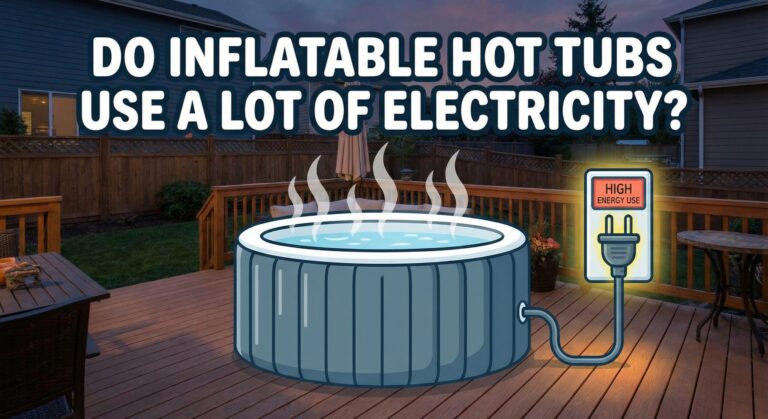
The Cost of Comfort: Unraveling Inflatable Hot Tub Electricity Usage
The allure of the inflatable hot tub is undeniable: instant, portable relaxation without the thousands of dollars in installation costs required for a fixed acrylic spa. Yet, for many prospective owners, the most daunting question remains: **Will this portable luxury drain my bank account through excessive electricity bills?** The answer is complex, but ultimately manageable. Inflatable hot tubs, such as the widely popular Coleman SaluSpa or Intex PureSpa models, are indeed power-hungry appliances, but their consumption is entirely predictable and, crucially, controllable.
The key to understanding the cost isn’t measuring the maximum wattage—which is typically a modest 1,000 to 1,300 watts for the heater on a 120V system—but rather mastering the **thermodynamic battle** the spa fights every hour it’s plugged in. The energy consumed is the direct result of replacing the heat lost to the environment. This extensive guide dives into the true cost drivers: the physics of heat loss, the cost breakdown of the mechanical components, and the critical role of external accessories and smart usage habits in slashing your monthly energy bill. We will move beyond anecdotal evidence and provide the quantitative knowledge needed to run your spa efficiently, ensuring your relaxation budget remains firmly in check.
🔗 **Before you plug in, understand the basics:**
How Does An Inflatable Hot Tub Work? (A Technical Breakdown)Table of Contents: Calculating Your Energy Bill
- 1. The Electrical Anatomy: Watts, Amps, and Kilowatt-Hours
- 2. The Four Vectors of Heat Loss (The True Cost Driver)
- 3. Mitigation Strategy I: Thermal Insulation (The ROI of Accessories)
- 4. Mitigation Strategy II: Smart Scheduling & Pump Optimization
- 5. Comparative Costs: Inflatable vs. Hard-Sided Spas
- Final Cost Management Tips
1. The Electrical Anatomy: Watts, Amps, and Kilowatt-Hours
To determine your monthly operating cost, you must translate the technical specifications of your spa into a financial metric: Kilowatt-hours (kWh). Every inflatable hot tub, such as models found in our Best Inflatable Hot Tub Guide, relies on three major electrical components, each with a defined power draw (wattage).
Power Breakdown of a Typical 120V Inflatable Spa (e.g., Intex/Coleman)
- **Heater Element:** 1,000 to 1,300 Watts (W)
- **Circulation/Filter Pump:** 50 to 100 Watts (W)
- **Air Blower (Jets):** 600 to 750 Watts (W)
**Critical Constraint:** On a standard 120V household circuit, most inflatable spas are limited to a maximum total draw of 12.5 Amps (A) to prevent tripping the breaker. This is why the heater element cannot run simultaneously with the air blower/jets—a fundamental operational safeguard that limits your maximum instantaneous power to roughly 1500W (Heater + Pump, or Blower + Pump). This is the key engineering difference between portable and hard-sided 240V spas.
1.1. The Cost Equation: Heater Run-Time is Everything
The heater is, by far, the dominant energy consumer. The total monthly cost is determined not by the heater’s wattage, but by the cumulative hours it spends running to counteract heat loss. The formula is simple:
(Heater Wattage / 1000) × Hours Run × Cost per kWh = Total Cost
If your 1,300W heater runs for 5 hours a day (a realistic average in moderate climates), and your electricity costs $0.15/kWh, the calculation is:
(1.3 kW) × (5 hours) × ($0.15/kWh) = $0.975 per day.
This extrapolates to approximately $30 per month. However, this is only the *starting point*. Factors like ambient temperature, wind speed, insulation quality, and usage frequency can easily triple the run-time, pushing the monthly cost dramatically higher. This is why tools to measure actual usage are invaluable.
💡 Know Your Real Usage: Plug-In Energy Monitor
The only way to accurately calculate your cost is to measure it. A simple plug-in energy monitor (available on Amazon) can be placed between the wall outlet and the spa’s plug to record the precise kWh consumed over a day or week, giving you actionable data for optimization.
View Energy Monitors on Amazon2. The Four Vectors of Heat Loss (The True Cost Driver)
Energy consumption is directly proportional to heat loss. A hot tub’s goal is to minimize four physical processes that drain heat from the water. Inflatable spas, due to their thin, flexible walls, are inherently vulnerable to all four vectors compared to thickly insulated hard tubs.
2.1. Evaporation (The Largest Drain)
Evaporation is the single greatest culprit, accounting for up to 70% of total heat loss, particularly when the cover is off or poorly sealed. When water turns from liquid to vapor, it carries a massive amount of latent heat with it. This process is exacerbated by wind and low ambient humidity. A gap in the cover the size of a thumbnail can negate hours of heating time.
2.2. Convection (Air Flow)
Convection is the heat transfer through moving air. This happens primarily around the edges of the cover, where warm, humid air escapes and is replaced by cold, outside air. The thinner the cover and the less secure the seal, the faster the convective loop drains heat. This is also the main reason why running the air blower (as detailed in our technical guide) is so expensive: it forces hundreds of gallons of cold, ambient air through the water, dropping the temperature rapidly and forcing the heater to compensate later.
2.3. Conduction (Ground and Wall Transfer)
Conduction is heat transfer through direct contact. Inflatable spas sit directly on the ground, which acts as a huge heat sink. Without proper insulation underneath, heat flows rapidly from the warm water, through the thin vinyl base, and into the cold soil, concrete, or deck. Similarly, heat conducts through the thin PVC walls to the colder ambient air. This is the vector we can most easily and cheaply combat with smart accessories.
2.4. Radiation (The Unavoidable Leak)
Heat radiates from the surface of the tub (like light waves) into the colder surroundings. While less significant than evaporation or conduction, radiation is part of the total heat loss that needs to be minimized, particularly on dark-colored spa exteriors exposed to cold, clear skies.
🔗 **Deep Dive into Thermal Management:**
3. Mitigation Strategy I: Thermal Insulation (The ROI of Accessories)
The most effective way to reduce running costs is to interrupt the four vectors of heat loss using specialized accessories. This is where a small initial investment translates directly into significant long-term energy savings.
3.1. Sealing the Top: The Double-Cover Method
The factory-provided inflatable cover is a good start, but adding a secondary thermal layer can reduce heat loss by another 20-30%. This is the single highest-impact efficiency upgrade.
🌡️ Essential Upgrade: The Spa Thermal Blanket
A thin, floating thermal blanket (often made of closed-cell foam or heavy bubble wrap material) sits directly on the water surface, beneath the main cover. This acts as a near-perfect evaporation barrier, eliminating the primary source of heat loss (latent heat transfer). Look for a blanket large enough for an 85-inch spa footprint.
View Spa Thermal Blankets on AmazonThe double-cover method works because the floating blanket stops evaporation, while the inflated cover stops convection and adds bulk insulation (R-value). This is a vital strategy for owners of larger models like a 4-person inflatable hot tub, where the surface area for heat loss is greatest.
3.2. Battling Conduction: The Insulated Base
Placing the spa directly on cold concrete or soil is the fastest way to bleed heat. The base of the spa has minimal factory insulation. Adding a high-R value pad is mandatory for efficiency.
We highly recommend using a high-density EVA foam mat or a specialized closed-cell pad, as discussed in detail in our Hot Tub Pads Guide. This accessory reduces conductive heat loss by creating a thick layer of trapped air between the vinyl base and the ground. In cold climates, placing the pad on gravel (rather than concrete) can further enhance the thermal break.
4. Mitigation Strategy II: Smart Operational Control
While insulation manages the passive loss of heat, intelligent scheduling manages the active consumption of electricity. You must ensure the heater runs only when energy is cheapest or most beneficial.
4.1. The Scheduling Debate: Maintain vs. Heat-on-Demand
A long-standing debate exists: Is it cheaper to keep the tub constantly hot (maintain temperature) or to drop the temperature and heat it up only before use (heat-on-demand)?
For inflatable spas, the science heavily favors **Maintaining Temperature**. Because the heater is low-wattage (slow) and the insulation is relatively poor, letting the temperature drop severely—say, from 104°F to 80°F—requires an extremely long heating cycle (often 12–24 hours of continuous running), which is highly inefficient. Maintaining a temperature 5–10 degrees below your target is the most energy-efficient strategy, minimizing the time the 1,300W heater needs to be active.
The exception is prolonged absence (e.g., a two-week vacation), in which case turning it off completely is the best course.
4.2. Utilizing Smart Scheduling and Off-Peak Power
If your local utility offers time-of-use (TOU) billing, heating your spa during off-peak hours (usually overnight) can dramatically cut costs. Since the spa’s internal timer is often basic, using an external smart device provides precision control.
⏰ Precision Control: Outdoor Wi-Fi Smart Switch
An outdoor-rated Wi-Fi smart switch or heavy-duty smart plug (like those from Kasa or DEWENWILS on Amazon) allows you to automate the power supply to the spa, ensuring the heater only activates during the cheapest utility hours (e.g., 1 AM to 6 AM). Always ensure the smart switch is rated for 15A/1800W for safety and reliability.
Find Outdoor Smart Timers on AmazonUsing a smart switch is a proactive measure that leverages the physics of low-wattage heating against your local utility rates. By ensuring the heater cycles only during cheaper periods, you minimize the financial impact of the unavoidable energy required to maintain temperature.
5. Comparative Costs: Inflatable vs. Hard-Sided Spas
Understanding the cost of your inflatable tub requires context: how does it compare to its hard-sided counterpart?
5.1. The Insulation Advantage vs. The Wattage Disadvantage
Hard-sided tubs typically boast **full foam insulation** and higher R-values, drastically reducing passive heat loss. However, they use much larger, 240V heaters (4,000–6,000W).
The inflatable spa’s **wattage disadvantage** (slow, 1,300W heating) forces it to run for significantly longer periods, but its cost per hour is low. The hard tub’s **insulation advantage** means it loses less heat, but when it *does* heat, it pulls massive power for a shorter duration. In moderate climates, the costs can be surprisingly similar (often $30–$60 per month), but the inflatable tub requires the owner to be far more diligent about managing the thermal envelope.
🔗 **Understanding the Trade-Offs:**
Comparing the costs of a Coleman SaluSpa vs. Intex PureSpa.5.2. Energy Impact of Usage Habits and Chemistry
Usage patterns are a major cost multiplier:
- **The Bubble System:** Running the bubbles for 30 minutes can drop the water temperature by 5–10°F, requiring several hours of heater run-time to recover. Use bubbles sparingly, especially in cold weather.
- **Water Chemistry:** Poorly maintained chemistry (high TDS or dirty filters) reduces the efficiency of the heater and pump, increasing run-time. Regular cleaning of the filter and balancing the water is an **energy-saving habit**. Maintaining your tub is directly linked to lower bills.
⭐ Final Conclusion: Actionable Steps to Minimize Consumption
The answer is yes: an inflatable hot tub *can* use a lot of electricity if left unmanaged. However, unlike hard-sided spas where the cost is built into the insulation, the cost of an inflatable tub is determined by **your behavior and your accessories**. The goal is to aggressively combat heat loss through insulation and control the heater’s active time through smart scheduling.
Your three most effective energy-saving actions:
- **Double-Insulate the Top:** Use a thermal blanket beneath your primary cover to stop evaporation (the largest heat killer).
- **Insulate the Bottom:** Place the spa on a high-R value pad to stop conductive heat loss into the ground.
- **Schedule Smart:** Use a smart timer to ensure the heater runs only during off-peak utility hours.
By implementing these strategies, you can minimize the running cost, regardless of whether you own a small blow-up hot tub or a larger model, making year-round relaxation affordable.
🔗 **Your Comprehensive Hot Tub Resources:**