How to Raise Alkalinity in a Hot Tub: The Baking Soda Method
If you find that your hot tub’s pH level is swinging wildly—one day it’s low, the next day it’s high—you likely have a problem with your Total Alkalinity (TA).
When alkalinity is low, your water loses its ability to “buffer” acid. This leads to what we call “pH Bounce,” which can corrode your heater, ruin your pump seals, and irritate your skin. Fortunately, fixing it is one of the cheapest tasks in hot tub maintenance.
In this guide, we will show you exactly how to raise your alkalinity safely using common household baking soda. We’ll also go well beyond the basics: how to test correctly, how to calculate your exact tub volume, a full dosage chart for every common spa size, what happens when alkalinity swings too high instead of too low, how alkalinity interacts with calcium hardness and the Langelier Saturation Index, and the specific mistakes that cause owners to chase their tail for weeks without ever landing in the correct range.
What is Total Alkalinity?
Think of Total Alkalinity as the “anchor” for your pH.
- pH is the measure of how acidic or basic the water is.
- Alkalinity is the water’s ability to resist changes in pH.
When your anchor (alkalinity) is weak (low), the pH drifts away with the slightest breeze (bather load, rain, or sanitizer). You need to keep your TA between 80 ppm and 120 ppm to keep the water stable.
The Anchor and the Boat: A Better Mental Model
Spa technicians like to describe the relationship this way: alkalinity is the anchor, and pH is the boat. Without a heavy enough anchor, the boat drifts with every wave that hits it — a wave being anything from a new bather getting in, to a dose of sanitizer, to a splash of rainwater landing in the shell. Hot tubs run hot, typically between 100°F and 104°F, and heat accelerates chemical reactions. That means a hot tub with low alkalinity will show pH swings far faster and more dramatically than an unheated swimming pool with the same problem.
This is also why so many hot tub owners get stuck in a frustrating loop: they add pH increaser, watch the reading climb for a day, and then watch it fall right back down within 24–48 hours. If that pattern sounds familiar, the pH itself was never the real problem — the alkalinity underneath it was too low to hold the correction in place. This is the single most common water chemistry mistake reported across spa owner communities and forums: fixing the symptom (pH) while ignoring the root cause (TA).
Total Alkalinity Is Not the Same as “Alkaline” Water
Because we use the word “alkaline” to describe basic (non-acidic) water, it’s easy to assume that raising Total Alkalinity is the same thing as raising pH. It isn’t. Total Alkalinity measures the concentration of alkaline substances dissolved in the water — mainly bicarbonates, along with smaller amounts of carbonates and hydroxides. These substances act as a chemical buffer, absorbing small doses of acid or base without letting the pH itself swing very much. pH, on the other hand, is a direct measurement of hydrogen ion concentration — literally the “power of Hydrogen.” You can raise the total concentration of alkaline buffering substances in your water without meaningfully changing how acidic or basic it currently reads, which is exactly why baking soda is the tool of choice: it nudges pH only slightly while addressing alkalinity aggressively.
Signs of Low Alkalinity
How do you know if you need to raise it? Aside from testing with a digital meter (see our reviews of the best hot tub water testers), look for these physical symptoms:
- Green Water: Low alkalinity is acidic, which eats away copper heating elements, turning the water green (even if it’s clear).
- Burning Eyes: Acidic water irritates mucous membranes instantly.
- Corrosion: If you see rust on your headrests or jets, your water is likely eating the metal.
- Cloudy Water: While high alkalinity usually causes scaling, severe instability can also lead to issues discussed in our guide on why hot tub water gets cloudy.
Structural Symptoms You Might Be Missing
Beyond the obvious visual cues, chronically low alkalinity does slow, cumulative damage that many owners don’t connect to their water chemistry until the repair bill arrives. Acidic water etches acrylic shells over time, leaving a rough, dull texture where the surface used to be glossy. On vinyl or foam-core inflatable tubs, the liner can become brittle and prone to cracking at the seams. Pump seals and o-rings, which are designed to tolerate a specific pH range, degrade faster in acidic conditions and start to weep small amounts of water around fittings — a leak that owners often blame on a “bad pump” when the underlying cause was months of unbalanced water.
Low alkalinity can also quietly sabotage your sanitizer. Because pH bounces unpredictably in low-alkalinity water, your chlorine or bromine spends part of its time in a pH range where it’s far less effective at killing bacteria, and part of its time in a range where it dissipates too quickly from heat and UV exposure. The result is a spa that seems to “eat” sanitizer no matter how much you add, and that occasionally develops a musty or chemical smell even though the numbers on your test strip look almost right.
How to Test Your Hot Tub’s Alkalinity Correctly
Before you add a single tablespoon of anything, you need an accurate baseline reading. A surprising number of “my alkalinity won’t budge” complaints actually trace back to a bad test, not bad chemistry.
Choosing a Testing Method
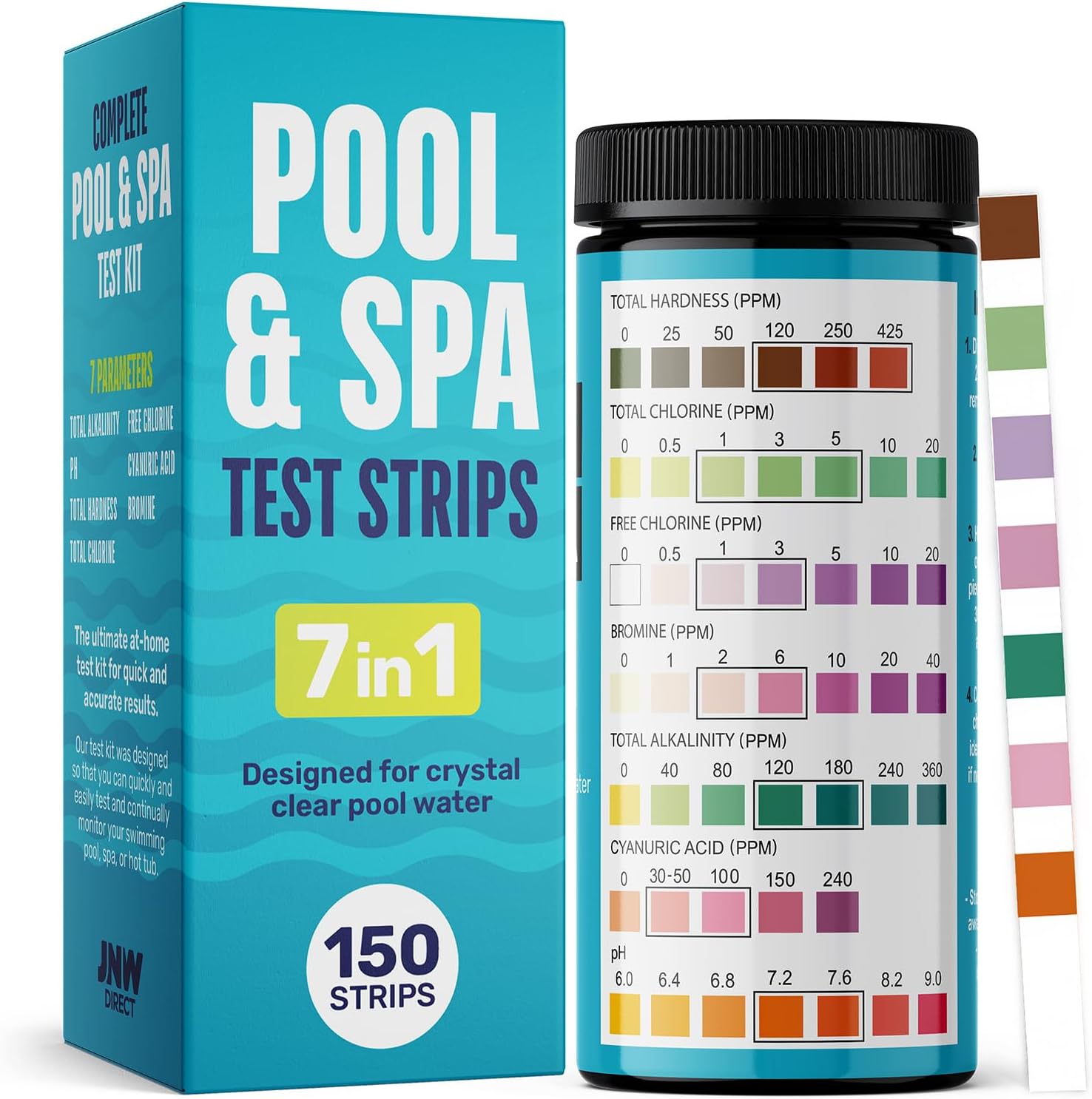
Test Strips
- Cheapest and fastest option
- Good for daily “at a glance” checks
- Least precise — color-matching by eye introduces error
- Sensitive to humidity and age; replace bottles yearly
Liquid Test Kits
- More accurate drop-count titration method
- Slightly slower, needs a clean vial and steady hand
- Preferred by many long-term owners for reliability
- Reagents degrade over time; check expiration dates
Digital Meters
- Most consistent, removes color-perception guesswork
- Higher upfront cost, needs occasional calibration
- Great for owners who test frequently or are colorblind
- Some models test 5–7 parameters at once
Professional Water Analysis
- Send a sample to a pool/spa store for a full panel
- Useful when your own results feel inconsistent
- Not practical for weekly maintenance
- Good once or twice a season as a “second opinion”
Step-by-Step Testing Procedure
- Turn off the jets and air blower for one to two minutes before sampling. Agitated water pulls in extra air, which temporarily skews pH and can make alkalinity readings look slightly off.
- Sample from mid-depth, away from equipment. Reach in about elbow-deep, away from the jets, skimmer, or any chemical dispenser, and take your sample there rather than at the surface.
- Avoid the first few minutes after adding chemicals. Freshly added chemicals haven’t fully dissolved and circulated yet, so testing immediately gives you a false reading.
- Read results in good light, quickly. Test strip colors continue to shift the longer they sit, so compare them to the color chart within the time window printed on the bottle — usually 15 to 30 seconds.
- Log your numbers. Keeping a simple written or spreadsheet log of TA, pH, sanitizer, and calcium hardness over time makes it far easier to spot patterns, like alkalinity that always drops after you shock the water.
Keeping a Simple Test Log
A written or spreadsheet log doesn’t need to be complicated to be useful. At minimum, record the date, Total Alkalinity, pH, sanitizer level, and any chemical you added that day. Over a few weeks, patterns start to emerge that a single test never reveals on its own — for example, noticing that TA consistently drops by 15–20 ppm within two days of every shock treatment, or that pH always creeps upward the morning after a heavy soak session with several bathers. A log turns your hot tub maintenance from a series of isolated snapshots into an ongoing trend line, which is far more useful for catching small drifts before they become full-blown imbalances that require multiple correction cycles to fix.
Why Reagents and Strips Expire
The dyes used in both liquid reagents and test strip pads are chemically reactive by design — that’s what makes them change color in response to your water sample. That same reactivity means they slowly degrade from exposure to light, humidity, and simple time, even in a sealed container. A strip bottle that’s more than a year old, or one that’s been stored somewhere warm and humid like a pool shed in summer, can produce readings that are subtly — or sometimes dramatically — wrong, even though nothing about your actual water chemistry has changed. If your readings suddenly start looking erratic after months of consistency, replacing your test kit before making any chemical changes is a cheap way to rule out a bad testing tool as the culprit.
Metric Conversion Reference
Most dosing charts in North America are written in tablespoons, ounces, and gallons, but many spa owners outside the US work in liters and grams. Use the reference table below to convert between the two systems.
| US Measurement | Metric Equivalent |
|---|---|
| 1 tablespoon baking soda | ≈ 17 grams |
| 1 ounce | ≈ 28.3 grams |
| 1 gallon | ≈ 3.785 liters |
| 100 gallons | ≈ 378.5 liters |
| 10 ppm | 10 mg per liter (mg/L) |
To convert any dosage chart in this guide into metric units, multiply the tablespoon figure by 17 to get grams, and multiply the gallon figure by 3.785 to get liters. For example, “5 tbsp per 500 gallons” becomes roughly “85 grams per 1,893 liters.”

Don’t overpay for fancy branding. Pure Sodium Bicarbonate is the gold standard for raising alkalinity safely.
Check Price on AmazonCalculating Your Hot Tub’s Volume
Every dosage recommendation in this guide is based on gallons of water, so an accurate volume figure matters more than most owners realize. Manufacturer spec sheets are a good starting point, but many people fill their tub slightly below the “full” line, which changes the real volume you’re dosing for.
The Formula
For a roughly rectangular tub: multiply length (ft) × width (ft) × average water depth (ft) × 7.5 to get gallons. For round or oval tubs, spa manufacturers typically publish a rated capacity — use that figure, then subtract roughly 5–10% to account for the space displaced by seats, jets, and the footwell, since that volume isn’t actually water.
If you have several people regularly soaking, remember that displaced water from bathers slightly reduces the effective volume while they’re in the tub — this matters for very small spas but is generally negligible for anything above 300 gallons.
How to Raise Alkalinity with Baking Soda
Yes, you can use the same box of baking soda sitting in your fridge. The chemical name is Sodium Bicarbonate, which is exactly what “Alkalinity Increaser” is sold as in pool stores.
Step 1: Determine the Dose
Rule of Thumb: 1 tablespoon of baking soda will raise the alkalinity of 100 gallons of water by roughly 10 ppm.
- For a 300-gallon tub: Start with 3 tablespoons (approx 1.5 oz).
- For a 500-gallon tub: Start with 5 tablespoons (approx 2.5 oz).
Step 2: Dissolve and Pour
Dissolve the baking soda in a bucket of warm spa water first, then pour it evenly around the perimeter of the tub while the jets are running.
Step 3: Circulate and Test
Let the water circulate for 20 minutes. Test again. If it is still low, repeat the process. Never add too much at once, or you will lock your pH too high.
Should You Split a Large Dose Into Rounds?
If your current reading is dramatically below range — say, 30 ppm when you need 100 ppm — resist the urge to dump the entire calculated amount in at once. Large single doses can cause a temporary local spike in pH right where the powder concentrates before it fully disperses, which can trigger cloudiness or scaling at the point of contact with metal surfaces. Splitting a big correction into two or three rounds, spaced several hours or a day apart, produces a smoother, more predictable result and gives you a chance to catch an overcorrection before it happens.
What Purity of Baking Soda Should You Use?
Plain sodium bicarbonate — the same product sold for baking — is chemically identical to the “Alkalinity Increaser” sold in pool stores. The only thing to check is that the box doesn’t contain added anti-caking agents, fragrances, or other additives, which some novelty or specialty baking sodas do. A plain, unscented, additive-free box is exactly what your spa needs.
Full Baking Soda Dosage Chart by Tub Size
Use this chart as a starting reference. Always retest after each round rather than assuming the math will land you exactly on target — real-world results vary slightly based on your tub’s current pH, calcium hardness, and sanitizer type.
| Tub Volume | To Raise TA by 10 ppm | To Raise TA by 30 ppm | To Raise TA by 50 ppm |
|---|---|---|---|
| 150 gallons | 1.5 tbsp | 4.5 tbsp | 7.5 tbsp |
| 250 gallons | 2.5 tbsp | 7.5 tbsp | 12.5 tbsp |
| 300 gallons | 3 tbsp | 9 tbsp | 15 tbsp |
| 400 gallons | 4 tbsp | 12 tbsp | 20 tbsp |
| 500 gallons | 5 tbsp | 15 tbsp | 25 tbsp |
| 600 gallons | 6 tbsp | 18 tbsp | 30 tbsp |
| 800 gallons | 8 tbsp | 24 tbsp | 40 tbsp |
| 1,000 gallons | 10 tbsp | 30 tbsp | 50 tbsp |
As a rough weight conversion, 1 tablespoon of baking soda weighs approximately 17 grams (about 0.6 oz). For larger corrections, many owners find it easier to measure by weight on a kitchen scale rather than counting out a large number of tablespoons.
Worked Example
Say your 400-gallon spa tests at 60 ppm and your target is 100 ppm — a 40 ppm increase. Using the chart, 12 tbsp gets you 30 ppm and 4 tbsp gets you the remaining 10 ppm, for a total of roughly 16 tbsp. Rather than adding all 16 tablespoons in one go, add 8 tablespoons, circulate for 20–30 minutes, retest, then add the remainder based on your new reading.
Chemistry Alert: Baking Soda vs. Soda Ash
Baking Soda (Sodium Bicarbonate): Raises Alkalinity drastically, but raises pH only slightly. Use this for low Alkalinity.
Soda Ash (Sodium Carbonate): Raises BOTH pH and Alkalinity drastically. Use this (pH Up) only if both numbers are dangerously low.
If your pH is fine (7.4) but your Alkalinity is low (40 ppm), using Soda Ash/pH Up will cause your pH to skyrocket to unsafe levels. Stick to Baking Soda.
Why the Confusion Happens So Often
Retail shelves don’t help matters — many bottles labeled generically as “pH Up” or “Alkalinity Up” contain sodium carbonate rather than sodium bicarbonate, and the ingredient list is often printed in small text on the back. Always flip the bottle over and confirm the active ingredient before assuming a product will behave like baking soda. If the label lists “sodium carbonate” as the primary ingredient, treat it as a pH-focused product, not a gentle alkalinity-focused one — its effect on pH will be far stronger, gram for gram, than plain baking soda.
Borax as a Third Option
Some owners use borax as a gentler way to nudge pH upward without significantly disturbing alkalinity. Borax raises pH with comparatively little effect on TA, which makes it a useful tool specifically when your alkalinity is already in range but your pH alone has drifted low. It is not a substitute for baking soda when the actual problem is low Total Alkalinity.
Baking Soda vs. Commercial Alkalinity Increaser: Cost & Performance
Both options raise Total Alkalinity through the same active ingredient — sodium bicarbonate — so the performance difference between them is minimal to none. The real difference is price and convenience.
| Product Type | Active Ingredient | Typical Cost | Notes |
|---|---|---|---|
| Grocery Store Baking Soda | Sodium Bicarbonate | ~$0.50–$1.00 per lb | Identical chemistry, no branding markup |
| Branded “Alkalinity Increaser” | Sodium Bicarbonate | ~$10–$20 per lb | Pre-measured scoops, spa-store convenience |
| Bulk Food-Grade Sodium Bicarbonate | Sodium Bicarbonate | ~$1–$2 per lb | Best value for large or frequently drained tubs |
The main argument in favor of a branded increaser is convenience — a scoop measured specifically for spa dosing, and clear instructions printed for less experienced owners. For anyone comfortable following a tablespoon-based chart, plain baking soda delivers the same chemical result for a fraction of the cost, which is why many long-term hot tub owners buy it in bulk rather than repurchasing small branded containers every season.
The Correct Order to Add Hot Tub Chemicals
Water chemistry adjustments interact with each other, so the sequence in which you correct them matters. Spa professionals consistently recommend the same order:
- Total Alkalinity first. Since alkalinity governs how stable your pH will be, correcting it first means every adjustment you make afterward is more likely to hold.
- pH second. Once TA is in the 80–120 ppm range, small pH corrections become far more predictable and stop bouncing back within a day.
- Calcium hardness third. This protects your equipment over the long term but has less day-to-day impact on comfort than TA and pH.
- Sanitizer last. Chlorine or bromine works far more efficiently once the water is chemically stable, so dosing sanitizer into unbalanced water often wastes product.
Wait roughly 10–20 minutes between each chemical addition, with jets running to circulate, before adding the next product or retesting.
The Chemistry Behind the Order
This sequence isn’t arbitrary — it reflects how these three parameters physically interact in solution. Total Alkalinity is made up largely of bicarbonate ions, which act as a reservoir that absorbs excess hydrogen ions (acid) or hydroxide ions (base) before they can swing the pH reading. If you correct pH while TA is still out of range, you’re essentially trying to set a needle’s position while the surface it’s balanced on keeps tilting underneath it. Once TA is stabilized, that reservoir is sized correctly, and pH adjustments behave predictably because the buffering capacity is no longer working against you. Calcium hardness, by contrast, doesn’t meaningfully buffer pH or interact with TA in the short term — its main role is long-term surface protection — which is why it can be corrected third without destabilizing the two more reactive parameters ahead of it.
Why Your Fill Water Matters
Every time you drain and refill your hot tub, you are starting your water chemistry over from whatever is already in your tap or well water — and that starting point varies enormously by location.
Tap and Municipal Water
Many municipal water supplies carry naturally high levels of bicarbonates and carbonates, meaning a freshly filled tub can start with an already-elevated Total Alkalinity reading before you’ve added a single chemical. Other regions supply notably soft water with very low natural alkalinity, meaning you may need to add baking soda almost immediately after every refill just to reach the 80 ppm floor.
Well Water
Well water is more variable and often carries dissolved iron or manganese, which won’t show up as an alkalinity problem directly but can cause staining and interfere with sanitizer performance in ways that look similar to a chemistry imbalance. If you consistently struggle to stabilize your water after refills, testing your fill water on its own — before it even reaches the tub — tells you whether the source itself is the root cause.
Using a Pre-Filter
An inline hose pre-filter, attached between the spigot and your fill hose, is a low-cost way to catch some of these minerals before they ever enter your spa, and is particularly worthwhile for owners on well water or in regions known for hard water.
Regional Water Hardness Patterns
Water hardness and alkalinity vary significantly by region due to the underlying geology of the local water table. Areas with limestone-heavy bedrock — common across much of the central and southwestern United States — tend to produce naturally hard, high-alkalinity tap water because water passing through limestone dissolves calcium carbonate along the way. Regions with granite or sandy-soil geology, more common in parts of the Pacific Northwest and New England, often produce naturally soft, low-alkalinity water instead. If you’ve moved to a new home, or if you use water hauled in from a different source than usual, don’t assume your old dosing habits will apply — always retest a fresh fill before making any assumptions.
Municipal Treatment Changes
Even within the same city, municipal water treatment can shift seasonally as utilities adjust chemical dosing at the treatment plant to manage taste, corrosion control, or seasonal supply changes. It’s not uncommon for long-term hot tub owners to notice that a refill in one season behaves slightly differently than a refill from the same tap a few months earlier. This is a normal, minor variation — not a sign that your testing or dosing technique has become unreliable — and is one more reason to treat every fresh fill as its own starting point rather than assuming consistency year-round.
What Happens When Alkalinity Is Too High
Most of this guide focuses on raising low alkalinity, since that’s the more common and more damaging scenario — but alkalinity that climbs above 120 ppm creates its own set of problems, and it’s worth recognizing the signs.
- Cloudy or murky water: High TA allows dissolved particles to come out of solution more easily, clouding the water even when sanitizer levels look fine.
- Scaling: White, chalky deposits build up around jets, heating elements, and shell surfaces, restricting water flow and forcing your pump to work harder.
- pH Lock: Once TA climbs too high, it becomes extremely resistant to pH adjustments — you can add pH decreaser repeatedly and barely move the needle, because the excess alkalinity is actively fighting the correction.
- Reduced sanitizer efficiency: Chlorine and bromine both work less effectively in over-alkaline water, which can allow bacteria to gain a foothold even when you’re dosing sanitizer on schedule.
How to Lower High Alkalinity Safely
If your TA has climbed above 120 ppm, the fix runs in the opposite direction of everything covered above, using an acid-based product instead of baking soda.
The Two Standard Products
- Sodium Bisulfate (“Dry Acid” or pH Decreaser): The more common and beginner-friendly option, sold specifically for spa use. Sprinkle it evenly across the water’s surface with jets running rather than dumping it in one spot.
- Muriatic Acid: A stronger liquid acid, effective but harder to dose precisely and more hazardous to handle. Many spa-specific guides recommend sticking to dry acid/sodium bisulfate for hot tubs rather than muriatic acid, which is more commonly reserved for larger swimming pools.
Step-by-Step Process
- Confirm your reading with a retest — don’t correct based on a single test if the number seems unusually high.
- Turn on the jets to help circulate the product evenly.
- Add the acid product gradually, following the dosing chart on the packaging for your tub’s volume and the number of ppm you need to reduce.
- Let the water circulate for the time recommended on the product label, often up to several hours for a full reaction.
- Retest both alkalinity and pH — lowering TA with an acid-based product will typically lower pH somewhat as well, so budget for a possible follow-up pH correction.
Common Mistakes When Adjusting Alkalinity
- Testing immediately after dosing. Chemicals need time to fully dissolve and circulate — testing too soon gives you an inaccurate reading and often leads to an unnecessary second dose.
- Adding the full calculated dose in one shot on a large correction. Splitting big corrections into rounds produces a smoother, more predictable result.
- Confusing soda ash with baking soda. Using a stronger sodium-carbonate product when you only meant to raise alkalinity gently can send your pH far outside the safe range.
- Ignoring the jets. Chemicals that aren’t circulated properly can pool in one area, giving localized readings that don’t reflect the whole tub.
- Chasing pH without checking alkalinity first. If your pH corrections keep reverting within a day or two, your real problem is almost always low TA.
- Not accounting for fill water. Skipping a fresh-water test after a drain-and-refill means you’re guessing at your starting point instead of measuring it.
- Letting the cover sit open during storms. Rainwater is naturally soft and slightly acidic, and a few unexpected inches of rain can measurably drag both pH and alkalinity down overnight.
A Closer Look at the Most Costly Mistake
Of everything on this list, chasing pH without ever checking alkalinity is the mistake that costs owners the most time and money. It’s an easy trap to fall into because pH test results are usually the more visually dramatic reading — a strip pad that goes bright pink or deep purple feels more urgent than an alkalinity pad sitting in a middling yellow-green. But repeatedly adding pH increaser or decreaser into water with badly out-of-range alkalinity is a bit like trying to keep a boat steady by grabbing the sail instead of dropping the anchor: you can spend an entire afternoon adding chemicals, watching numbers move temporarily, and still end up back where you started the next morning. Breaking this cycle is as simple as testing TA first, every time, before touching pH at all.
Why “More Is Better” Backfires With Water Chemistry
Unlike some household tasks where using extra product just wastes a bit of money, overdosing alkalinity increaser or decreaser actively creates a new problem while trying to solve the old one. Because TA, pH, and calcium hardness are interconnected, an aggressive overcorrection in one direction often means you’ll need a second, opposite correction just to undo the overshoot — effectively doubling your chemical cost and the number of days your water spends outside the ideal range. Small, patient, verified doses are almost always cheaper and faster in total than one large, unverified dose.
Alkalinity’s Relationship With Calcium Hardness and the LSI
Total Alkalinity doesn’t operate in isolation — it works alongside pH and Calcium Hardness (CH) as the three pillars of water balance. Calcium Hardness measures the concentration of dissolved calcium in your water, and the ideal range for most hot tubs sits around 175–250 ppm.
Water that is low in calcium hardness tends to become “aggressive,” meaning it will pull calcium out of any surface it can find — grout, metal fittings, even the plaster or acrylic gelcoat of the shell itself — in an attempt to reach equilibrium. Water that is too high in calcium hardness deposits that calcium back out as visible scale, often on the same surfaces that suffer from a different problem when hardness runs low.
The Langelier Saturation Index (LSI)
Advanced spa technicians use a combined formula called the Langelier Saturation Index, which factors in pH, Total Alkalinity, Calcium Hardness, and water temperature together to describe whether water is balanced, corrosive, or scale-forming as a whole system. The practical takeaway for most hot tub owners is simpler: even if your TA and pH both individually test within their recommended ranges, a calcium hardness reading that’s badly out of range can still leave your water technically unbalanced. If you’ve corrected alkalinity and pH but keep experiencing scaling or corrosion symptoms, calcium hardness is the next parameter to check.
Health Risks of Imbalanced Water
Beyond equipment damage, unbalanced alkalinity creates conditions that make it harder for your sanitizer to do its job protecting bathers.
Water with unstable pH — the direct downstream effect of low alkalinity — moves in and out of the range where chlorine or bromine works most efficiently. Left unaddressed over time, this instability can create the warm, under-sanitized conditions associated with hot tub folliculitis, a bacterial skin infection linked to spas with inconsistent sanitizer performance. Correcting and stabilizing your Total Alkalinity is one of the simplest steps you can take to keep your sanitizer working consistently and reduce that risk.
Eye and Skin Comfort
Even without a full-blown infection, water sitting outside the recommended pH and alkalinity range is simply less comfortable to soak in. Overly acidic water — the direct result of chronically low alkalinity — strips natural oils from skin and irritates the thin mucous membranes around the eyes, which is why “burning eyes after a soak” is one of the most frequently reported low-alkalinity symptoms among hot tub owners. On the other end of the spectrum, water that has drifted too far alkaline can leave skin feeling dry and slightly filmy, along with a general sense that soap and shampoo don’t rinse away as cleanly as usual.
Respiratory Considerations
Because hot tubs run warm and are frequently covered, they naturally produce more vapor and off-gassing than an unheated pool. Sanitizer that isn’t working efficiently — often the downstream result of unstable pH caused by low alkalinity — can produce a stronger, more irritating chemical smell in that vapor. A well-balanced hot tub, by contrast, typically has only a mild, clean scent rather than a sharp or overpowering one.
Seasonal Alkalinity Maintenance
Spring and Summer
Warmer months bring heavier bather loads, more sunscreen and lotion residue entering the water, and — depending on your climate — more frequent rain events. All three factors tend to push alkalinity and pH around more than usual, so testing twice a week rather than once becomes worthwhile during peak usage season.
Fall and Winter
Colder months typically mean lighter bather loads but also longer stretches between water changes for owners who use their tub less often. Alkalinity that starts in range can still drift slowly over weeks even without heavy use, largely due to sanitizer breakdown and off-gassing, so don’t assume a lightly used tub in winter needs less frequent testing — just less frequent correction.
Opening and Closing a Seasonal Spa
If you drain your tub for storage during part of the year, treat every refill as a fresh start: test your fill water before adding any chemicals, establish your baseline TA and pH, and then work through alkalinity first, exactly as outlined earlier in this guide, before moving on to sanitizer.
Alkalinity Considerations Across Different Spa Types
Inflatable Hot Tubs
Inflatable and portable spas typically hold smaller water volumes, which means the same chemical dose produces a bigger swing in ppm than it would in a larger built-in spa. Precision matters more here — always err toward smaller, more frequent doses rather than large corrections.
Chlorine vs. Bromine Systems
Both sanitizers are affected by unstable pH caused by low alkalinity, but bromine tends to be somewhat more forgiving across a wider pH range than chlorine. That said, neither sanitizer performs at its best outside the recommended TA window, so the 80–120 ppm target applies regardless of which sanitizer system you run.
Salt Water and Mineral Systems
Salt water generators and mineral cartridge systems still rely on the same underlying Total Alkalinity chemistry — the salt cell or mineral cartridge doesn’t change how alkalinity buffers pH. Owners of these systems sometimes assume alkalinity matters less because the system feels more “automated,” but skipping TA testing is just as risky here as with a manually dosed chlorine or bromine tub.
Built-In (Hardscape) Spas vs. Portable Acrylic Spas
Built-in spas plumbed into a backyard hardscape typically hold larger water volumes and are drained less frequently than portable acrylic or inflatable models, which means alkalinity tends to drift more slowly but can also go unnoticed for longer stretches between tests. Portable acrylic spas sit in a middle ground — smaller than built-in spas but sturdier and better insulated than inflatable models — and generally follow the same 80–120 ppm target without any special adjustment.
Commercial and Shared-Use Spas
Spas used by rotating groups of bathers, such as those in vacation rentals, gyms, or shared amenity spaces, experience far heavier and more variable bather loads than a private residential tub. Body oils, sunscreen, and general organic contaminant load rise quickly under heavy use, which can accelerate both sanitizer demand and alkalinity drift. These settings typically call for daily testing rather than weekly, along with more frequent shock treatments — which, as covered earlier, can themselves affect Total Alkalinity and should be tracked accordingly.
Real-World Scenarios: Diagnosing Your Situation
Sometimes it’s easier to recognize your own situation in someone else’s than to work purely from a checklist. Here are five common patterns spa owners report, along with the likely cause and fix for each.
Scenario 1: “I balanced everything last week and it’s already off again”
This is almost always a sign that alkalinity was corrected without also addressing whatever was driving it down in the first place — frequent pH decreaser use, an uncovered tub during a rainy week, or naturally soft fill water. Balancing the number once doesn’t fix an ongoing cause; you have to identify and address the underlying driver, or you’ll be back at the same low reading within days.
Scenario 2: “My pH keeps climbing no matter how much decreaser I add”
This is the classic signature of pH lock caused by alkalinity that’s too high. Test your TA specifically — if it’s above 120 ppm, correcting alkalinity downward first, then reattempting the pH correction, usually resolves the issue far more efficiently than continuing to add more pH decreaser into water that’s actively resisting the change.
Scenario 3: “The water looks cloudy but my sanitizer level is fine”
Cloudiness with a normal sanitizer reading often points toward high Total Alkalinity or high calcium hardness causing dissolved particles to fall out of solution. Check both parameters — sanitizer level alone doesn’t tell the whole story about water clarity.
Scenario 4: “I just refilled the tub and the alkalinity is already high”
This points toward your fill water itself carrying a naturally high mineral content. Test your tap or well water directly, before it enters the tub, to confirm. If your source water consistently runs high, you may want to correct TA downward as a standard first step after every refill, rather than treating it as a surprise each time.
Scenario 5: “Everything tests fine but my skin still feels irritated after soaking”
When both TA and pH check out but irritation persists, look at sanitizer level and type next, followed by calcium hardness. Occasionally the irritation traces back to a testing error rather than the water itself — cross-check with a second testing method (for example, a liquid kit if you normally use strips) before assuming a chemical is to blame.
Buying Guide: What to Look for in an Alkalinity Product
Whether you choose plain baking soda or a branded increaser, a few label details are worth checking before you buy.
- Active ingredient: Confirm the label lists sodium bicarbonate as the primary ingredient if your goal is to raise alkalinity gently. If it lists sodium carbonate instead, understand you’re buying a stronger pH-focused product.
- Purity: Avoid scented, colored, or anti-caking-additive versions of baking soda intended for household cleaning rather than food or pool use — stick to plain, food-grade sodium bicarbonate.
- Packaging size relative to your tub volume: A large bulk bag makes sense for bigger built-in spas or owners who drain and refill often; a small box is often plenty for a single inflatable tub used mostly for pH maintenance touch-ups.
- Dosing instructions on the container: Branded increasers often include a scoop and per-volume dosing chart, which can simplify things for less experienced owners even though the underlying chemistry is identical to plain baking soda.
- Storage conditions: Keep any alkalinity product sealed, dry, and away from direct sunlight — moisture exposure causes clumping and can slowly reduce potency over time.
Troubleshooting: Why Won’t My Alkalinity Hold?
If you’ve corrected your alkalinity but it keeps drifting back down within days, work through this checklist:
- Are you shocking with an acidic product? Some non-chlorine and chlorine shocks lower alkalinity as a side effect. Check the product label.
- Is your pH decreaser overused? Every time you lower pH with an acid product, you also lower alkalinity to some degree — frequent pH-lowering sessions will steadily erode TA over time.
- Is rain getting into an uncovered tub? A poorly sealed or frequently removed cover lets soft, mildly acidic rainwater dilute your carefully balanced chemistry.
- Is your test method consistent? Switching between test strips, liquid kits, and digital meters without cross-checking can make it look like your levels are “bouncing” when the real issue is measurement variance.
- Is your bather load heavier than usual? Body oils, lotions, and sweat all introduce contaminants that interact with your water chemistry, sometimes lowering effective alkalinity readings.
If you’ve ruled out all of the above and TA still won’t stabilize after two or three full correction cycles, it may be worth a full drain and refresh, paired with a test of your fill water on its own, since a persistent source-water problem is otherwise very difficult to diagnose from inside an already-imbalanced tub.
Glossary of Hot Tub Water Chemistry Terms
- Total Alkalinity (TA)
- A measurement, in parts per million, of the water’s ability to buffer and resist changes in pH.
- pH
- A measurement of how acidic or basic the water is, ideally kept between 7.2 and 7.8 in a hot tub.
- Calcium Hardness (CH)
- The concentration of dissolved calcium in the water, ideally kept between roughly 175 and 250 ppm.
- Sodium Bicarbonate
- The chemical name for baking soda; the active ingredient in most alkalinity increaser products.
- Sodium Carbonate (Soda Ash)
- A stronger alkaline compound that raises both pH and TA significantly; typically sold as “pH Up.”
- Sodium Bisulfate (Dry Acid)
- The common active ingredient in spa pH/alkalinity decreaser products.
- pH Lock
- A condition where excessively high Total Alkalinity makes the water strongly resist pH adjustments.
- Langelier Saturation Index (LSI)
- A formula combining pH, TA, calcium hardness, and temperature to describe whether water is balanced, corrosive, or scale-forming.
- Scaling
- Visible white, chalky mineral deposits that form when water is oversaturated with dissolved calcium and alkalinity.
- Parts Per Million (ppm)
- The standard unit for measuring the concentration of a dissolved chemical in spa or pool water.
- Bather Load
- The number of people using a hot tub over a given period, which directly influences how quickly sanitizer, pH, and alkalinity shift.
- Shock Treatment
- A concentrated dose of oxidizer or chlorine used to break down organic contaminants like sweat, oils, and lotions that regular sanitizer levels can’t fully handle.
- Non-Chlorine Shock (Oxidizer)
- A shock product that oxidizes contaminants without adding chlorine, often used in bromine systems or by owners wanting to shock more frequently without building up chlorine levels.
- Cyanuric Acid (Stabilizer)
- A compound that protects chlorine from breaking down under UV exposure; more relevant to outdoor pools than most enclosed or covered hot tubs.
- Aggressive Water
- Water with low alkalinity and/or low calcium hardness that actively pulls minerals from surfaces and metal components it contacts, leading to corrosion and etching.
- Scale-Forming Water
- Water with high alkalinity and/or high calcium hardness that deposits dissolved minerals back out as visible scale on surfaces and equipment.
- Dry Acid
- A granular, spa-safe acid product (sodium bisulfate) used to lower both pH and Total Alkalinity.
- Titration
- The drop-by-drop testing method used in liquid test kits, where reagent drops are counted until a color change occurs, giving a numeric readout.
Prevention and Maintenance
Alkalinity naturally drops over time as you add acid to balance high pH or as rain enters the tub. To keep it stable:
- Test Weekly: Make this a non-negotiable part of your inflatable hot tub maintenance routine.
- Shock Carefully: Using acidic shocks can lower alkalinity. Know how often to shock a hot tub to avoid over-dosing.
- Cover Up: Acid rain can destroy your alkalinity levels overnight. Always keep the cover locked when not in use.
A Simple Weekly Routine
- Test TA, pH, and sanitizer with jets off, sampling mid-depth.
- Correct alkalinity first if it’s out of the 80–120 ppm range.
- Wait 20–30 minutes with jets running, then correct pH if needed.
- Check calcium hardness roughly every two weeks rather than every session.
- Log every reading so you can spot slow drifts before they become sudden problems.
Printable Weekly Checklist
- ☐ Jets and air blower off for 1–2 minutes before sampling
- ☐ Sample taken mid-depth, away from jets and dispensers
- ☐ Total Alkalinity recorded (target: 80–120 ppm)
- ☐ pH recorded (target: 7.2–7.8)
- ☐ Sanitizer level recorded and topped up if needed
- ☐ Calcium hardness checked (every 2 weeks; target: 175–250 ppm)
- ☐ Cover inspected for a tight, secure seal
- ☐ Filter checked and rinsed or replaced on schedule
Final Cheat Sheet: Everything on One Page
Target pH: 7.2–7.8
Target Calcium Hardness: 175–250 ppm
To raise TA: Sodium bicarbonate (baking soda), ~1 tbsp per 100 gallons per 10 ppm
To lower TA: Sodium bisulfate (dry acid / pH decreaser)
Correction order: Alkalinity → pH → Calcium Hardness → Sanitizer
Wait time between doses: 20–30 minutes with jets circulating
Never use: Baking soda to lower alkalinity, or soda ash when only alkalinity (not pH) is low
Bookmark this page or save a screenshot of the cheat sheet above for quick reference next time you’re standing at the edge of the tub with a test strip in hand. Between the dosage chart, the correction order, and the mistakes to avoid, you now have everything needed to keep your Total Alkalinity — and by extension your pH, your equipment, and your comfort in the water — stable season after season.
Frequently Asked Questions
Yes, but it is better to dissolve it in a bucket of water first. Pouring dry powder directly can cause it to settle on the bottom and feel gritty or cloud the water temporarily.
Yes, but only slightly. Baking soda has a pH of 8.3, so it will gently nudge your pH up, but its primary function is to boost Alkalinity. This is why it is preferred over Soda Ash (pH 11.3) when you just need to fix TA.
You should wait at least 20–30 minutes to allow the chemical to fully dissolve and circulate. Always retest the water before jumping in to ensure the levels are safe.
The most common cause is the use of pH Decreaser (acid). Every time you lower your pH, you also lower your alkalinity. Heavy bather loads and rainwater can also drag the levels down.
No. Baking soda only raises Total Alkalinity. If your TA is too high, you need an acid-based product such as sodium bisulfate (dry acid), not baking soda.
Always correct Total Alkalinity first. Since alkalinity governs how stable your pH will be, fixing it first means any pH adjustment you make afterward is far more likely to hold instead of reverting within a day or two.
Not chemically. Most commercial alkalinity increaser products use sodium bicarbonate as their active ingredient — the same compound as household baking soda. The main difference is price and pre-measured convenience, not performance.
Weekly at minimum, and twice a week during periods of heavy use, after a fresh refill, or following any rainstorm. Consistent testing catches slow drifts before they turn into full pH-bounce episodes.
The most common causes are frequent use of pH decreaser, an uncovered tub exposed to rain, or a fill-water source that is naturally low in alkalinity. Check each of these before assuming your dosing math is wrong.
They are measured separately but work together as part of overall water balance. Even with TA and pH both in range, badly imbalanced calcium hardness can still cause scaling or corrosion symptoms, so it’s worth checking if problems persist after correcting alkalinity.
Yes. Pool and spa alkalinity increaser products are chemically the same sodium bicarbonate, just sold under different branding and sometimes at different price points. Dosing math works the same way per gallon of water regardless of which container the product came in.
Running jets helps circulate and dissolve the chemical evenly, but it doesn’t speed up the underlying chemical reaction itself. Twenty to thirty minutes of circulation is generally enough regardless of how long the jets run beyond that point.
Mildly out-of-range alkalinity by itself is not an emergency, but it often travels alongside unstable pH, which can cause skin and eye irritation. If alkalinity is far outside the 80–120 ppm range, it’s best to correct it before soaking rather than during.