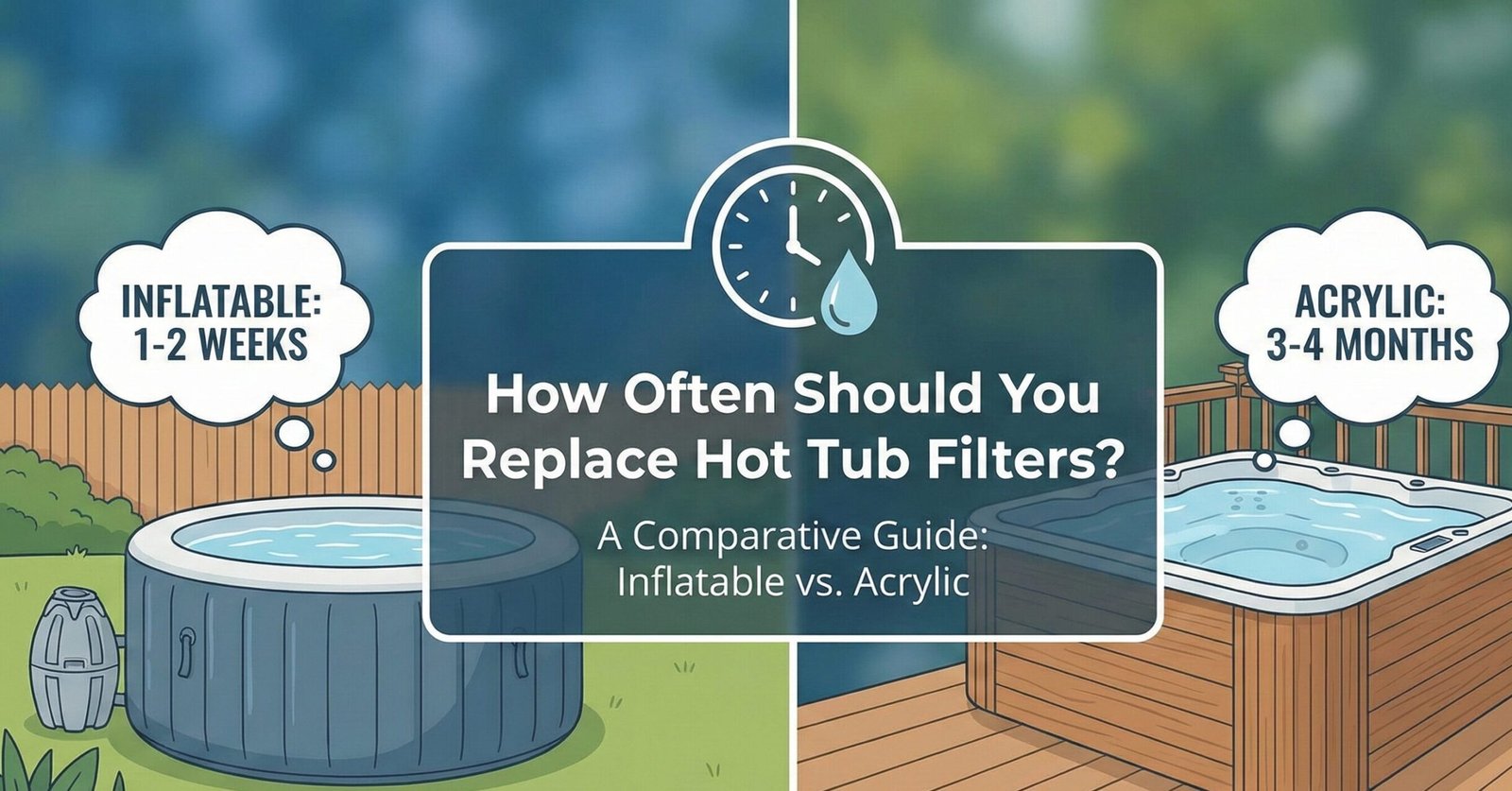
How Often Should You Replace Hot Tub Filters? (Inflatable vs. Acrylic)
The filter is the kidney of your hot tub. It works silently in the background, trapping body oils, hair, dead skin, and environmental debris. But unlike a kidney, it doesn’t heal itself.
If you ignore your filter, you aren’t just risking cloudy water; you are risking the life of your pump. A clogged filter restricts water flow, causing heater errors (like the dreaded E90 code) and motor burnout.
For Inflatable Hot Tubs (Intex/Coleman): Rinse your filter cartridges weekly and replace them every 2 to 4 weeks depending on usage.
For Hard-Shell Hot Tubs: Rinse weekly, deep clean chemically every month, and replace the filter cartridge every 12 months.
1. Why Inflatable Tubs Need Frequent Changes
Many new owners of inflatable hot tubs are shocked to learn they need to buy filters so often. The reason lies in the design.
Filters for inflatable spas (like the Type S1 for Intex or Type VI for Coleman) are significantly smaller and made of thinner paper pleats than the robust filters found in acrylic spas. They saturate quickly.
1.1 Understanding Filter Micron Ratings and Filtration Efficiency
To truly understand why filter replacement schedules differ so dramatically between tub types, you need to understand micron ratings. A micron is one-millionth of a meter, and filter micron ratings indicate the smallest particle size the filter can effectively capture. Standard inflatable hot tub filters typically have a micron rating of 25-50 microns, meaning they capture particles roughly the size of white blood cells and larger. Hard-shell hot tub filters often achieve 10-25 micron ratings, capturing significantly smaller particles including many types of bacteria and fine silt.
The relationship between micron rating, surface area, and filter longevity is governed by fundamental fluid dynamics. A filter with a tighter micron rating (smaller number) captures more particles but clogs faster if the surface area isn’t proportionally larger. Hard-shell tub filters compensate for their tighter filtration with dramatically larger pleated surface areas—often 50-100 square feet compared to the 5-15 square feet typical of inflatable spa cartridges. This is why a hard-shell filter can operate effectively for months while an inflatable filter saturates in weeks.
The paper media itself differs significantly between filter grades. Economy inflatable filters use cellulose-based paper with minimal resin impregnation, which provides adequate filtration initially but degrades rapidly when exposed to hot, chemically treated water. Premium hard-shell filters use polyester-reinforced media with higher resin content, providing superior chemical resistance and structural integrity over extended use. Some commercial-grade filters even incorporate antimicrobial treatments into the media to resist bacterial colonization between cleanings.
1.2 The Physics of Filter Loading: How Contaminants Accumulate
Filter loading follows a predictable pattern that explains why replacement timing is so critical. When a filter is new, water flows through with minimal resistance, and particles are captured primarily through mechanical straining—particles larger than the pore size are trapped on the surface. As the surface accumulates debris, the effective pore size decreases, and the filter actually becomes more efficient at capturing smaller particles. This is the “sweet spot” of filtration where water quality is optimal.
However, as loading continues, flow resistance increases exponentially rather than linearly. When a filter reaches approximately 70-80% of its maximum particulate holding capacity, the pressure differential across the filter media increases sharply. This is the danger zone for your pump. Most hot tub pumps are designed to operate against a specific range of head pressure, and a severely clogged filter can push the pump outside its design parameters. The resulting strain manifests as increased energy consumption (20-40% higher), reduced flow rates, overheating, and eventually premature pump failure.
The type of contaminants loading your filter also matters. Organic contaminants (body oils, sweat components, lotions) create a sticky matrix that traps additional particles and is difficult to remove with water alone. Inorganic contaminants (calcium scale, dirt, sand) can be abrasive to filter media and may be more effectively removed with acid-based cleaners. Understanding your specific contaminant profile based on usage patterns and water source helps you optimize your cleaning and replacement schedule.
| Feature | Inflatable Tub (Type S1/VI) | Hard-Shell Tub |
|---|---|---|
| Surface Area | Small (5-15 sq ft) | Large (50-100+ sq ft) |
| Micron Rating | 25-50 microns | 10-25 microns |
| Media Type | Cellulose with minimal resin | Polyester-reinforced with high resin |
| Rinse Schedule | Every 3-5 Days | Weekly |
| Chemical Deep Clean | Every 1-2 weeks | Monthly |
| Replacement | Every 2-4 Weeks | Every 1 Year |
| Annual Cost (Approx.) | $60-$120 | $40-$80 |
2. The “Rinse, Soak, Rotate” Method
To extend the life of your filters and save money, you should adopt the “Rotation Method.” This involves owning two sets of filters.
2.1 Detailed Rinsing Technique: Beyond the Garden Hose
Proper rinsing technique is the foundation of filter maintenance, yet most hot tub owners do it incorrectly. The goal of rinsing is to remove loose debris from between the pleats without damaging the filter media or driving contaminants deeper into the material.
Water Pressure Considerations: Use a standard garden hose with a spray nozzle set to a fan or shower pattern, not a jet stream. The ideal water pressure is 30-50 PSI—typical residential water pressure. Pressure washers, even on their lowest setting, generate 1000+ PSI and will tear the paper pleats, creating channels where unfiltered water can bypass the media entirely. If you can feel the water stream sting your hand from six inches away, the pressure is too high for filter rinsing.
Angle of Attack: Hold the filter at a 45-degree angle and spray between the pleats from top to bottom, working your way around the circumference. Spraying directly into the pleats (perpendicular to the surface) drives debris deeper. Spraying at an angle allows the water to lift debris out of the pleat valleys. Rotate the filter slowly as you work, ensuring each pleat section receives 15-20 seconds of directed spray.
Water Temperature: Use cool or lukewarm water for routine rinsing. Hot water can set oils and proteins into the filter media, making them more difficult to remove during chemical cleaning. If you’re rinsing a filter that’s been in a heavily used tub, you might see a milky white residue washing away—this is emulsified body oils and is a good sign that your rinsing is effective.
Inspection During Rinsing: As you rinse, inspect the filter pleats carefully. Look for areas where the pleats remain compressed or stuck together even under water spray—this indicates oil saturation that requires chemical cleaning. Also check for any tears, holes, or separation between the pleated media and the plastic end caps. Any breach in the filter integrity means unfiltered water is bypassing the media and circulating through your pump and heater.
2.2 Chemical Soaking: The Science of Degreasing
Water rinsing removes loose debris but cannot dissolve the oils, lotions, and organic films that coat filter fibers. Chemical soaking is essential for removing these hydrophobic contaminants that water alone cannot address. Understanding the chemistry helps you choose the right products and avoid damaging your filters.
Alkaline Degreasers (Filter Cleaners): Most commercial filter cleaning solutions are alkaline-based, typically containing sodium hydroxide, potassium hydroxide, or proprietary surfactant blends. These products saponify oils—a chemical reaction that converts fats and oils into water-soluble soaps that rinse away easily. The soaking process requires time because the degreaser must penetrate between tightly packed pleats and react with accumulated oils. Twenty-four hours is the recommended soak time because it allows complete penetration and reaction.
Acid Cleaners (Scale Removal): If your water source is hard (high calcium and magnesium content), your filters may develop scale deposits in addition to oil accumulation. Acid-based cleaners, typically containing muriatic acid or phosphoric acid, dissolve mineral scale. However, these should be used cautiously and only after degreasing, as the acid cannot penetrate oil layers to reach underlying scale. Never mix acid and alkaline cleaners, as this creates dangerous chemical reactions including heat generation and toxic gas release.
TSP (Trisodium Phosphate) Alternative: Some experienced hot tub owners use TSP as an economical filter cleaner. While effective at degreasing, TSP is increasingly regulated due to environmental concerns about phosphate pollution in waterways. Modern phosphate-free filter cleaners achieve similar results with less environmental impact. If you choose to use TSP, wear gloves and eye protection, and dispose of the spent solution responsibly.
Proper Soaking Procedure:
- Fill a clean 5-gallon bucket with enough water to completely submerge the filter
- Add filter cleaner according to manufacturer instructions (typically 1:8 to 1:16 dilution)
- Submerge the rinsed filter completely, ensuring no air pockets remain trapped inside
- Allow to soak for 12-24 hours (overnight is ideal)
- Remove and rinse thoroughly with clean water until no cleaning solution remains
- Allow the filter to dry completely before storing (if rotating)
- Never install a filter wet with cleaning solution into your hot tub
Critical Safety Note: Always add filter cleaner to water, never water to concentrated cleaner. This prevents splashing of concentrated chemicals. Wear chemical-resistant gloves and safety glasses when handling filter cleaning solutions. Work in a well-ventilated area, preferably outdoors.
- Rinse: Remove the dirty filter and blast it with a hose. Do not use a pressure washer, as this will tear the paper pleats.
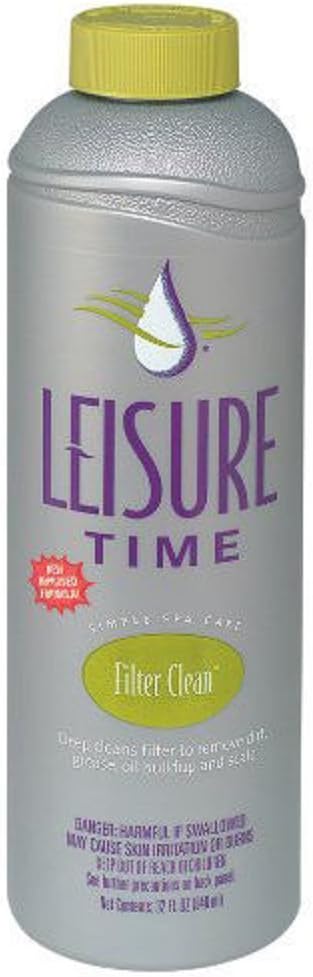
- Soak: Place the rinsed filter in a bucket with a specialized filter cleaning solution (degreaser) for 24 hours. This breaks down the oils that water alone cannot remove.
- Rotate: While Filter A is soaking, put Filter B into the hot tub. Never run the tub without a filter.

Filter Cartridge Cleaner Tool
Stop using your thumb over the hose. This comb-like attachment sprays water deep between the pleats to dislodge debris without damaging the filter fabric. The flexible tines separate pleats for thorough cleaning while protecting the filter media from tears. Fits standard garden hoses and works with both inflatable and hard-shell filters.
Check Price on Amazon3. Signs It Is Time to Replace
Even with cleaning, filters eventually die. According to The Cover Guy, you should look for these signs of failure:
3.1 Detailed Visual Inspection Protocol
Developing a systematic inspection routine helps you catch filter degradation before it causes equipment damage. Perform this inspection every time you rinse your filter, not just when you suspect problems. Early detection of filter failure can prevent hundreds of dollars in pump and heater repairs.
Step 1: Overall Color Assessment – Hold the filter against a white background (a piece of paper or a white wall) in good lighting. A healthy, cleanable filter will appear cream or light tan. If the filter appears dark brown, gray, or black even after chemical cleaning, the media fibers are permanently impregnated with oils and biofilm. At this stage, the filter’s effective surface area is significantly reduced, and it’s functioning more as a flow restrictor than a filter. Replacement is necessary.
Step 2: Pleat Integrity Check – Run your finger gently along the pleats from top to bottom. The pleats should feel firm and spring back when pressed. If they feel soft, mushy, or remain compressed after gentle pressure, the resin binder in the paper has degraded. This degradation typically occurs from chemical exposure over time—chlorine and bromine slowly break down the organic binders that give filter paper its structure.
Step 3: End Cap Inspection – Examine the plastic end caps carefully for cracks, warping, or separation from the filter media. The bond between the end caps and the pleated media is created with hot-melt adhesive during manufacturing. Repeated exposure to hot water (especially above 104°F) can soften this adhesive over time. If you can see gaps between the media and the end cap, or if the end cap spins freely, water is bypassing the filter entirely through these gaps.
Step 4: Core Structure Examination – Look through the center hole of the filter. The inner plastic core should be perfectly cylindrical with no deformation. If the core appears oval, has visible cracks, or shows signs of collapse (concave areas), the filter has experienced excessive pressure differential. This typically indicates the filter was operated long past its useful life, forcing the pump to pull against extreme resistance. A collapsed core can shed plastic fragments into your plumbing system.
Step 5: Light Transmission Test – Hold the filter up to a bright light source and look through the pleats. With a new or clean filter, you should see diffuse light through the media. If the filter blocks virtually all light even after cleaning, the media is clogged with material that chemical cleaning cannot remove. This test is particularly useful for identifying filters that look clean on the surface but are clogged internally.
⚠️ Visual Inspection Checklist
- Discoloration: If the filter remains brown or gray after a chemical soak, the fibers are permanently stained with biofilm and oils.
- Fraying: Look at the paper pleats. If they look “fuzzy” or are separating from the plastic end caps, the structural integrity is gone.
- Core Collapse: If the plastic inner core is bent or warped, water flow is being restricted.
- Pleat Compression: Pleats that remain stuck together after cleaning indicate resin breakdown.
- End Cap Separation: Any gap between media and end caps means water is bypassing filtration.
3.2 Performance-Based Replacement Indicators
Beyond visual inspection, certain performance issues indicate filter failure even if the filter looks acceptable externally. These operational signs should trigger immediate filter replacement regardless of the filter’s apparent condition.
Frequent Error Codes: If your hot tub displays flow-related error codes (such as E90 on Intex models, FLO on many hard-shell tubs, or DRY on some systems) despite a clean filter, the filter media may be restricting flow even when visually clean. This occurs when oils have penetrated deep into the filter fibers, creating a hydrophobic barrier that water struggles to pass through. The filter looks clean because the oils aren’t visible, but flow is severely restricted. Replacing the filter usually resolves persistent flow errors immediately.
Reduced Jet Pressure: When your jets feel noticeably weaker than normal, and you’ve confirmed the filter is clean, try running the tub briefly without the filter installed. If jet pressure returns to normal, the filter is creating excessive resistance and should be replaced. Never operate the tub without a filter for extended periods, as debris can enter and damage the pump impeller.
Short Filter Life Cycles: If you notice that a newly installed filter becomes visibly dirty or triggers flow errors within days rather than weeks, you may have a biofilm problem in your plumbing (discussed in Section 4), or you may be using incompatible chemicals. Some clarifiers and flocculants can coat filter media with residues that dramatically reduce effective filtration area. If this occurs consistently across multiple filters, investigate your water chemistry before continuing to replace filters.
Increased Energy Consumption: A severely restricted filter forces your circulation pump to work harder, increasing energy consumption. If you track your electricity usage and notice an unexplained increase coinciding with filter age, filter replacement may restore efficiency. The energy cost of running a pump against high resistance often exceeds the cost of more frequent filter changes.
If you see these signs, replace the filter immediately. A $10 filter is cheaper than a $150 heating pump.

Intex Type S1 Filter Cartridges (12 Pack)
If you own a PureSpa, buy these in bulk. Since you need to change them every 2 weeks during peak season, a 12-pack ensures you never run your pump with a clogged filter. Each filter features 25-micron filtration with reinforced end caps designed specifically for Intex PureSpa models. Bulk purchasing reduces per-filter cost by approximately 30% compared to single-pair purchases.
Check Price on AmazonComparison: Intex vs Coleman Maintenance Costs
4. Biofilm: The Filter Killer
Sometimes, filters clog within days of being replaced. This isn’t a filter problem; it’s a plumbing problem.
Biofilm is a bacterial slime that lives in your pipes. When you turn the jets on, it coats your new filter in slime, blocking flow immediately. If you are burning through filters too fast, you need to purge the lines.
4.1 The Microbiology of Biofilm Formation
Biofilm is not simply bacteria floating in water—it’s a complex, structured community of microorganisms encased in a self-produced matrix of extracellular polymeric substances (EPS). This matrix, composed of polysaccharides, proteins, and extracellular DNA, adheres tenaciously to surfaces and provides remarkable protection for the bacteria within. Understanding biofilm biology explains why it’s so difficult to eliminate and why it’s so destructive to filtration systems.
Biofilm formation follows a predictable developmental sequence. First, free-floating (planktonic) bacteria attach to pipe surfaces through weak, reversible interactions. Within minutes to hours, these bacteria produce EPS and the attachment becomes irreversible. The bacteria then multiply, forming microcolonies within the protective matrix. As the biofilm matures, it develops a three-dimensional structure with channels that allow nutrient transport and waste removal—essentially, a primitive circulatory system.
The mature biofilm continuously releases planktonic bacteria into the water. This is why you can shock your hot tub, achieve perfect sanitizer readings, and still have biofilm problems. The chlorine or bromine kills the free-floating bacteria but cannot penetrate the EPS matrix to reach the protected cells within. Within hours of sanitizer levels dropping, the released bacteria recolonize surfaces and the cycle continues.
The EPS matrix is particularly problematic for filters. It’s sticky and hydrophobic, adhering strongly to filter media fibers. When biofilm fragments break loose from pipe walls (often during jet activation when flow increases suddenly), they’re carried directly to the filter, where they coat the media surface. This coating is what causes rapid filter clogging—the biofilm acts as a secondary filtration layer on top of your filter, but one that blocks water flow far more effectively than the particulates the filter is designed to capture.
4.2 Chemical Purge Protocols for Biofilm Removal
Eliminating established biofilm requires aggressive chemical treatment that penetrates and disrupts the EPS matrix. Standard sanitizers and shock treatments are insufficient for established biofilm. Specialized plumbing line cleaners (often called “pipe purge” or “system flush” products) are formulated specifically for this task.
Chlorine-Based Purge Products: These typically contain high concentrations of sodium dichlor or lithium hypochlorite, often combined with surfactants that help the chlorine penetrate the EPS matrix. Products like Ahh-Some and Spa Marvel Cleanser use this approach. The surfactant component is crucial—without it, the chlorine only affects the outer biofilm layer.
Enzyme-Based Purge Products: These use concentrated enzyme formulations to digest the proteins and polysaccharides that form the EPS matrix. Products like SpaFlush and Natural Chemistry’s Spa Purge work on this principle. Enzyme treatments are gentler on equipment and can be left in the plumbing for extended periods (24-48 hours) for deep penetration. However, they may be less effective against thick, mature biofilms than chlorine-based alternatives.
Proper Purge Procedure:
- Remove your filter(s) from the tub—the purge will release massive amounts of biofilm that would permanently clog them
- Add the purge product according to manufacturer instructions, typically 2-4 ounces per 300 gallons
- Run all pumps on high speed for 30-60 minutes to circulate the product through all plumbing lines
- You will likely see foam and floating debris—this is the dislodged biofilm
- Allow the product to work for the recommended duration (typically 1-24 hours depending on product)
- Drain the tub completely
- Wipe down all surfaces to remove biofilm residue
- Refill, balance chemistry, and install a new filter
- Shock heavily before use
After a successful purge, you’ll notice dramatic improvement in water clarity, reduced chemical demand, and normal filter life. If you’ve been experiencing rapid filter clogging, purging should be your first intervention before investigating other causes.
5. Pro Tips for Longevity
Want to clean your filters less often? Keep the dirt out of the water in the first place.
5.1 Advanced Filtration Strategies for Extended Filter Life
Beyond basic maintenance, several strategies can significantly extend your filter replacement intervals while maintaining or improving water quality. These approaches require some initial investment but pay for themselves through reduced filter purchases and improved equipment longevity.
Pre-Filter Your Fill Water: The water you use to fill your hot tub contains dissolved minerals, metals, and sometimes particulate matter that immediately begins loading your filter. Using a hose-end pre-filter when filling removes much of this initial contaminant load. Products like the CleanSpa Pre-Filter or the EcoOne filter attach directly to your garden hose and use activated carbon and ion exchange media to remove chlorine, heavy metals, and sediment before they ever enter your tub. This is especially important if you’re on well water or municipal water with high mineral content.
Scum Absorption Technology: Floating scum absorbers (like the ScumBug, ScumRay, or Zorbie) are oil-absorbent sponges that float on the water surface and absorb body oils, lotions, and other hydrophobic contaminants before they reach your filter. These products can extend filter life by 20-40% in heavily used tubs because they intercept the most challenging contaminants for filter media. Replace scum absorbers every 30-60 days depending on bather load.
Secondary Filtration Systems: Some hot tub enthusiasts install inline pre-filters on their circulation pump intake. These coarse filters capture larger debris (hair, leaves, insects) before they reach the main filter, reducing the particulate load on your primary filtration. While not necessary for most residential installations, these are common in high-use commercial settings and can be adapted for home use if you consistently struggle with filter longevity.
Ozone and UV Supplemental Systems: Ozone generators and UV-C sanitizers don’t directly extend filter life, but they reduce the organic load in your water by oxidizing contaminants before they can accumulate on filter media. Ozone, in particular, is a powerful oxidizer that breaks down oils and organic compounds into simpler molecules that are easier for your sanitizer system to handle. The result is less organic material reaching your filter, which translates to longer intervals between cleanings and replacements.
5.2 Seasonal Maintenance Considerations
Filter maintenance requirements vary significantly with seasonal changes, and adjusting your routine accordingly can prevent problems and extend filter life. Understanding these seasonal patterns helps you anticipate increased maintenance needs before they become problems.
Summer Challenges: Summer typically brings the highest bather loads and the most environmental contaminants. Sunscreen, insect repellent, sweat, and increased bather frequency all contribute to accelerated filter loading. Pollen, grass clippings, and airborne dust add particulate matter that fills filter pleats quickly. During summer months, consider doubling your rinse frequency and reducing your replacement interval by 25-50%. If you normally replace filters every 4 weeks, plan for every 2-3 weeks during peak summer use.
Winter Considerations: Cold weather presents different challenges. If you use your hot tub year-round in a cold climate, filters can freeze during removal for cleaning, causing structural damage to the paper media as ice crystals form within the fibers. Always bring filters indoors for winter cleaning and allow them to warm to room temperature before reinstalling. Winter also brings increased use of lotions and moisturizers as skin dries out, adding to the oil load on filters.
Spring Startup: If you drain and store your hot tub for winter, the spring refill requires particular attention to filtration. Tubing that has sat dry for months may shed biofilm fragments when water flow resumes, immediately clogging new filters. Always perform a plumbing purge as part of your spring startup routine before installing new filters. The small cost of purge chemicals is far less than replacing filters ruined by startup debris.
Fall Preparation: Falling leaves and increased wind-borne debris characterize autumn hot tub use. If your tub is located near deciduous trees, consider using a fine-mesh leaf skimmer before each use to remove floating debris that would otherwise find its way into your filter. Some owners also place nylon stocking material over filter intakes during heavy leaf-drop periods as a coarse pre-filter—just remember to clean this material daily as it will clog quickly.
5.3 Water Chemistry’s Impact on Filter Longevity
Your water chemistry parameters directly affect how quickly your filters degrade and how effectively they function. Understanding these relationships allows you to optimize both water quality and filter economics.
pH Effects: Filter media is designed to operate within a pH range of 7.2-7.8. Consistently low pH (below 7.0) accelerates the breakdown of the resin binders that hold filter fibers together, leading to premature pleat collapse and media shedding. High pH (above 8.0) promotes calcium scale formation, which can crystallize within filter pores and permanently reduce flow capacity. Maintaining proper pH balance is as important for filter longevity as it is for bather comfort.
Sanitizer Levels: While sanitizers are necessary for water safety, excessive chlorine or bromine concentrations accelerate filter media degradation. Operating consistently above 5 ppm free chlorine or 6 ppm bromine will shorten filter life. This is another reason to maintain proper sanitizer levels rather than “over-shocking” to compensate for poor maintenance practices. The oxidizing environment inside a filter (where contaminants concentrate) is already harsh; excessive sanitizer levels compound this stress.
Calcium Hardness: High calcium hardness (above 400 ppm) leads to scale formation on filter media, reducing effective pore size and flow capacity. Calcium scale is particularly problematic because it’s not removed by standard degreasing cleaners—it requires acid treatment to dissolve. If your water source is naturally hard, using a pre-filter for fill water and maintaining proper pH to prevent scale precipitation are essential for filter longevity.
Total Dissolved Solids (TDS): As TDS increases over time (from chemical additions, bather waste, and environmental contaminants), the water’s ability to hold additional dissolved material decreases. High TDS water is more likely to deposit scale and residues on filter media. Regular water changes (every 3-4 months for inflatables, 4-6 months for hard-shell tubs) prevent TDS buildup and its associated filter problems.
- Shower Before Soaking: Makeup, lotions, and deodorant are the #1 cause of filter clogging.
- Use Scum Absorbers: These sponges float in the water and collect oils so your filter doesn’t have to. Check out our top picks here.
- Shock Regularly: Oxidizing the water helps break down organic waste into gas, relieving pressure on the filter.
6. Comparing Filter Types: Pleated, Cartridge, and Sand Filtration
While most residential hot tubs use pleated cartridge filters, understanding the broader landscape of filtration technologies helps you make informed decisions about maintenance and potential upgrades. Each filter type has distinct characteristics that affect replacement schedules and maintenance procedures.
🔹 Pleated Cartridge Filters
Standard in most residential hot tubs. These use folded (pleated) filter paper to maximize surface area within a compact cylinder. Available in various micron ratings and media qualities. The pleated design provides excellent particle capture with moderate flow resistance. Replacement cost is moderate, and the cartridges are user-replaceable without tools.
Best for: Inflatable and hard-shell residential hot tubs with standard bather loads.
🔹 Depth Cartridge Filters
Premium upgrade option. These use thicker media that captures particles throughout the depth of the material rather than just on the surface. This provides higher dirt-holding capacity and longer service intervals. Some incorporate activated carbon or antimicrobial treatments. More expensive than standard pleated filters but can last 2-3 times longer with proper maintenance.
Best for: High-use tubs, athletic recovery setups, and owners wanting extended maintenance intervals.
🔹 Sand Filters (Commercial)
Rare in residential hot tubs. Water passes through a bed of specially graded sand that traps particles. These filters are backwashed (flow reversed) to clean, rather than having cartridges replaced. Very long media life (5-7 years for the sand bed). Common in large commercial spas and public pools but impractical for most residential installations due to size and complexity.
Best for: Commercial installations and very large custom residential spas.
7. Frequently Asked Questions About Hot Tub Filter Replacement
Q: Can I clean my hot tub filter in the dishwasher?
Absolutely not. This is one of the most common and damaging filter maintenance myths. Dishwasher detergents are highly alkaline and contain enzymes designed to break down food proteins—they will aggressively degrade filter media binders. The high heat of dishwasher cycles (typically 130-150°F) can warp plastic end caps and accelerate media breakdown. Additionally, residual detergent in the filter will cause severe foaming when the filter is reinstalled. Always use products specifically designed for filter cleaning.
Q: Is it safe to run my hot tub without a filter temporarily?
Running without a filter should be limited to brief diagnostic purposes only—no more than 15-30 minutes. Without a filter, debris that would normally be captured circulates through your pump impeller and heater element. Hair can wrap around the impeller shaft, causing bearing damage. Particulate matter can score the impeller housing. Debris passing through the heater can create hot spots on the element that lead to premature failure. If you need to run the tub without a filter while waiting for a replacement, use a nylon stocking or fine mesh secured over the filter intake as a temporary measure.
Q: Are aftermarket/third-party filters as good as OEM filters?
Quality varies significantly among aftermarket filter manufacturers. Some aftermarket filters match or exceed OEM specifications; others use inferior materials that degrade rapidly. Look for filters that specify the micron rating, media type, and end cap material. Reputable aftermarket brands (like Pleatco, Filbur, and Unicel) often supply OEM manufacturers and produce equivalent-quality products. The lowest-priced filters on Amazon or eBay often use thinner media with less resin content—they may cost 50% less but need replacement 3-4 times more frequently. In the long run, quality filters are usually more economical.
Q: How do I know if I need a 25-micron or 50-micron filter for my inflatable tub?
Most inflatable hot tubs use filters in the 25-50 micron range. The specific micron rating for your tub should be listed in your owner’s manual. If you’re unsure, a 25-micron filter generally provides better water clarity without significantly impacting flow rate in properly maintained tubs. However, 25-micron filters may clog faster than 50-micron alternatives, especially with high bather loads. Some manufacturers design their pump systems for specific filter specifications—using a filter with too tight a micron rating can restrict flow enough to trigger error codes. When in doubt, match the micron rating of the OEM filters that came with your tub.
Q: Can I use a hot tub filter that’s been dried out for months in storage?
Filters that have been properly cleaned, thoroughly dried, and stored in a cool, dry place away from direct sunlight can be used after storage periods of several months. Before reinstalling, inspect carefully for any signs of brittleness, cracking, or separation of the media from end caps. Soak the filter in clean water for 30 minutes before installation to rehydrate the media fibers—this prevents the initial surge of water pressure from damaging dried-out fibers. If the filter was stored without proper cleaning first, the dried contaminants may have permanently bonded to the media fibers, making the filter unusable.
Q: Will a clogged filter cause my hot tub heater to fail?
Yes, and this is one of the most expensive consequences of neglected filter maintenance. Most hot tub heaters contain a pressure or flow switch that prevents the heater from operating if water flow is insufficient. When a clogged filter restricts flow, the flow switch may cycle the heater on and off rapidly (short cycling), causing thermal stress on the heating element. In tubs without flow switches, restricted flow can cause water within the heater to overheat locally, leading to element burnout or housing damage. Heater replacement typically costs $150-$400, making it far more expensive than a consistent filter replacement schedule.
8. Building a Cost-Effective Filter Maintenance System
Effective filter maintenance doesn’t have to be expensive, but it requires organization and consistency. The following system helps you minimize costs while maximizing filter performance and equipment protection.
🛠️ The Complete Filter Maintenance Kit
Essential items to keep on hand:
- Two sets of filters (minimum) for rotation—this is non-negotiable
- Filter cleaning solution (alkaline degreaser) in a size appropriate for your usage
- Filter flosser/cleaning tool for effective rinsing without damage
- Clean 5-gallon bucket dedicated to filter cleaning (never used for other chemicals)
- Chemical-resistant gloves and safety glasses
- Filter storage container with lid for clean, dry filters
- Calendar or reminder system for tracking cleaning and replacement dates
The total investment for this kit is approximately $50-75, and it will pay for itself within 6-12 months through reduced filter purchases and prevention of equipment damage. More importantly, it ensures you always have the tools and supplies needed to perform maintenance when it’s due, eliminating the temptation to “let it go another week” because you don’t have what you need.
8.1 Calculating Your Annual Filter Budget
Understanding your expected annual filter costs helps you budget appropriately and recognize when something is wrong with your maintenance routine. For a typical inflatable hot tub used 2-3 times per week by 2 people:
- Filter replacement every 3 weeks = approximately 17 filter changes per year
- Using 2 filters per change (some tubs use 2 filters simultaneously) = 34 filters per year
- Bulk pricing: Approximately $3-5 per filter when buying 12-packs = $102-$170 per year
- Filter cleaner: One gallon of concentrate ($15-25) typically lasts 6-12 months with proper dilution
- Total annual filter maintenance cost: Approximately $120-$200
For a hard-shell hot tub with similar usage:
- Filter replacement every 12 months = 1 filter change per year
- Quality replacement filter: $30-80 depending on size and brand
- Filter cleaner: Same as above, $15-25 per year
- Total annual filter maintenance cost: Approximately $45-$105
These costs are modest compared to the alternative: pump replacement ($150-400), heater replacement ($150-400), or complete tub replacement ($400-1000+). Consistent filter maintenance is among the most cost-effective investments you can make in your hot tub’s longevity.
Final Thoughts
Maintaining your filter is the single most important task for hot tub longevity. Establish a routine: Rinse weekly, Soak monthly, Replace yearly (or bi-weekly for inflatables). The filter is your first line of defense against water quality problems, equipment damage, and unpleasant soaking experiences. Treat it as the critical component it is, and your hot tub will reward you with years of clean, inviting water and reliable operation.
The difference between a hot tub that lasts 2 years and one that lasts 10 years often comes down to filter maintenance. A $10 filter protects a $150 pump, a $200 heater, and a $500+ tub structure. The math is simple: filters are disposable by design, but the equipment they protect is not. Prioritize filter maintenance, and you’ll enjoy lower operating costs, better water quality, and fewer frustrating breakdowns.
Looking to upgrade to a tub with better filtration? See our guide to the Best Inflatable Hot Tubs of 2025.